
30 IELTS Writing Task 1 (Process Diagram) Practice Questions with Sample Answers
In this article, we will look at 30 practice IELTS Writing Task 1 prompts based on process diagrams, with full sample answers. Writing Task 1 asks you to describe a process in at least 150 words, summarising the main stages and making comparisons where relevant. Process diagram prompts can show manufacturing processes, natural cycles, recycling systems, or administrative procedures. Each sample answer is written at a Band 7 level, the most common target for university and immigration applicants.
If you want the format, scoring rules, and strategies explained in depth, read our complete guide to IELTS Writing Task 1 first, then use the questions below to practice.
Question 1
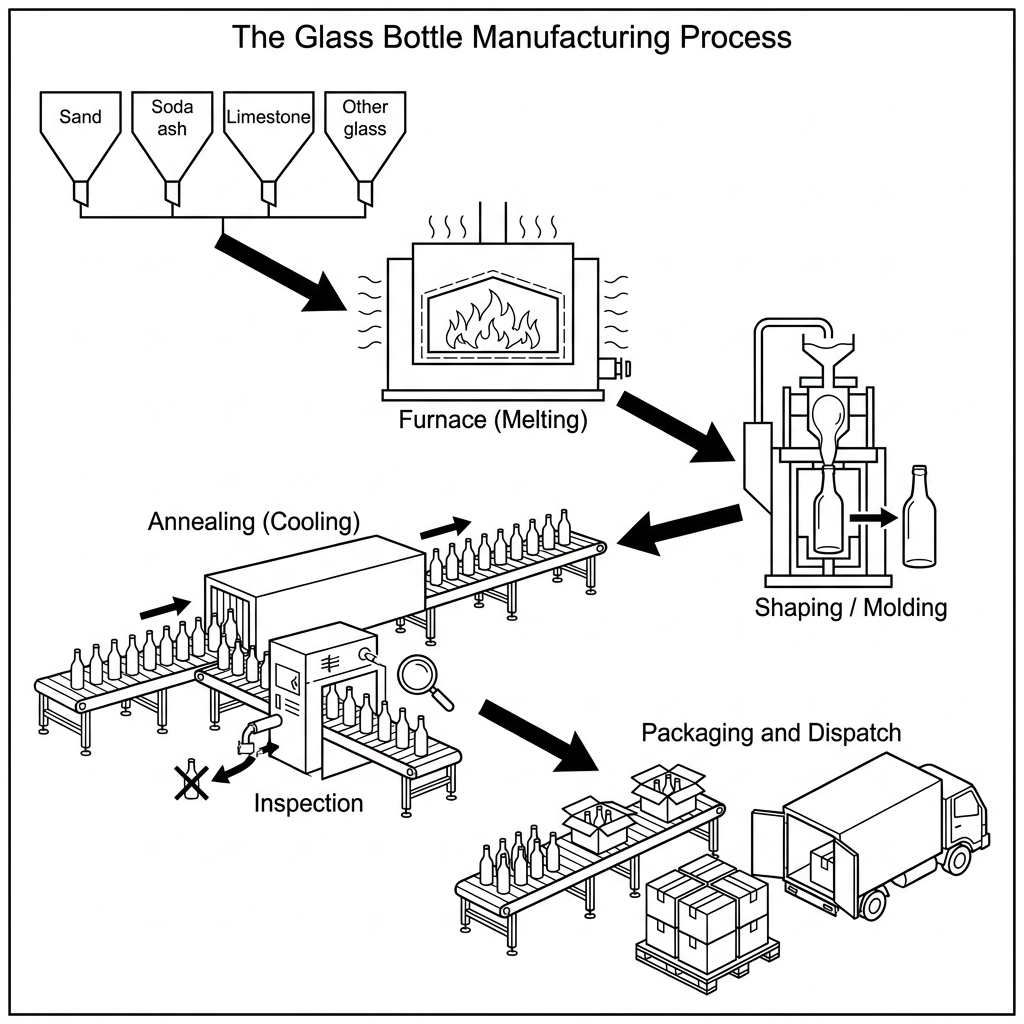
Prompt: The diagram illustrates the process used to manufacture glass bottles for commercial use.
Example Answer:
The diagram illustrates the six main stages involved in the commercial manufacture of glass bottles, from raw materials to dispatched product.
Overall, glass bottle production is a linear process that begins with the mixing of four raw materials and ends with finished bottles being packaged for delivery. Defective bottles identified during inspection are removed before the final packaging stage.
In the first stage, four raw materials, sand, soda ash, limestone, and other (recycled) glass, are fed from individual hoppers into a furnace. Inside the furnace, the mixture is melted, and the resulting molten glass is then transferred to a shaping and moulding machine, where it is formed into the shape of a bottle.
Once the bottles have been moulded, they pass along a conveyor belt into an annealing chamber, where they are gradually cooled. The cooled bottles then move through an inspection station, where any defective items are removed from the line. Finally, the approved bottles are packaged into boxes, loaded onto pallets, and transported by truck for dispatch.
Question 2
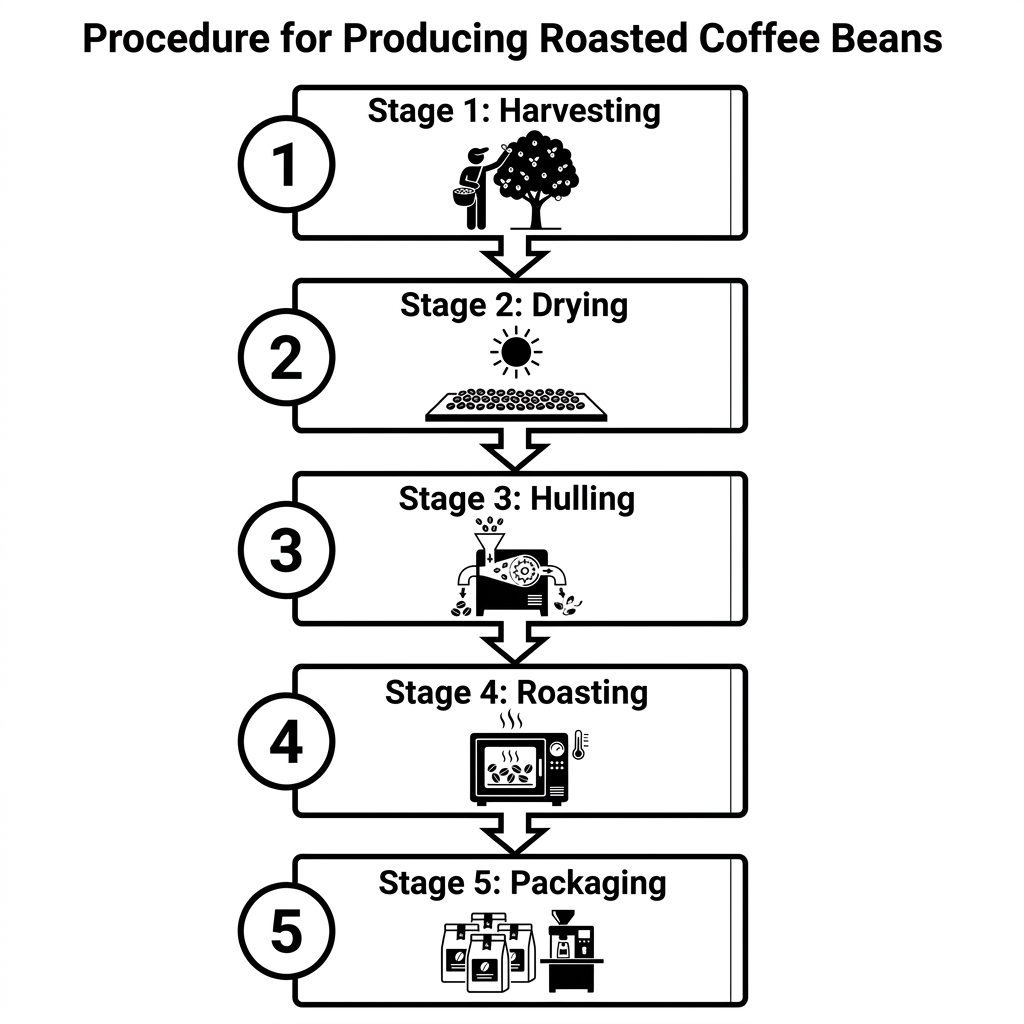
Prompt: The flowchart below shows the procedure for producing roasted coffee beans.
Example Answer:
The flowchart illustrates the five main stages involved in the production of roasted coffee beans, from the harvesting of cherries on a coffee tree through to the final packaged product.
Broadly speaking, the procedure is a straightforward linear process. It begins with manual harvesting in the field and ends with the packaging of the finished beans for sale, with three intermediate processing stages that transform the raw cherries into roasted beans.
In the first stage, ripe coffee cherries are picked by hand from coffee trees and gathered into baskets. The harvested cherries are then taken to a flat surface and laid out in the open air, where they are dried under the sun.
Once the cherries are sufficiently dried, they enter the hulling stage. A specialised machine separates the inner beans from the dried outer fruit, releasing the green coffee beans. The beans are then passed into a roasting oven, where they are heated until they reach the desired dark colour. At the final stage, the roasted beans are weighed, transferred into sealed bags, and prepared for distribution.
Question 3
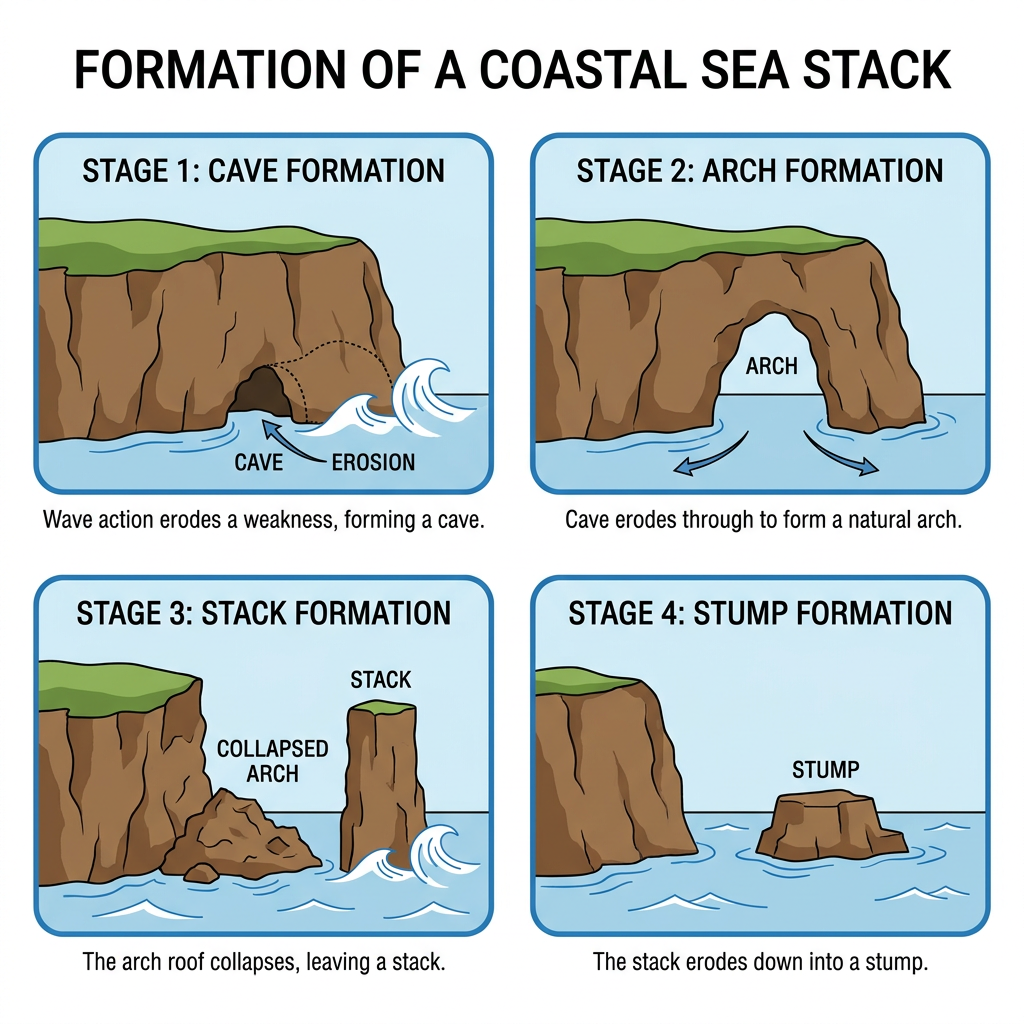
Prompt: The diagrams below show the stages in the formation of a coastal sea stack.
Example Answer:
The diagrams show the four geological stages in the formation of a coastal sea stack, from an initial cliff face through to a small residual stump on the seabed.
Overall, the formation of a sea stack is a slow erosional process driven by repeated wave action. It begins with a weakness in a cliff and ends with the gradual disappearance of the resulting rock formation into the sea.
In the first stage, wave action erodes a weakness at the base of a coastal cliff, hollowing out the rock to form a cave. In the second stage, the cave is eroded all the way through the headland, producing a natural arch with a visible passage of water beneath.
In the third stage, the arch is no longer able to support its own weight, and the roof eventually collapses into the sea. This leaves a tall, isolated column of rock standing offshore, known as a stack, with the rubble of the collapsed arch beside it. In the final stage, the stack itself is eroded further at its base until only a low stump remains above the waterline.
Question 4
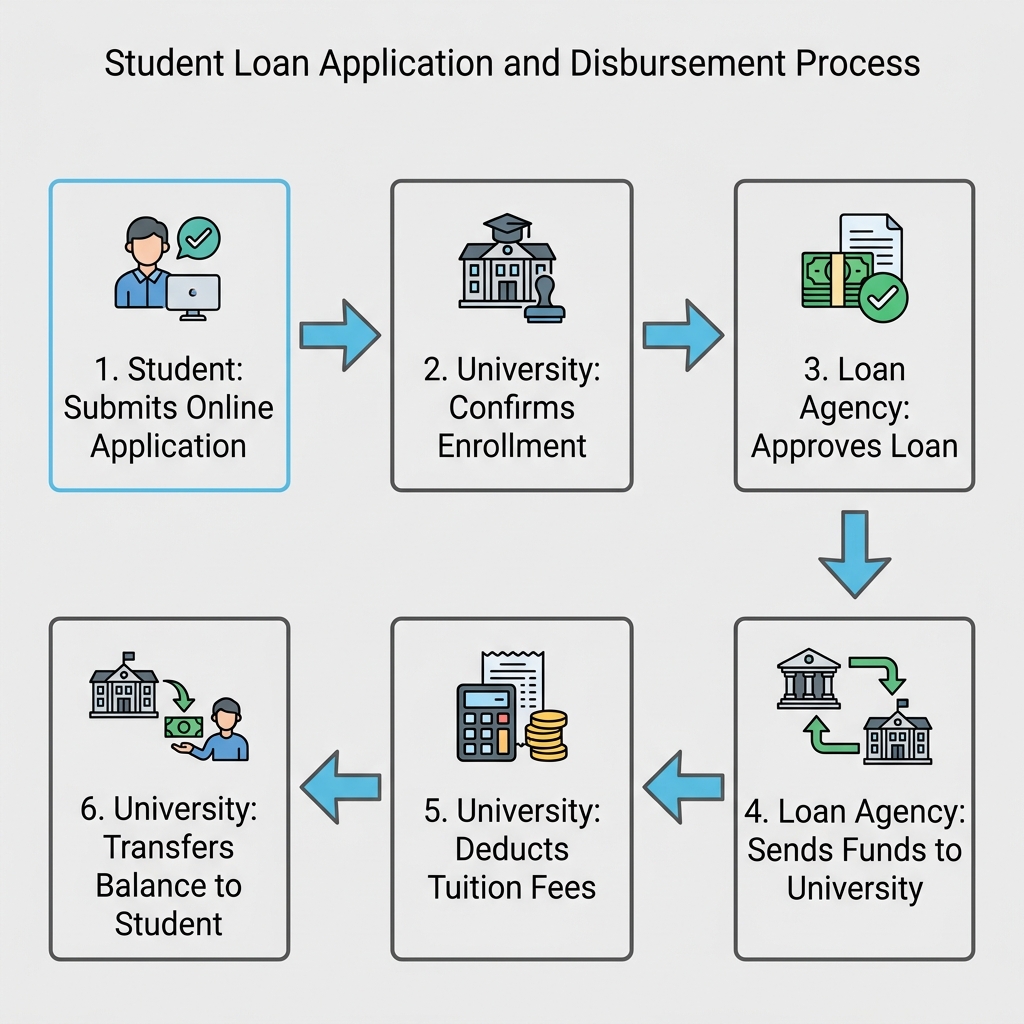
Prompt: The diagram below shows the process by which a student applies for and receives a government-funded student loan.
Example Answer:
The diagram illustrates the six steps involved when a student applies for and receives a government student loan, from the initial online application through to the payment of any remaining balance.
Looking at the process as a whole, the loan process involves three parties: the student, the university, and the loan agency. It begins with the student submitting an application and ends with the same student receiving any remaining funds after tuition has been deducted.
In the first step, the student submits an online application through the loan portal. The university then confirms the student's enrolment and forwards the application to the loan agency, which reviews the details and approves the loan in step three.
Once the loan is approved, the loan agency transfers the full amount directly to the university rather than to the student. The university then deducts the relevant tuition fees from the disbursed amount. At the final stage, any remaining balance is transferred from the university to the student, completing the process and allowing the student to use the funds for living expenses.
Question 5
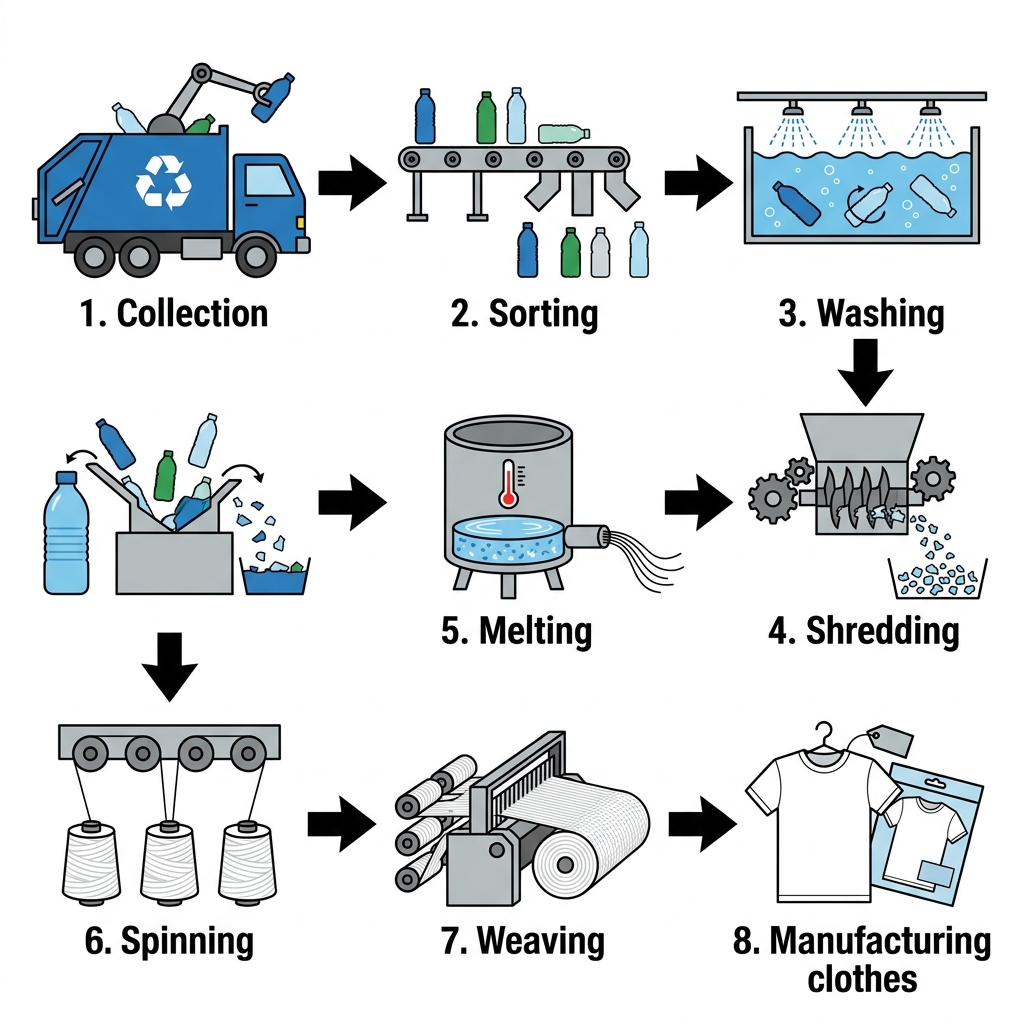
Prompt: The diagram illustrates the process by which plastic bottles are recycled and transformed into clothing.
Example Answer:
The diagram illustrates the eight stages involved in recycling plastic bottles and transforming them into new clothing, from the initial collection of used bottles through to the manufacture of finished garments.
In broad terms, the process is a linear sequence that converts discarded plastic into wearable products. It begins with the collection of bottles from a recycling truck and ends with the production of clothes ready for retail sale.
In the first three stages, used plastic bottles are collected by a recycling truck and transported to a processing plant. They are then sorted on a conveyor belt according to colour and type, after which they are washed under sprays of water to remove labels and residue.
In the next three stages, the cleaned bottles are passed through a shredder that breaks them into flakes. The flakes are then melted in a heated tank, and the resulting liquid is forced through fine nozzles to produce long fibres. The fibres are spun onto cones of yarn, woven into rolls of fabric, and finally cut and sewn into clothes such as T-shirts.
Question 6
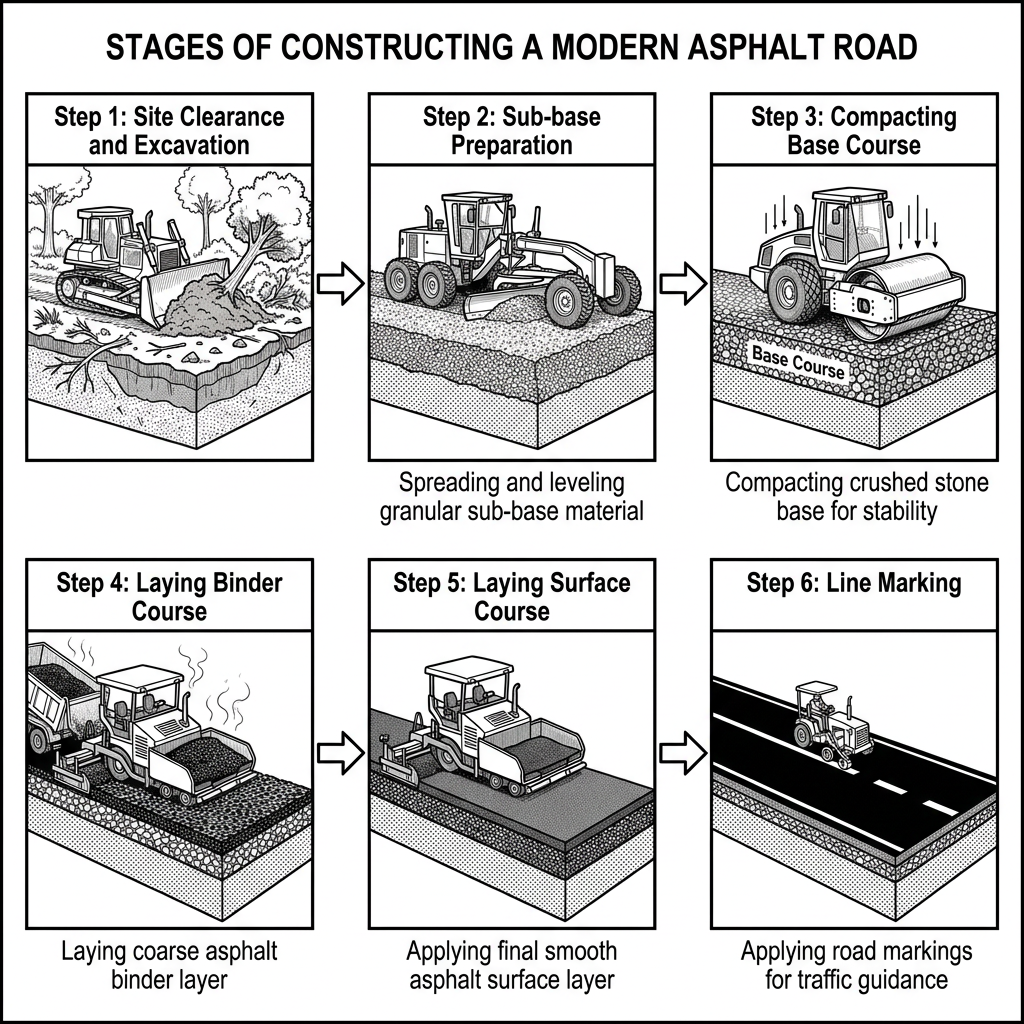
Prompt: The diagram below shows the process of constructing a modern asphalt road.
Example Answer:
The diagram illustrates the six steps involved in the construction of a modern asphalt road, from initial site clearance through to the painting of road markings on the finished surface.
Overall, the construction process is a strictly linear sequence in which successive layers are added on top of the prepared ground. It begins with site preparation and ends with the line marking that prepares the road for traffic.
In the first step, the construction site is cleared of vegetation and debris, and the ground is excavated to the required depth by heavy machinery. In the second step, a granular sub-base material is spread and levelled by a grader. In the third step, a roller compacts a layer of crushed stone on top of the sub-base, creating a stable base course.
In the next three steps, asphalt is applied to the road. A coarse asphalt binder layer is laid by a paving machine, followed by a final smooth asphalt surface course applied on top. Once the surface has cooled, a smaller line-marking vehicle paints the white road markings used to guide traffic.
Question 7
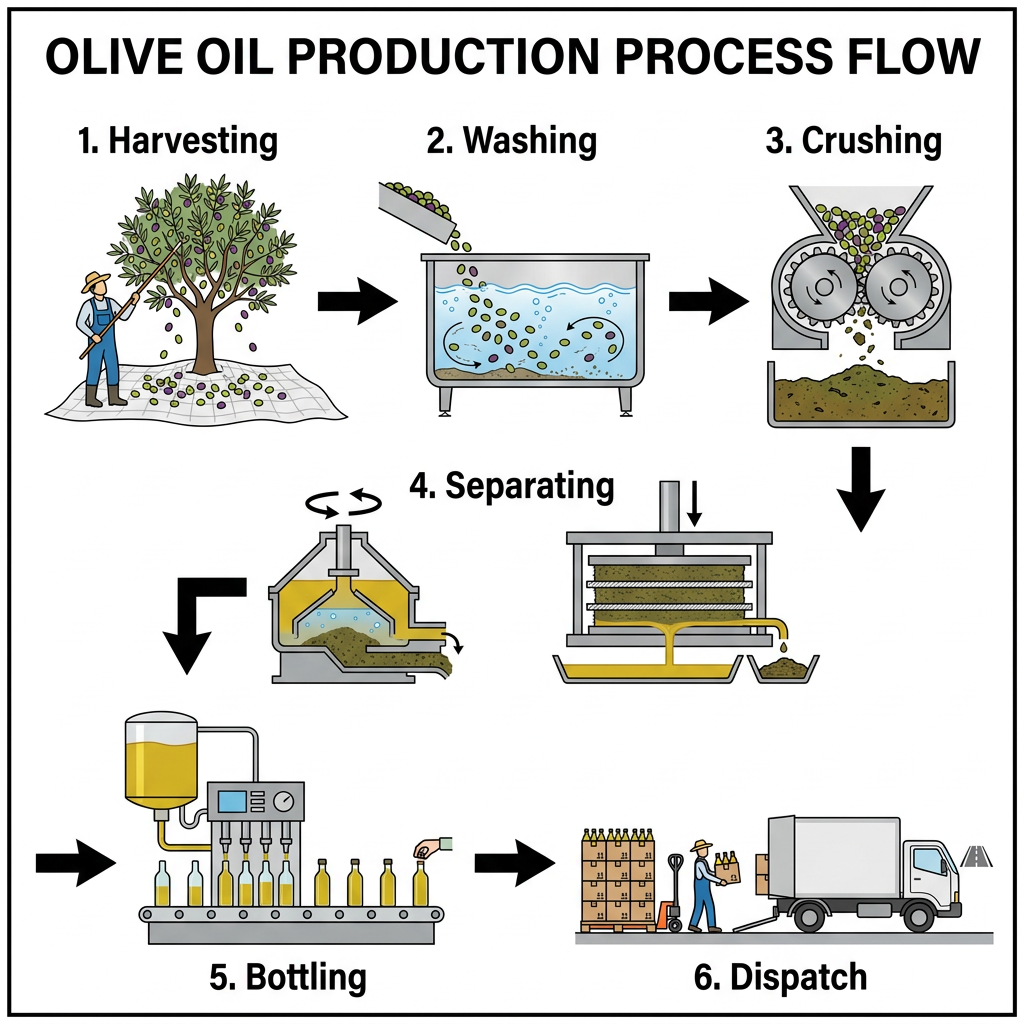
Prompt: The diagram illustrates the process by which olive oil is produced.
Example Answer:
The diagram illustrates the six main stages in the production of olive oil, from the harvesting of olives through to the dispatch of bottled oil ready for sale.
Overall, olive oil production is a linear process that converts whole olives into a bottled finished product. It begins with manual harvesting and ends with packaged bottles being loaded for distribution, with four intermediate stages that extract and refine the oil.
In the first stage, ripe olives are picked from the tree and collected in a net laid out beneath. The harvested olives are then transferred to a tank, where they are washed in water to remove dirt and leaves. The clean olives are then crushed between large mechanical rollers, producing a thick paste of pulp and oil.
In the next three stages, the paste is passed into a centrifugal separator, which divides the liquid oil from the solid residue. The oil is then transferred to a bottling line, where it is dispensed into glass bottles. At the final stage, the filled bottles are stacked onto pallets and loaded onto a delivery truck for dispatch to retailers.
Question 8
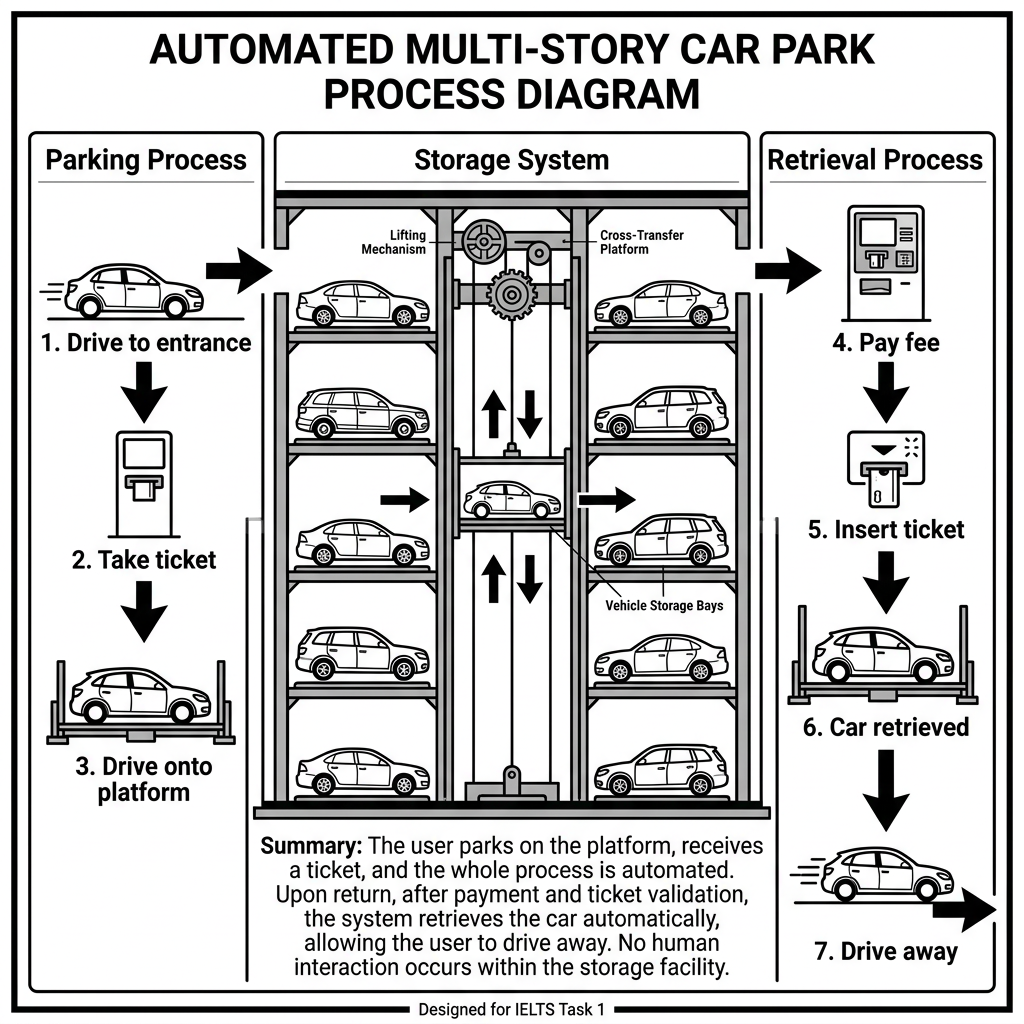
Prompt: The diagram below shows how an automated car parking facility operates.
Example Answer:
The diagram illustrates the seven steps that take place when a vehicle is parked in and retrieved from an automated multi-story car park, with the storage system operating automatically between the two interactions.
On the whole, the user only interacts with the car park at the entrance and exit. The intermediate storage is fully automated, with a lifting mechanism and cross-transfer platform moving vehicles between rows of storage bays without any human involvement.
The parking process consists of three steps. The driver drives to the entrance, takes a ticket, and then drives onto a platform that will receive the vehicle. Once the vehicle is on the platform, the automated system lifts it inside the building, where a lifting mechanism and cross-transfer platform move it to an available space within the rows of vehicle storage bays.
When the driver returns to retrieve the vehicle, the retrieval process begins. The user pays the fee at a machine and inserts the ticket. The system then automatically locates the vehicle and brings it back down to the exit platform. Finally, the driver collects the car and drives away.
Question 9
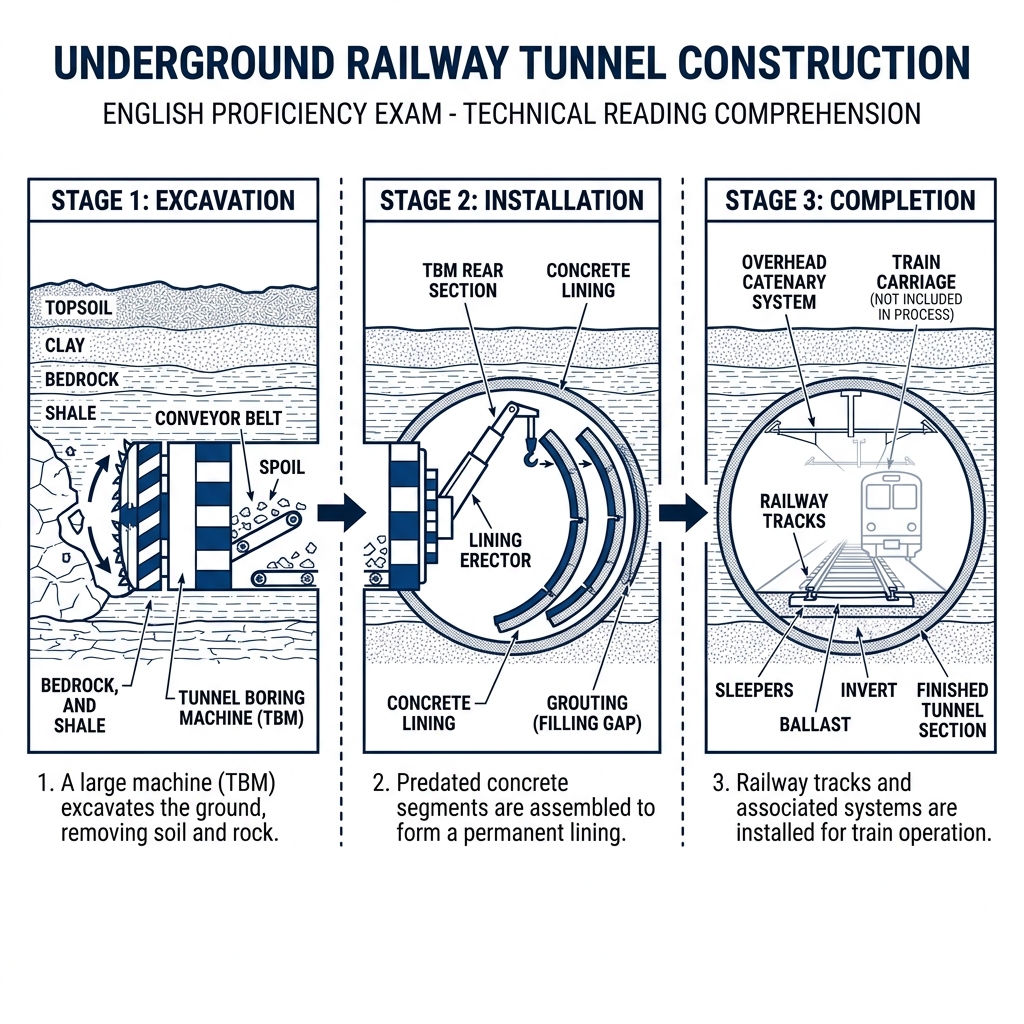
Prompt: The diagram below shows the process of constructing an underground railway tunnel.
Example Answer:
The diagram illustrates the three main stages involved in constructing an underground railway tunnel, from the initial excavation of the surrounding ground through to the installation of train tracks at completion.
Overall, tunnel construction is a linear three-stage process. It begins with the mechanical excavation of the ground using a tunnel boring machine and ends with a complete, lined tunnel containing the tracks needed for trains to run.
In the first stage, excavation, a large tunnel boring machine cuts through the layers of topsoil, clay, bedrock, and shale. The excavated material, known as spoil, is removed by a conveyor belt running through the centre of the machine and carried back to the surface.
In the second stage, installation, precast concrete segments are assembled by a lining erector immediately behind the machine to form a permanent circular tunnel lining. Any gaps between the segments and the surrounding ground are filled by grouting. In the final stage, railway tracks are laid along the floor of the tunnel on sleepers and ballast, and an overhead catenary system is installed along the roof to supply electricity.
Question 10
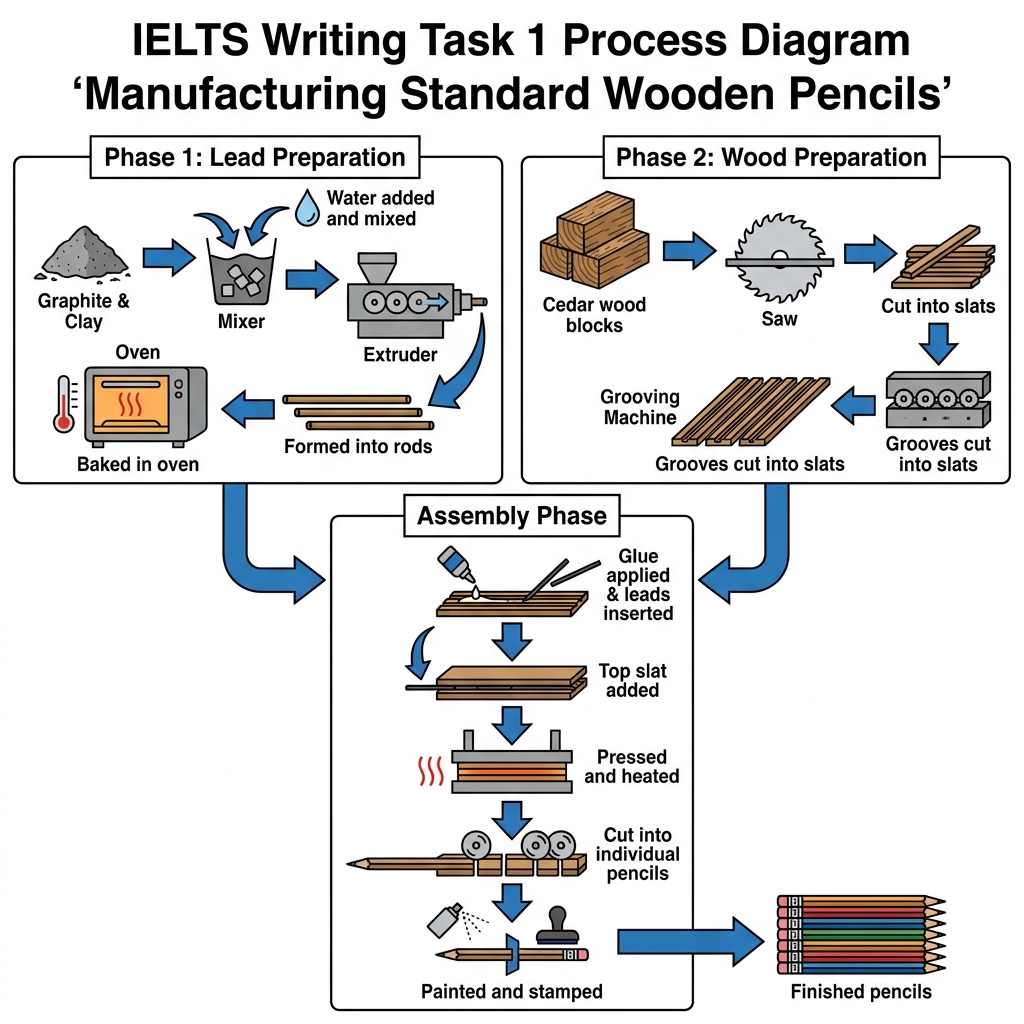
Prompt: The diagram below illustrates the process used to manufacture standard wooden pencils.
Example Answer:
The diagram illustrates the process used to manufacture standard wooden pencils, which is divided into three phases: lead preparation, wood preparation, and assembly.
Overall, the lead and wooden components are produced in parallel in the first two phases, and then brought together in the third phase, where they are combined, finished, and packaged. The output is a row of decorated pencils ready for sale.
In the lead phase, graphite and clay are combined in a mixer with added water. The mixture is then passed through an extruder, which forms it into thin cylindrical rods. The rods are baked in an oven to harden them. Meanwhile, cedar wood blocks are cut by a saw into slats, and a grooving machine cuts narrow channels along each slat.
In the assembly phase, the two streams come together. Glue is applied to a slat, and the baked leads are inserted into the channels. A second slat is added on top, after which the assembly is pressed and heated to bond the wood. The bonded blocks are cut into individual pencils, which are then painted and stamped as finished pencils.
Question 11
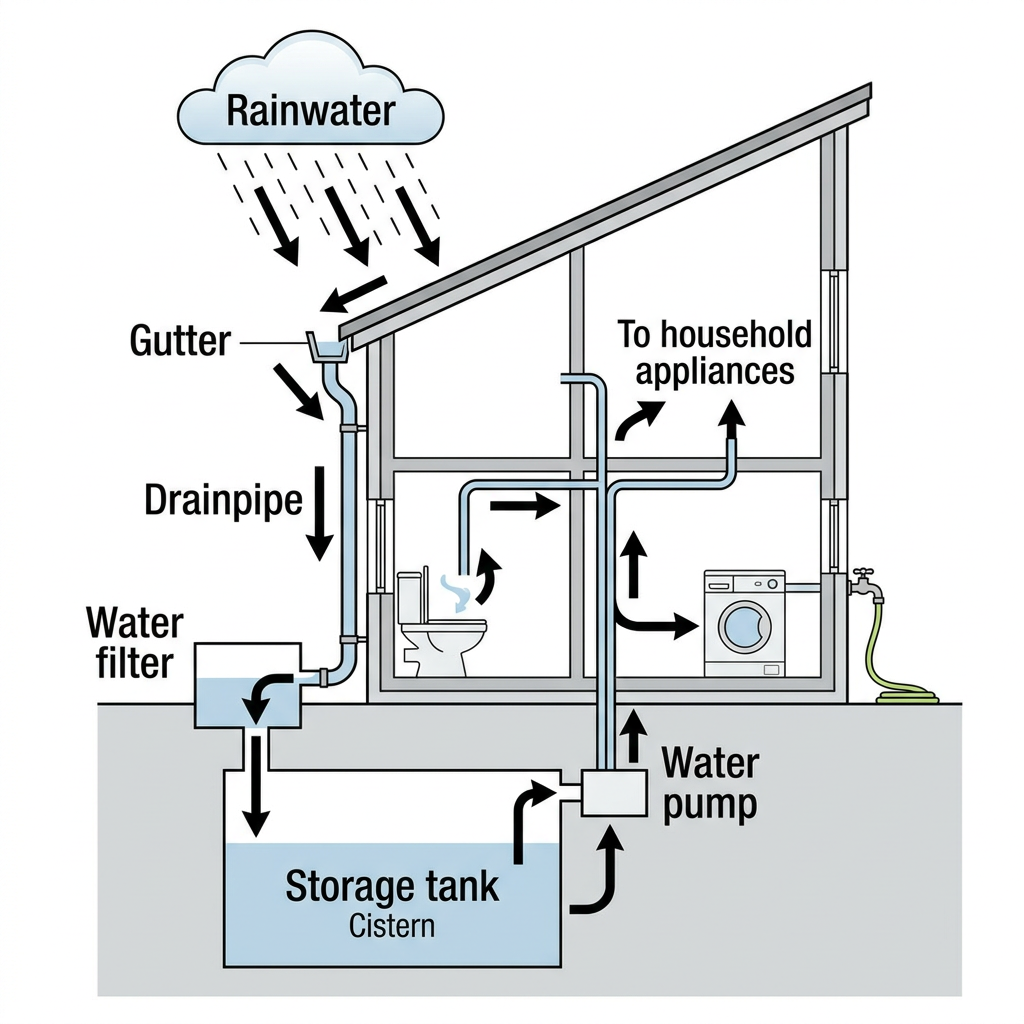
Prompt: The diagram below shows how a home rainwater harvesting and purification system works.
Example Answer:
The diagram illustrates how a home rainwater harvesting and purification system collects rainwater from the roof of a house, stores it underground, and delivers it to household appliances.
Overall, the system is a linear flow from roof to appliance, with one key processing point (the water filter) along the way. A cistern beneath the house provides a buffer, and a water pump moves water back into the house for use by toilets and washing machines.
Rainwater falls onto the sloping roof and runs into a gutter along its edge. The gutter feeds the water down a vertical drainpipe attached to the side of the house. At the bottom of the drainpipe, the water passes through a water filter that removes leaves and debris before it enters the system below.
The filtered water then flows into a large underground storage tank, or cistern, where it is held until needed. When water is required inside the house, a water pump draws it out and sends it upwards through pipes. The water is then distributed to household appliances, such as a toilet and a washing machine.
Question 12
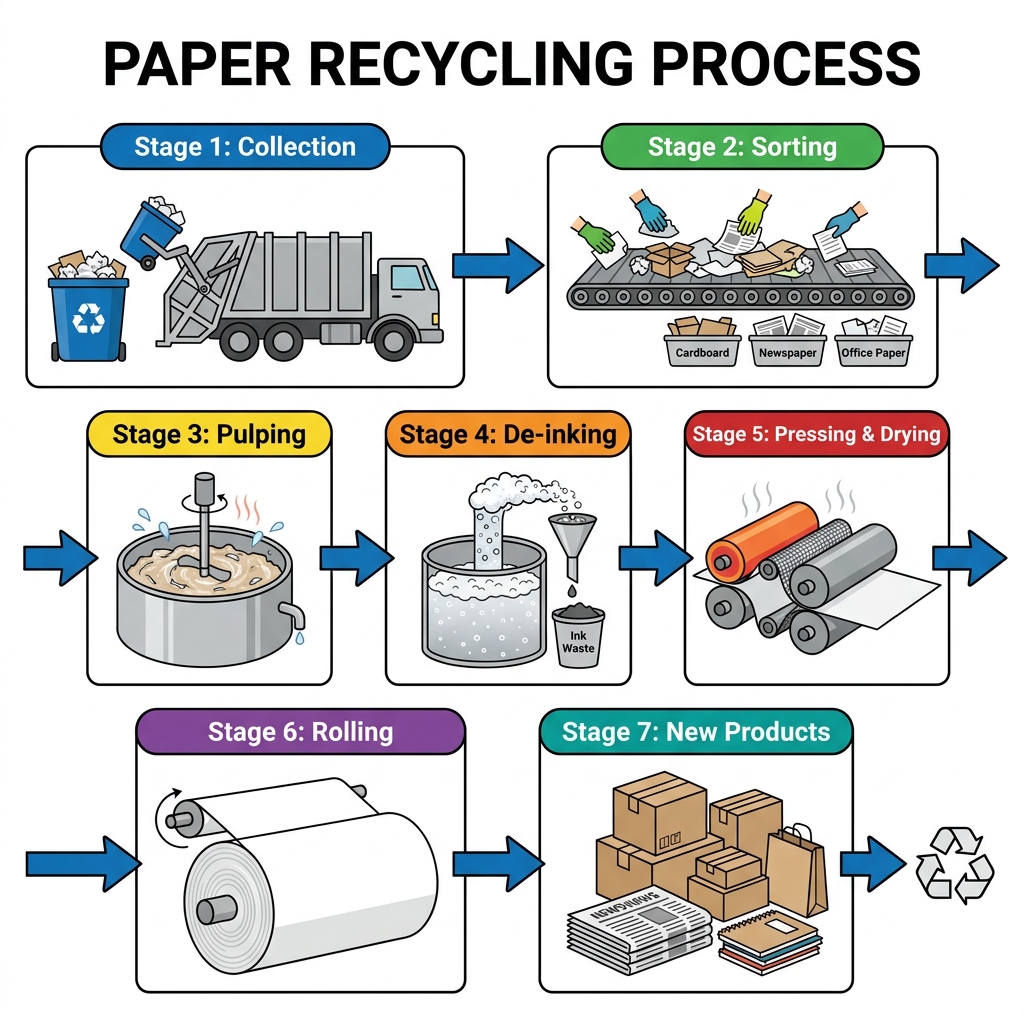
Prompt: The diagram below illustrates the process of recycling paper into new paper products.
Example Answer:
The diagram illustrates the seven stages involved in recycling used paper, from the initial collection of waste paper through to the manufacture of items such as boxes and bags.
Broadly speaking, paper recycling is a linear process that converts discarded paper into a usable raw material and then into finished products. It begins with the collection of waste paper and ends with the production of new paper goods.
In the first two stages, paper is collected from recycling bins by a truck and taken to a sorting facility, where it is separated into cardboard, newspaper, and office paper. The sorted paper is then transferred into a large vat of water in stage three, where it is broken down into a watery pulp.
In stage four, the pulp is treated to remove ink, which is collected as waste. The cleaned pulp is then passed between heated rollers in stage five to dry the sheet. In stage six, the dried sheet is wound onto a large roll. Finally, in stage seven, the rolled paper is converted into new products such as boxes, newspapers, and shopping bags.
Question 13
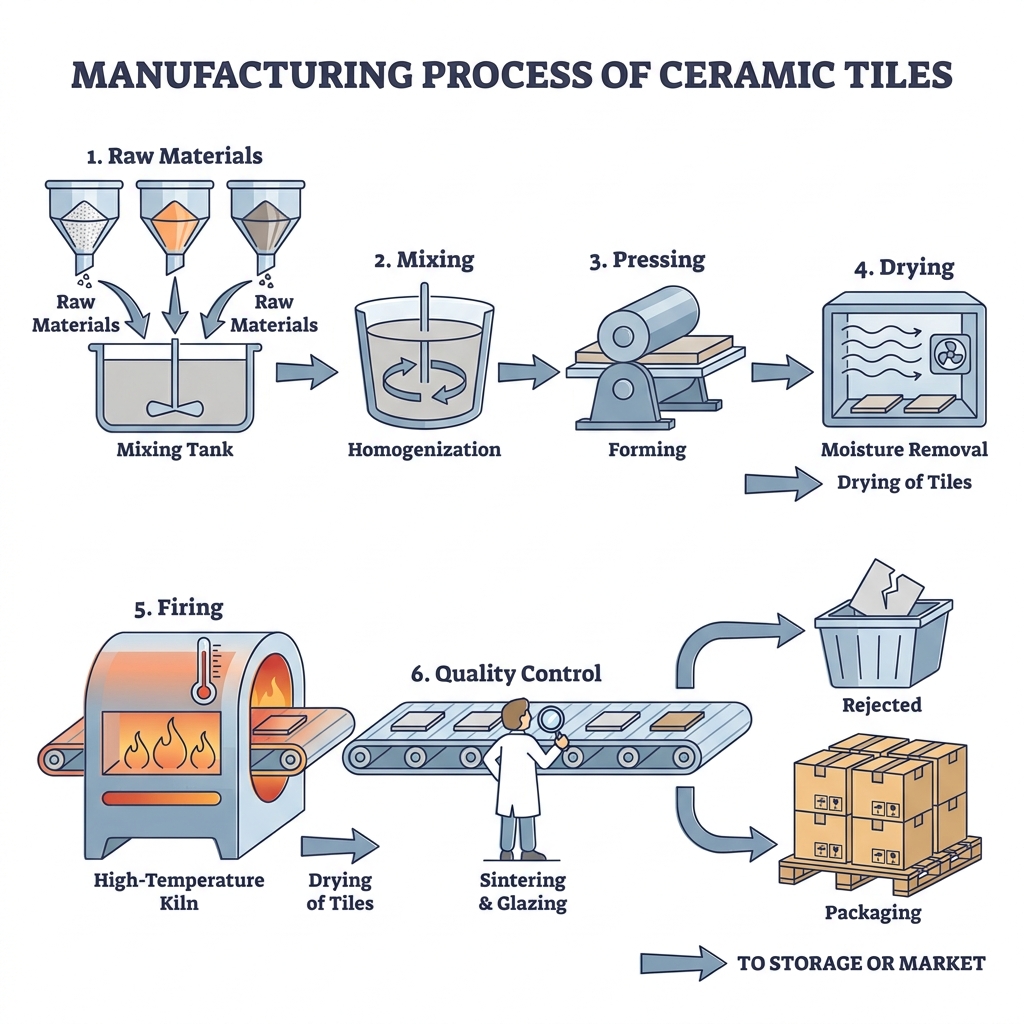
Prompt: The diagram below shows the manufacturing process of ceramic tiles.
Example Answer:
The diagram illustrates the six main stages involved in the industrial manufacture of ceramic tiles, from the initial raw materials through to the finished packaged product ready for storage or market.
On the whole, tile production is a largely linear process. It begins with the preparation of a raw mixture and ends with the packaging of approved tiles, although a small quality control loop diverts defective tiles away from packaging.
In the first stage, three raw materials are fed from separate hoppers into a mixing tank, where they are combined with water and homogenised into a uniform slurry. The mixture is then transferred to a mixing vessel in stage two, before being passed in stage three to a press that forms it into flat tiles.
In stage four, the formed tiles enter a drying chamber to remove moisture. In stage five, the dried tiles pass through a high-temperature kiln, where they are fired, sintered, and glazed. In the final stage, an inspector checks each tile: rejected items are removed, while approved tiles are packaged into boxes ready for market.
Question 14
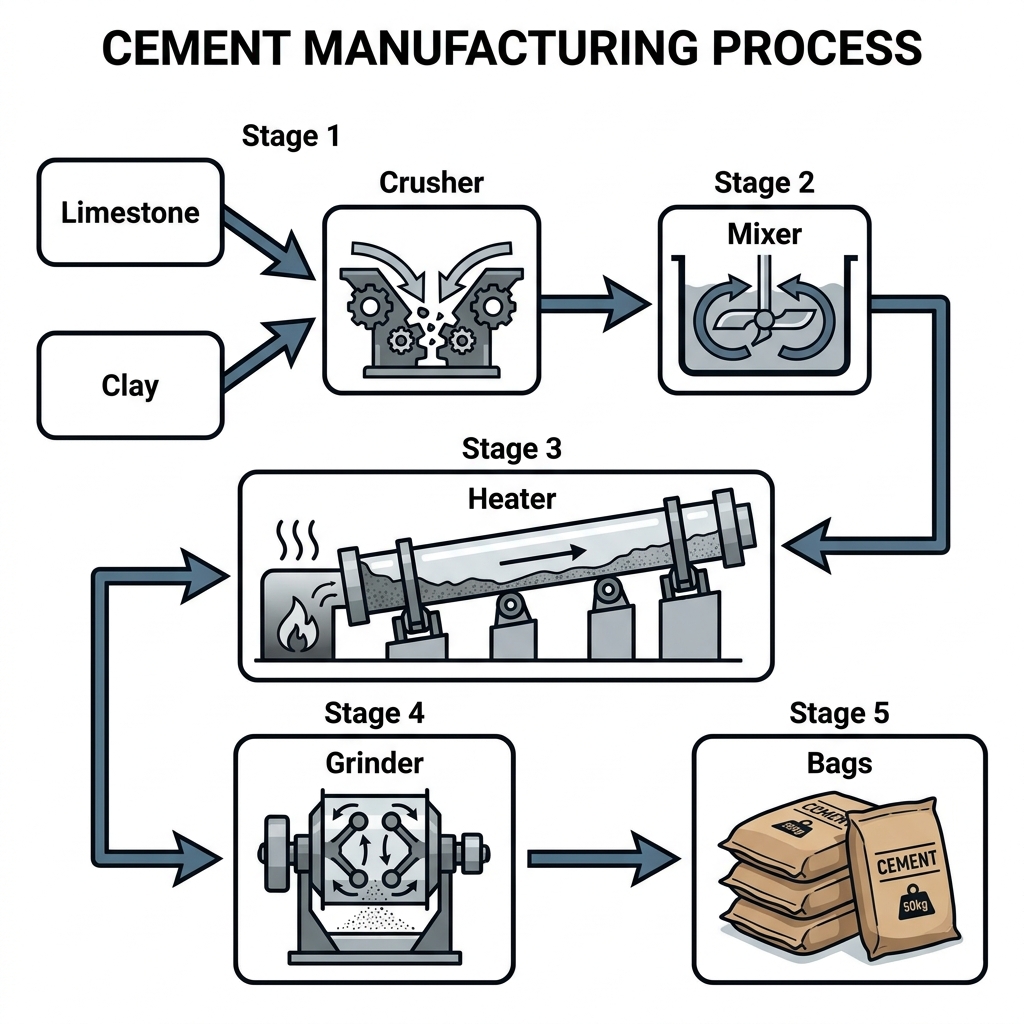
Prompt: The diagram illustrates the stages involved in the production of cement.
Example Answer:
The diagram illustrates the five main stages involved in the production of cement, from the two principal raw materials, limestone and clay, through to the finished bagged product.
Overall, cement manufacture is a strictly linear process. The two raw materials are combined into a powder, heated, ground, and finally packaged for sale. There is no recycling loop or branch in the production line.
In stage one, limestone and clay are fed into a crusher, which breaks them down into a fine powder. In stage two, the powder is transferred into a mixer, where it is blended into a homogeneous mixture. The mixed material is then transferred onwards into the heating stage.
In stage three, the mixture is fed into a large rotating heater, which is fired from below to maintain a high temperature inside. The mixture passes slowly through the heater and undergoes a chemical change that produces clinker. In stage four, the clinker is fed into a grinder, where it is reduced once more into a fine powder. At the final stage, the finished cement is filled into 50kg bags, ready for sale.
Question 15
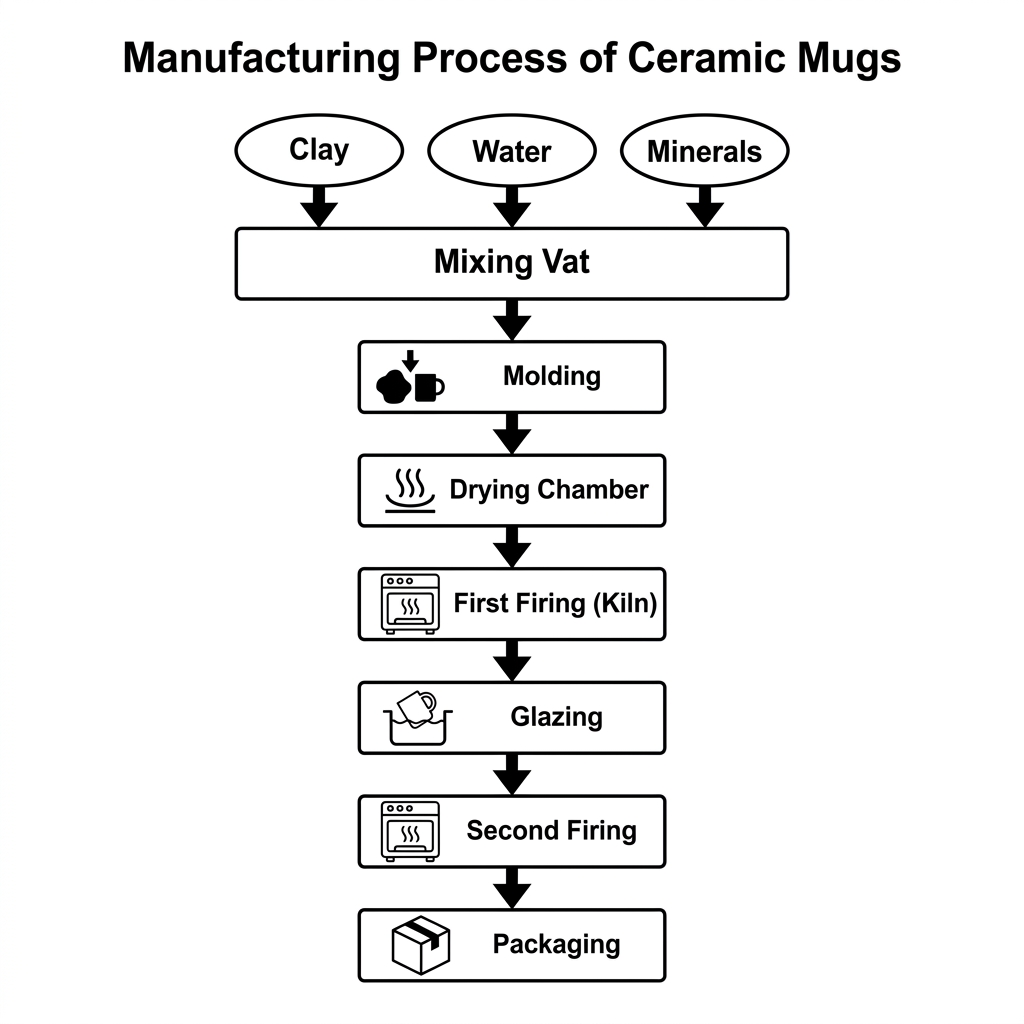
Prompt: The flowchart below illustrates the manufacturing process of ceramic mugs in a factory.
Example Answer:
The flowchart illustrates the seven main stages involved in the factory manufacture of ceramic mugs, from the three raw materials at the top through to the packaged finished product at the bottom.
Overall, mug production is a strictly linear process. It begins with the combination of clay, water, and minerals and ends with packaged mugs ready for distribution, passing through two separate firing stages along the way.
In the first stage, three raw materials, clay, water, and minerals, are fed into a mixing vat and combined into a uniform paste. The paste is then transferred to a moulding station in stage two, where it is shaped into a mug. In stage three, the moulded mugs are moved to a drying chamber to remove moisture.
In stage four, the dried mugs are placed in a kiln for a first firing, which hardens the ceramic. In stage five, they are glazed by dipping or spraying. In stage six, the mugs are returned to the kiln for a second firing, which seals the glaze. At the final stage, the finished mugs are packaged into boxes ready for delivery.
Question 16
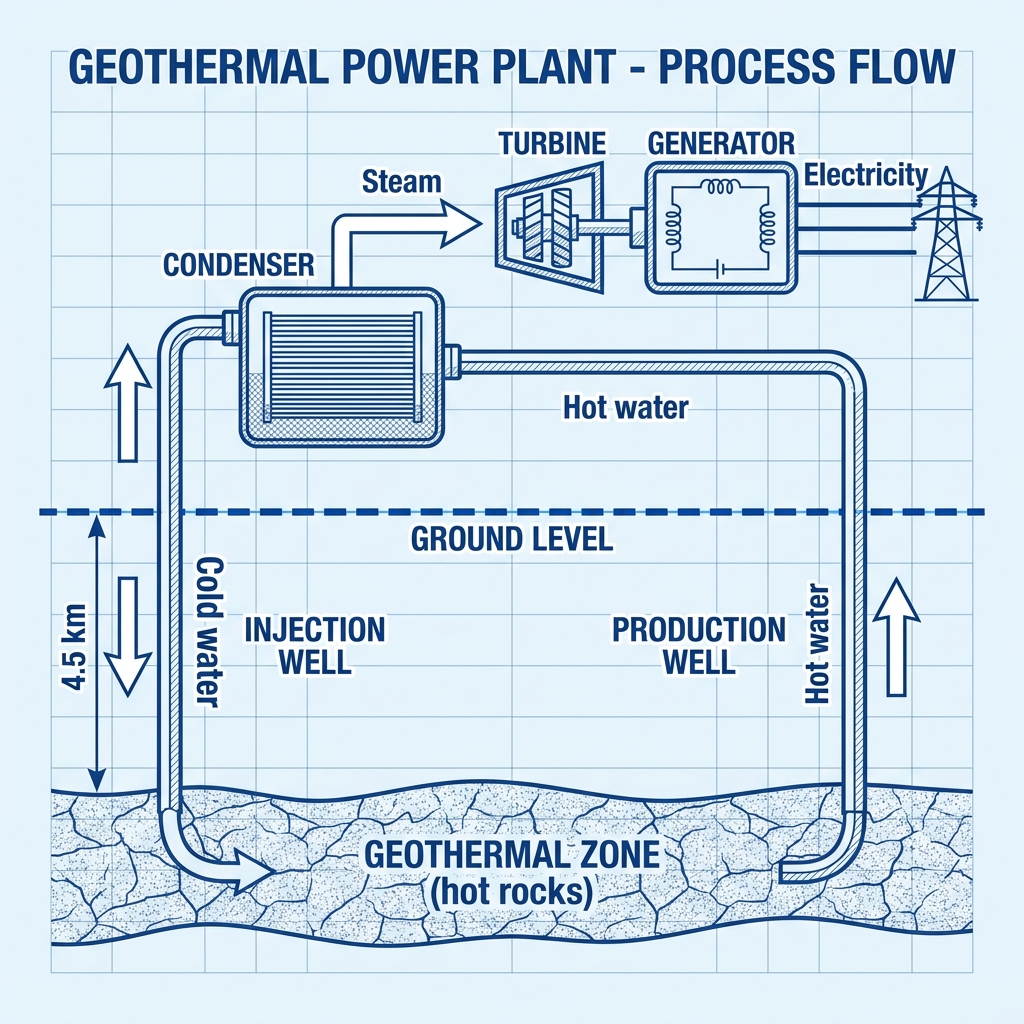
Prompt: The diagram below shows how a geothermal power plant generates electricity.
Example Answer:
The diagram illustrates the process by which a geothermal power plant uses hot rocks deep underground to generate electricity, with components shown both above and below ground level.
Overall, the process is a continuous closed loop. Cold water is pumped down to a hot geothermal zone, returned to the surface as hot water, and then used to produce steam, which drives a turbine and generator to produce electricity.
Below ground level, cold water is sent down an injection well to the geothermal zone, a layer of hot rocks approximately 4.5 km below the surface. As the water passes through the hot rocks, it is heated, and then rises back up through a parallel production well as hot water. The two wells form a continuous circuit.
Above ground, the hot water flows into a condenser, where it gives off steam. The steam is directed at a turbine, which is rotated by the high-pressure flow. The turbine drives a generator, which converts the mechanical energy into electricity. The electricity is then sent along power lines to a pylon for distribution to the wider grid.
Question 17
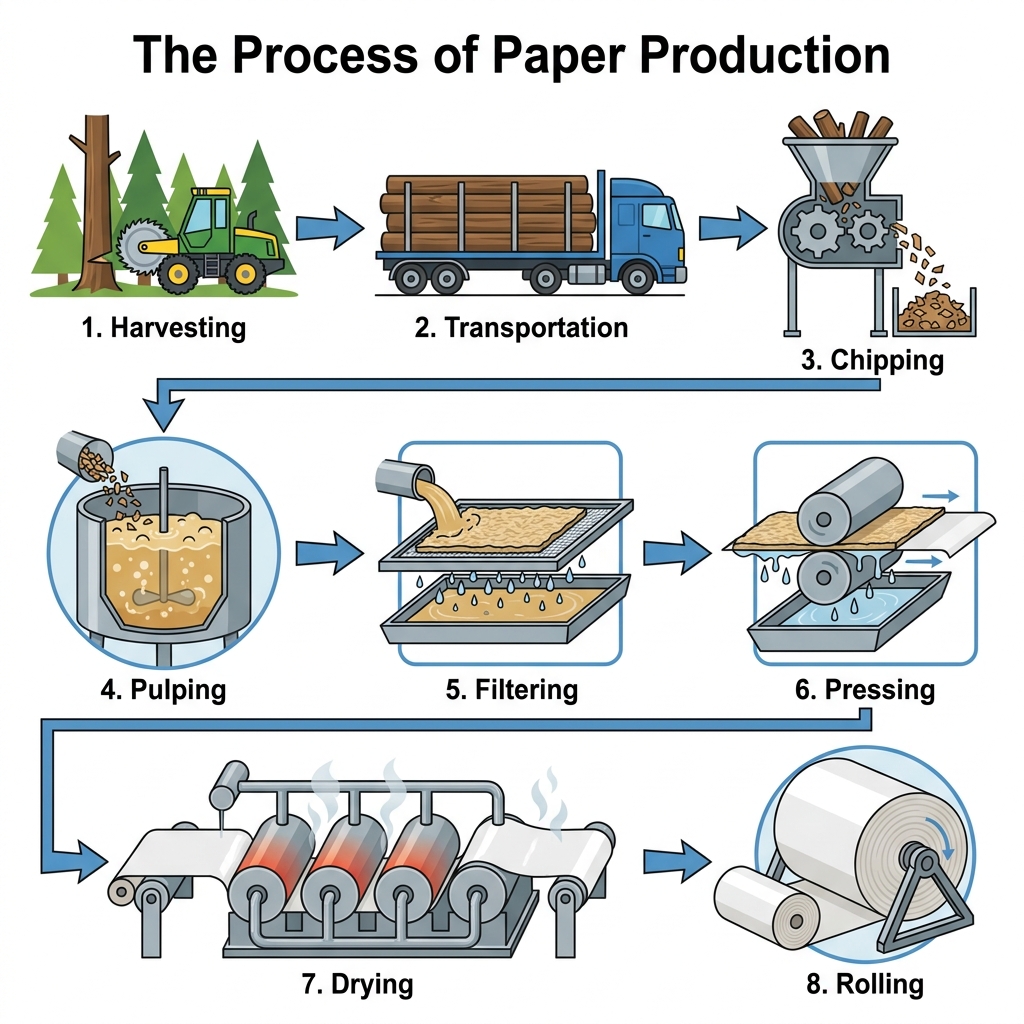
Prompt: The diagram illustrates the process by which paper is manufactured from wood.
Example Answer:
The diagram illustrates the eight stages involved in producing paper from raw wood, from the initial felling of trees in a forest through to the rolling of finished paper at the end of the line.
Broadly speaking, paper production is a linear process. It begins with logging in a forest and ends with a large roll of finished paper. The intermediate stages progressively reduce solid wood into a wet pulp and then dry that pulp back into a continuous sheet.
In stages one and two, trees are felled and transported by truck to a paper mill. In stage three, the logs are fed into a chipping machine and reduced to wood chips. The chips are then transferred to a pulping vat in stage four, where they are mixed with water and broken down into a thick slurry.
In stages five through seven, the slurry is filtered to drain off excess water, pressed between rollers to remove more moisture, and dried with heated rollers. In the final stage, the dry sheet of paper is wound onto a large roll, ready for cutting into smaller products.
Question 18
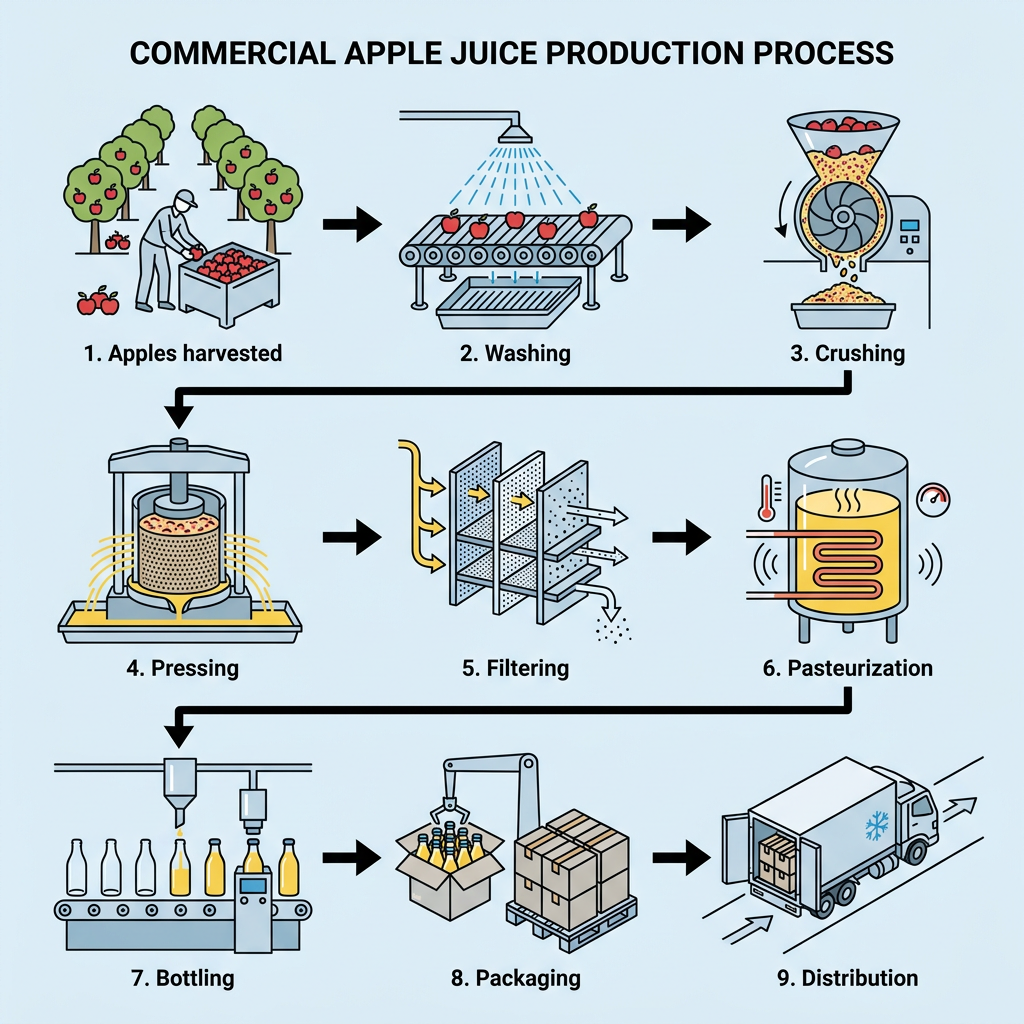
Prompt: The diagram below shows the process of producing commercial apple juice.
Example Answer:
The diagram illustrates the nine stages involved in the commercial production of apple juice, from the initial harvesting of apples in an orchard through to the final distribution of the packaged product.
On the whole, the process is a strictly linear sequence. It begins with manual harvesting and ends with refrigerated lorry distribution. The intermediate stages progressively transform whole apples into a stable bottled juice ready for retail sale.
In stages one and two, apples are harvested in an orchard and transferred to a washing line, where they are sprayed with water. In stage three, the apples are crushed into pulp by a rotating mill. The pulp is then transferred to a pressing machine in stage four, which extracts the raw juice from the solid material.
In stages five and six, the raw juice is passed through a filter to remove particles, and then heated in a pasteurising tank to kill bacteria. In stages seven and eight, the juice is bottled and packed into boxes that are stacked onto pallets. At the final stage, the pallets are loaded onto a refrigerated lorry for distribution.
Question 19
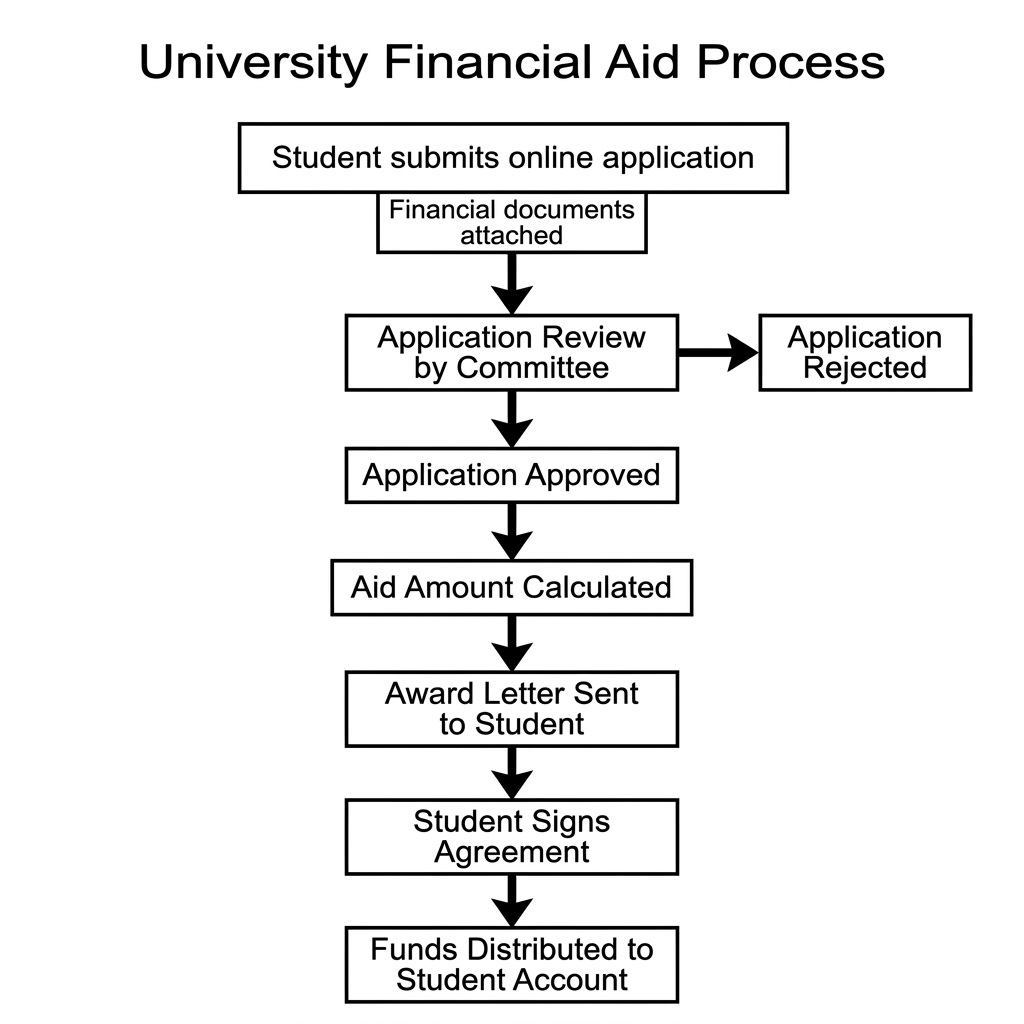
Prompt: The flowchart below shows the process by which a university assesses and distributes student financial aid.
Example Answer:
The flowchart illustrates the seven main steps in the process by which a university assesses applications and distributes financial aid to its students.
Looking at the process as a whole, the process is a linear administrative procedure with a single decision point. It begins with the student submitting an application and ends with the disbursement of funds, although applications that fail the committee's review are rejected at the second step.
In the first step, the student submits an online application accompanied by supporting financial documents. The application is then reviewed by an aid committee, which makes a single binary decision. Applications that do not meet the requirements are rejected at this stage and exit the process. Applications that do meet the requirements move forward as approved.
Once an application has been approved, the university calculates the amount of aid the student is entitled to receive. An award letter is then issued to the student, summarising the offer. The student reviews the letter and signs an agreement accepting the terms. At the final step, the awarded funds are released and distributed directly to the student's account.
Question 20
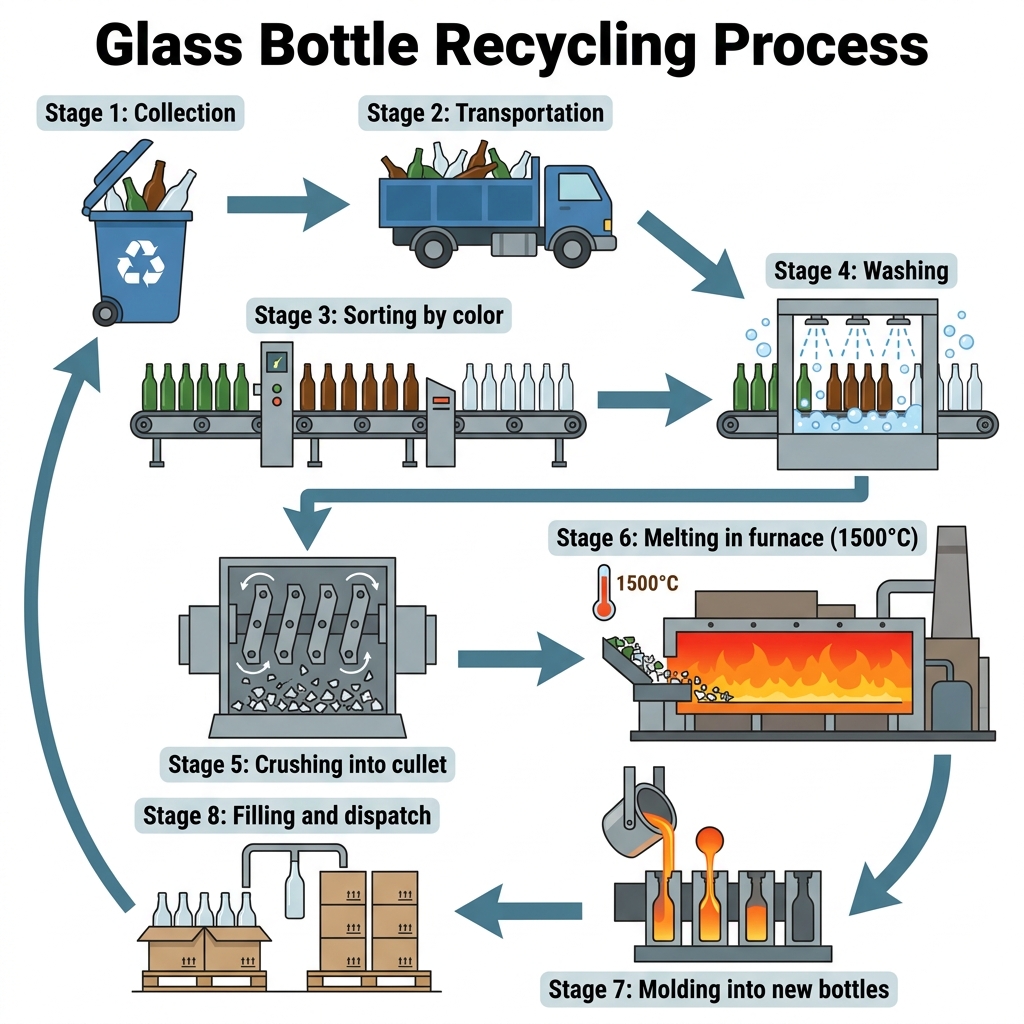
Prompt: The diagram below shows the process for recycling glass bottles.
Example Answer:
The diagram illustrates the eight stages involved in recycling glass bottles, from the initial collection of used bottles through to the dispatch of new ones, with the cycle eventually repeating.
Overall, glass bottle recycling is a circular process that returns the material to the start of the cycle. It begins with the collection of empty bottles and ends with new bottles being dispatched, which will eventually re-enter the cycle once used.
In stages one and two, used bottles are placed in recycling bins and then collected by a truck that transports them to a processing plant. In stage three, the bottles are sorted by colour into green, brown, and clear streams. The sorted bottles are then washed under sprays of water in stage four to remove labels and residue.
In stages five and six, the bottles are crushed into fragments called cullet, and then melted in a furnace at around 1500°C. The molten glass is moulded into new bottles in stage seven. At the final stage, the new bottles are filled, packed, and dispatched, eventually returning to the start of the cycle for collection.
Question 21
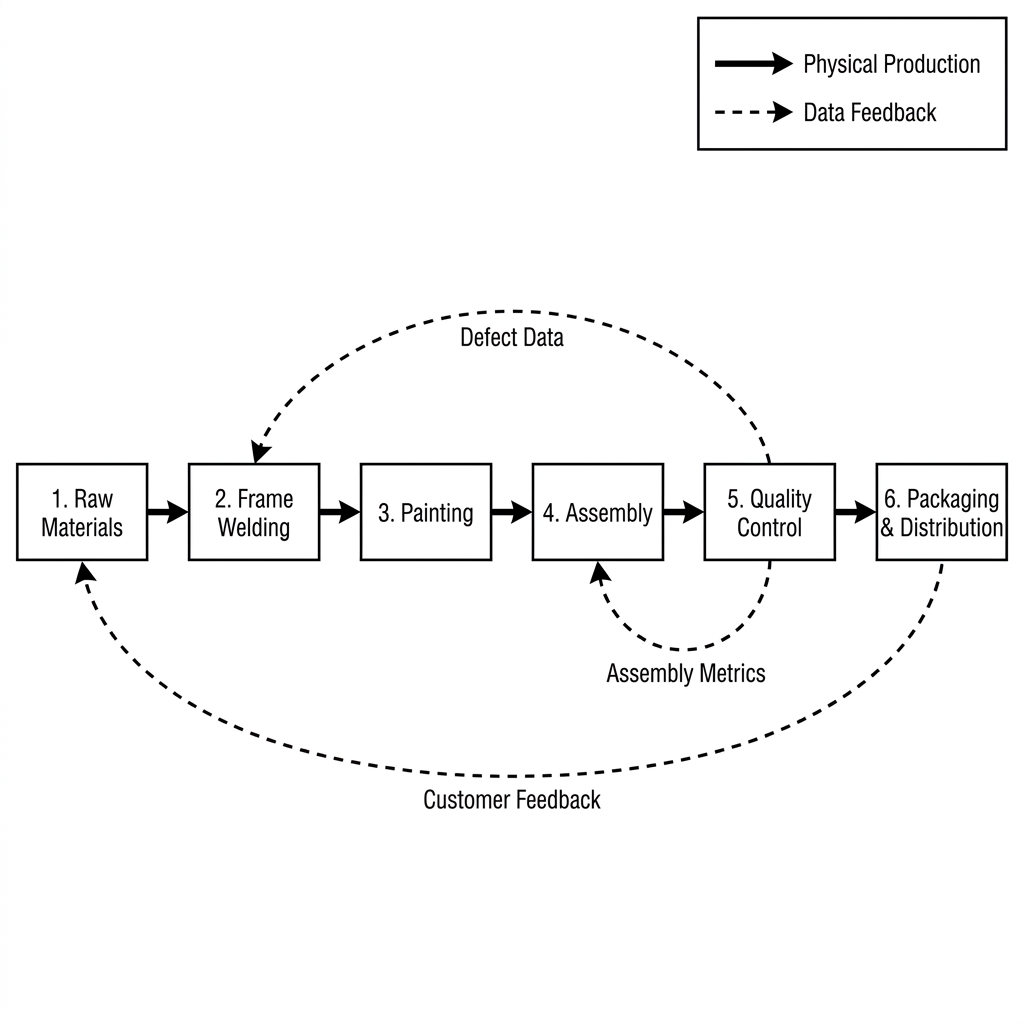
Prompt: The diagram below shows the process of manufacturing commercial bicycles, including how quality control data is fed back to earlier stages to improve production.
Example Answer:
The diagram illustrates the six physical production stages involved in commercial bicycle manufacturing, together with three data feedback loops that send information from later stages back to earlier ones.
Overall, the physical process is a linear sequence from raw materials through to packaging and distribution, while the feedback loops form a parallel quality control system that drives continuous improvement across the line.
In the physical sequence, raw materials are first delivered to the factory and then transferred to a frame welding station, where the bicycle frame is constructed. The welded frames are then painted, after which the remaining components are added at the assembly station. The completed bicycles pass through a quality control checkpoint and are finally packaged for distribution.
Three feedback loops run in the opposite direction. Defect data identified at quality control is sent back to frame welding, allowing faults to be corrected at source. Assembly metrics are returned to assembly, helping to refine the process. Customer feedback gathered after distribution is sent all the way back to the raw materials stage, informing decisions about component sourcing for future production runs.
Question 22
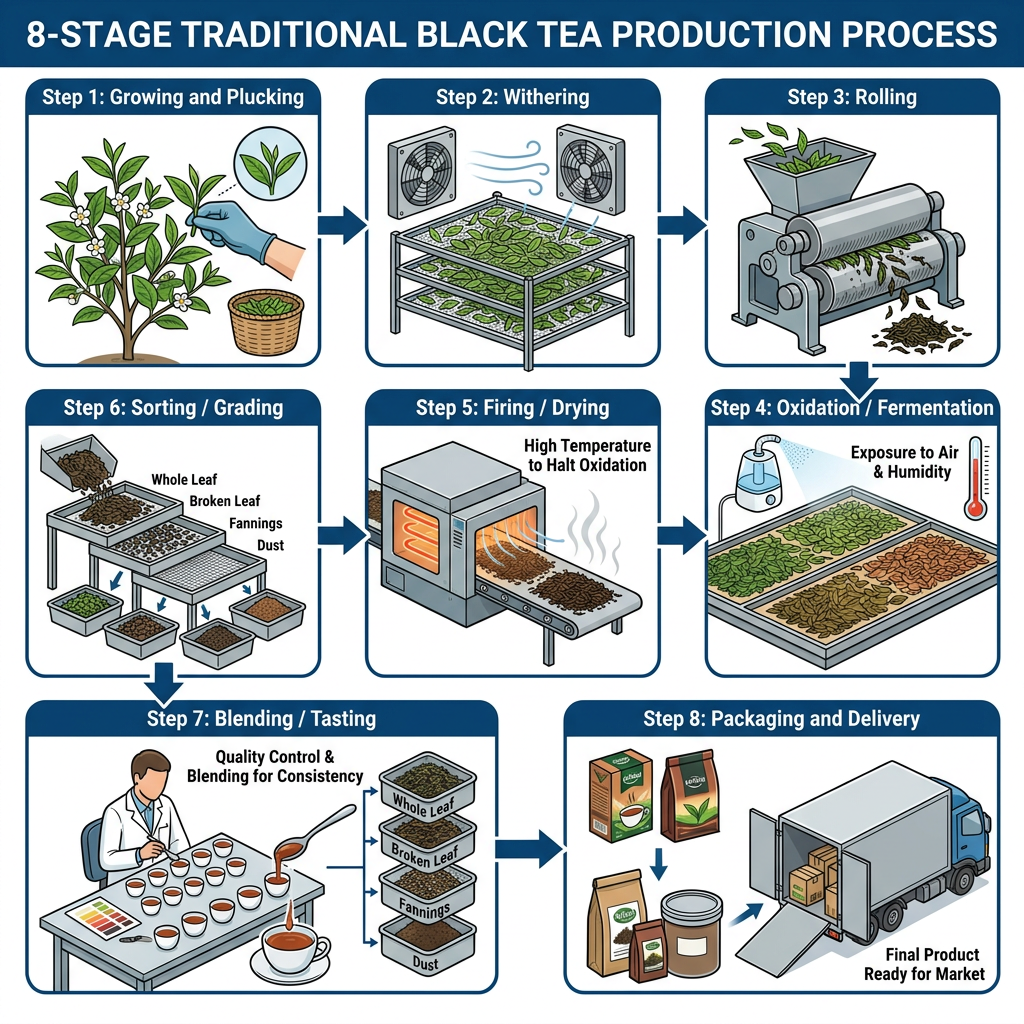
Prompt: The diagram below shows the process of producing traditional black tea for the commercial market.
Example Answer:
The diagram illustrates the eight stages involved in the production of traditional black tea, from the growing of tea plants on a farm through to the dispatch of the packaged product to market.
Broadly speaking, the process is a linear sequence. It begins with the cultivation and harvesting of fresh tea leaves and ends with packaged tea being prepared for sale, with six intermediate stages that transform the raw leaves into a graded, blended product.
In the first three stages, fresh tea leaves are grown and plucked, transferred to racks for withering, and then passed through a rolling machine. In stage four, the rolled leaves are spread on trays and exposed to air and humidity for oxidation. In stage five, the leaves are fired in an oven at a high temperature.
In the final three stages, the processed leaves are sorted and graded into whole leaf, broken leaf, fannings, and dust. A quality control specialist blends the graded leaves for consistency and tastes the result. Finally, the blended tea is packaged and loaded onto a delivery truck ready for market.
Question 23
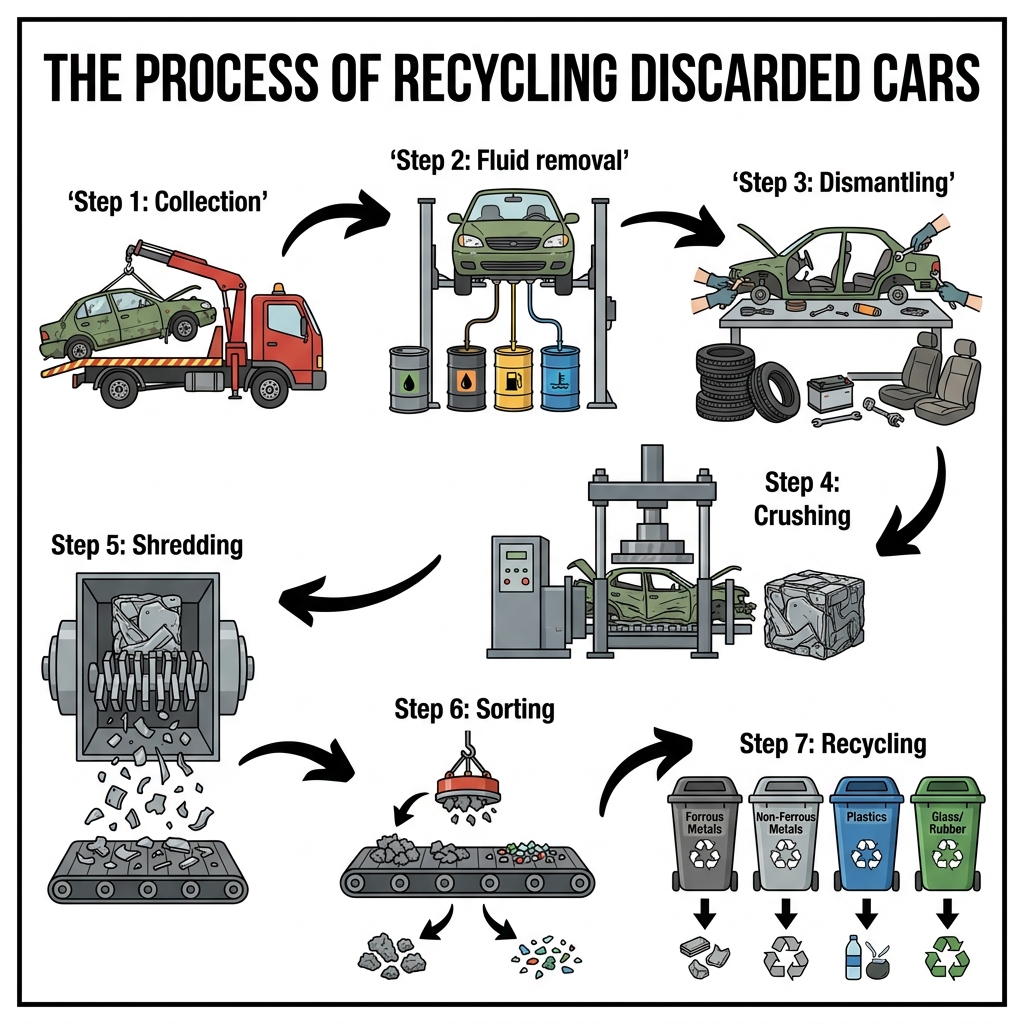
Prompt: The diagram below shows the process of recycling discarded cars.
Example Answer:
The diagram illustrates the seven steps involved in recycling discarded cars, from the initial collection of a damaged vehicle through to the separation of materials into different recyclable streams.
Overall, car recycling is a linear process that progressively breaks down a whole vehicle into smaller fragments. It begins with the collection of an intact car and ends with sorted bins of metal, plastic, and other recyclable materials.
In the first three steps, a discarded car is collected by a tow truck and taken to a recycling facility. There, it is raised on a hoist so that all of its fluids can be drained into separate barrels. The drained vehicle is then dismantled, with parts such as tyres, seats, and batteries removed and set aside.
In the next four steps, the stripped body is fed into a large hydraulic press, which crushes it into a compact metal cube. The cube is then passed through a shredder, which breaks it into small fragments. A magnetic separator sorts the fragments, and the sorted materials are placed into four bins: ferrous metals, non-ferrous metals, plastics, and glass or rubber.
Question 24
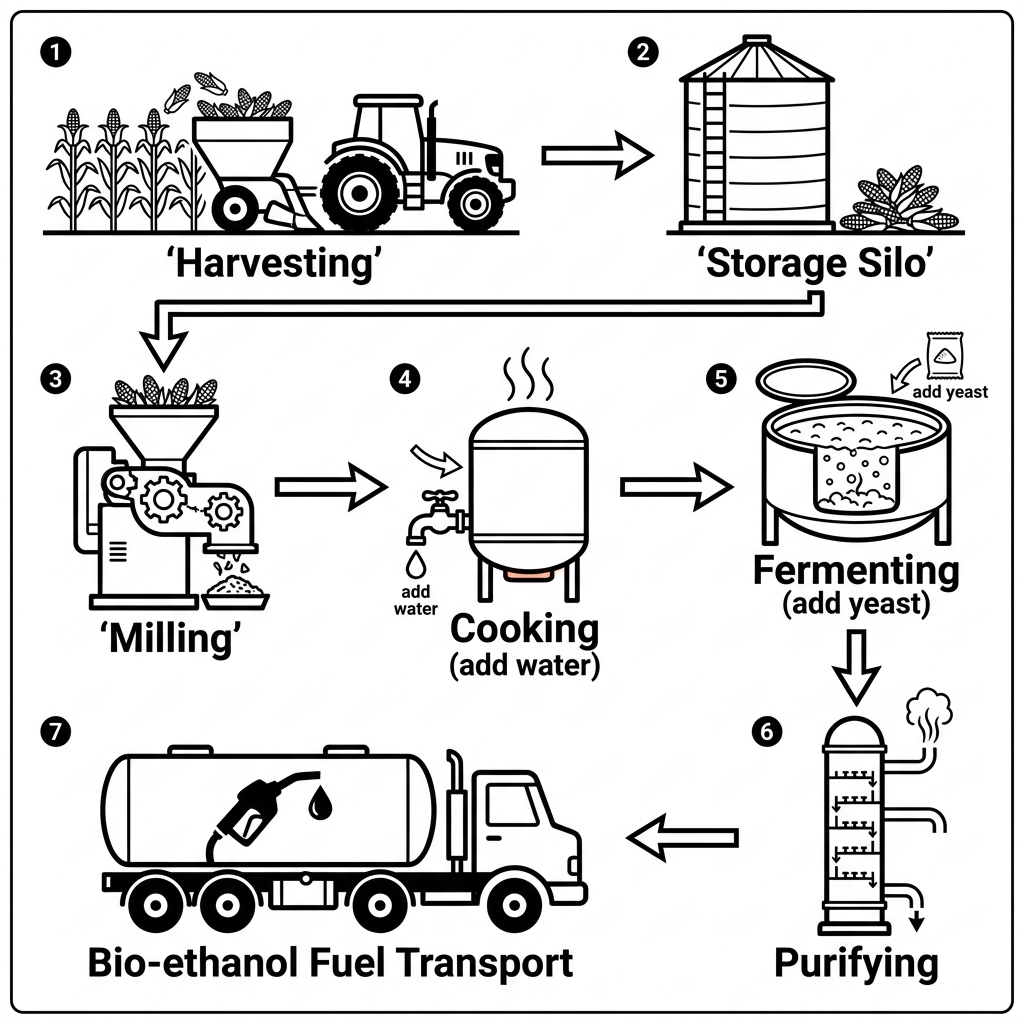
Prompt: The diagram below illustrates how bio-ethanol fuel is produced from corn.
Example Answer:
The diagram illustrates the seven stages involved in producing bio-ethanol fuel from corn, from the harvesting of corn in the field through to the dispatch of the finished fuel by tanker truck.
Overall, bio-ethanol production is a linear process. It begins with the agricultural harvesting of corn and ends with finished fuel being loaded for distribution, with five intermediate stages that progressively convert the corn into a refined liquid fuel.
In the first two stages, corn is harvested by a tractor and transferred to a storage silo. In stage three, the stored corn is fed into a milling machine and ground into a fine powder. The ground corn is then transferred in stage four into a cooking vessel, where water is added and the mixture is heated.
In stage five, yeast is added to the cooked mixture in a fermentation tank, where it converts the sugars into alcohol. In stage six, the fermented liquid is sent to a purifying column and distilled into bio-ethanol. At the final stage, the finished fuel is pumped into a tanker truck and transported for use.
Question 25
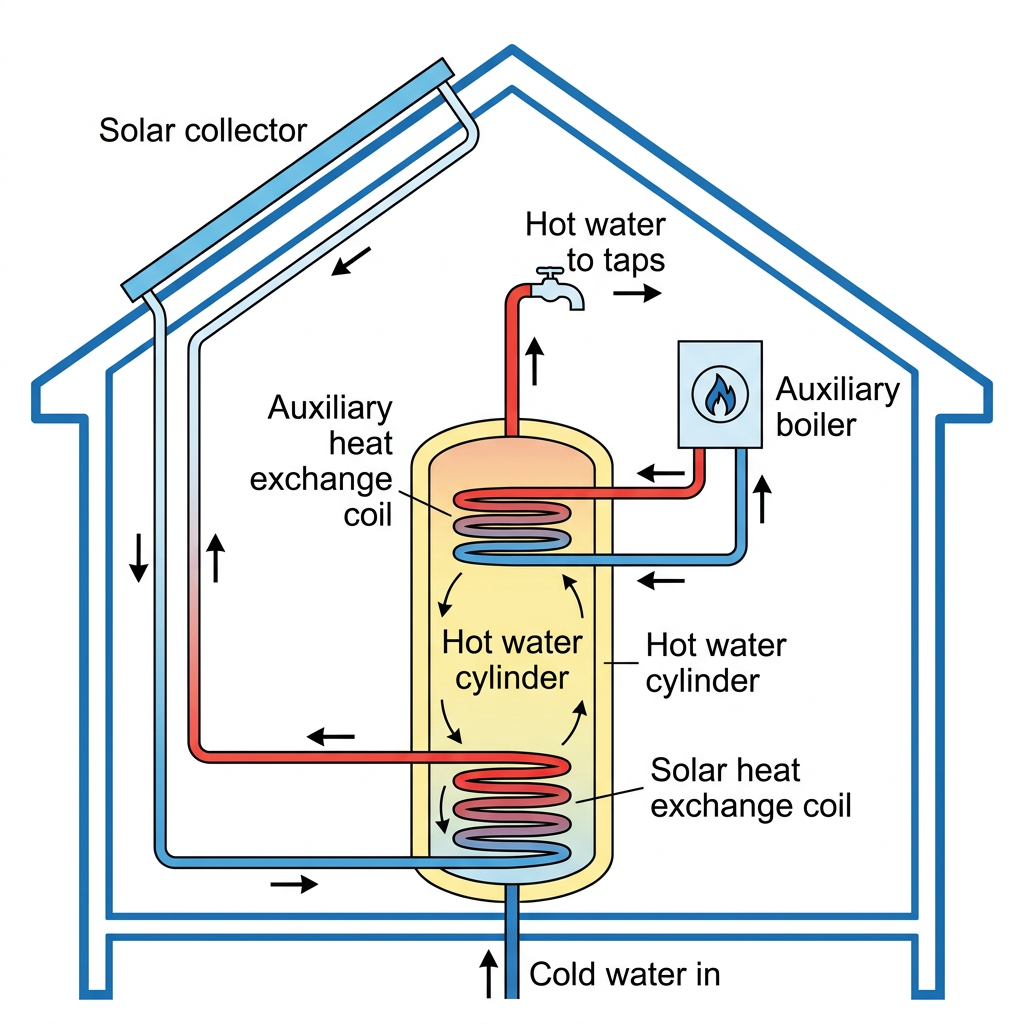
Prompt: The diagram below shows how a domestic solar water heating system works.
Example Answer:
The diagram illustrates how a domestic solar water heating system uses solar energy and an auxiliary boiler to provide hot water for a household, with the main components shown in cross-section.
In broad terms, the system is a closed loop. Cold water enters at the bottom of the house, is heated by the sun or by a backup boiler, rises to the top of a hot water cylinder, and is then drawn off through the taps.
On the roof, a solar collector absorbs heat from the sun. A pipe filled with water circulates between the solar collector and a solar heat exchange coil at the bottom of the hot water cylinder inside the house. As the heated water passes through the coil, it transfers its heat into the surrounding water.
When extra heat is needed, an auxiliary boiler beside the cylinder provides additional hot water through a second heat exchange coil higher up. Cold mains water enters the bottom of the cylinder and is heated by both coils. The warmed water rises to the top and flows out as hot water to the taps.
Question 26
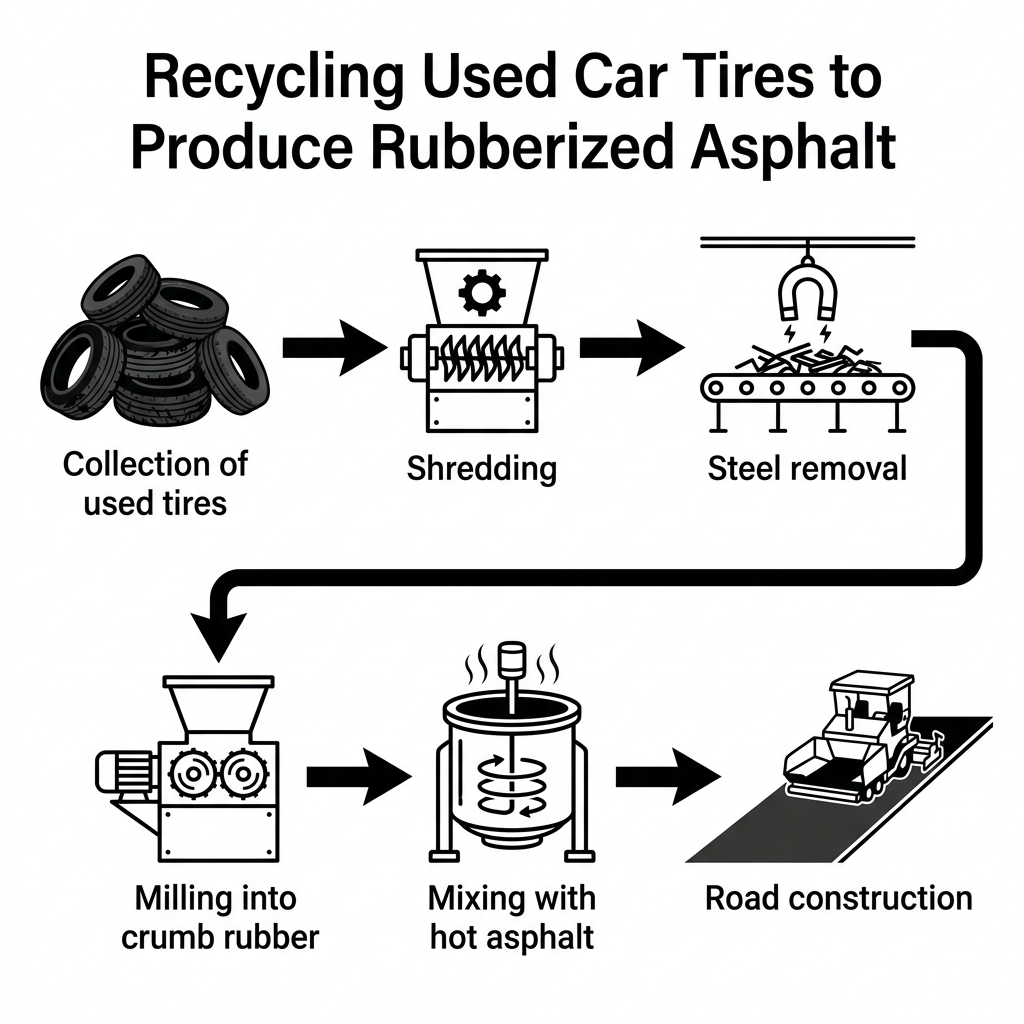
Prompt: The diagram below shows the process of recycling used car tires to produce rubberized asphalt for road construction.
Example Answer:
The diagram illustrates the six stages involved in recycling used car tyres to produce rubberised asphalt, from the initial collection of discarded tyres through to the final road construction.
Overall, the process is a linear sequence that converts a problematic waste material into a usable road surface. It begins with a pile of discarded tyres and ends with the laying of a finished asphalt road.
In the first three stages, used car tyres are collected from a central yard and fed into a shredder, which breaks them into smaller pieces. The shredded material is then passed under a large magnet, which removes any embedded steel wire from inside the tyres, leaving a stream of clean rubber pieces.
In the final three stages, the rubber pieces are fed into a milling machine, which grinds them into a fine crumb rubber. The crumb rubber is then transferred to a mixing tank, where it is combined with hot liquid asphalt and blended into a uniform mixture. At the final stage, the rubberised asphalt is laid on a road by a paving machine.
Question 27
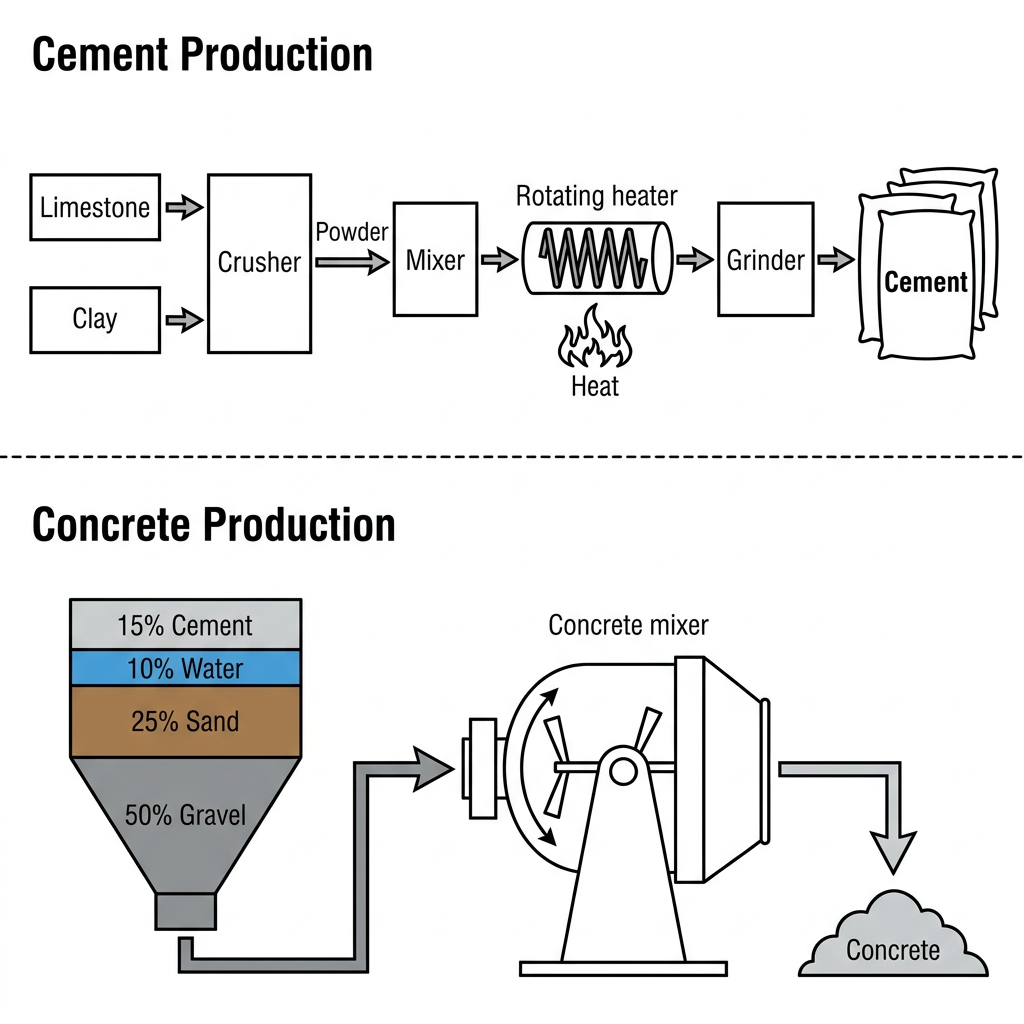
Prompt: The diagram illustrates the process of producing cement and how cement is used to make concrete for building purposes.
Example Answer:
The diagram illustrates two related processes: the production of cement from limestone and clay, and the subsequent use of that cement to produce concrete for building purposes.
Broadly speaking, the two processes form a linear chain. Cement is first manufactured in five stages, after which it is combined with three additional materials in fixed proportions to produce concrete. The output of the first process becomes one of the four inputs for the second.
In the cement production process, limestone and clay are fed into a crusher, which reduces them to a powder. The powder is transferred to a mixer and then passed through a rotating heater, which is fired from below to reach a high temperature. The heated material is then ground into a fine powder and bagged as finished cement.
In the concrete production process, four materials are combined in fixed proportions: 15% cement, 10% water, 25% sand, and 50% gravel. The materials are fed from a hopper into a rotating concrete mixer, where they are blended together. The finished concrete is then poured from the mixer for use on construction sites.
Question 28
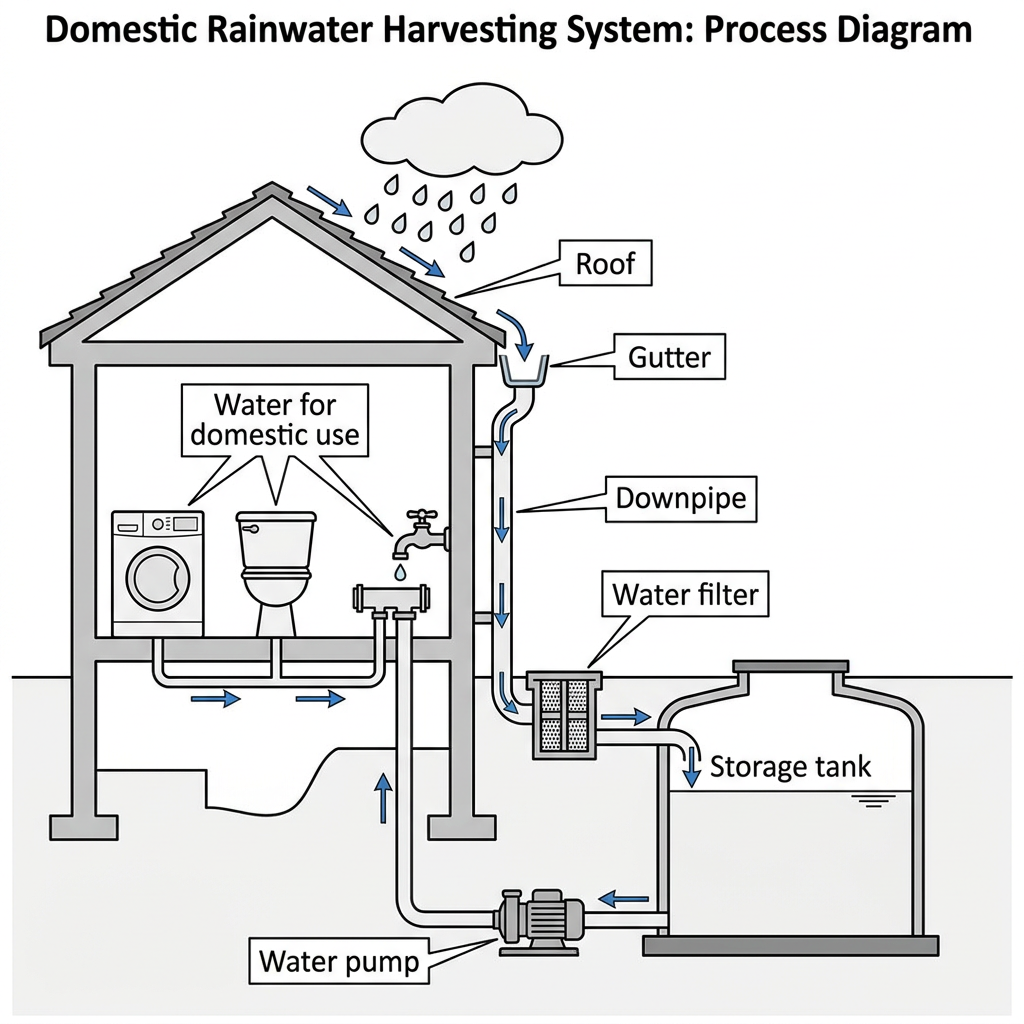
Prompt: The diagram below shows how a domestic rainwater harvesting system works to provide water for household use.
Example Answer:
The diagram illustrates how a domestic rainwater harvesting system collects rain from the roof of a house, stores it underground, and delivers it for use within the home.
Overall, the system is a linear flow from roof to tap, with a single processing point (the water filter) and a buffer (the storage tank) along the way. A water pump moves water from the underground storage back into the house when it is needed.
Rainwater falls on the sloping roof of the house and runs into a gutter along its lower edge. The gutter feeds the water down a vertical downpipe on the side of the house. As the water reaches ground level, it passes through a water filter, which removes leaves and debris before the water enters the storage system.
The filtered water then flows into a large storage tank buried in the garden next to the house. When water is required inside the house, a water pump draws it back up through underground pipes. The water is then delivered to domestic appliances and fixtures, including a washing machine, a toilet, and a tap.
Question 29
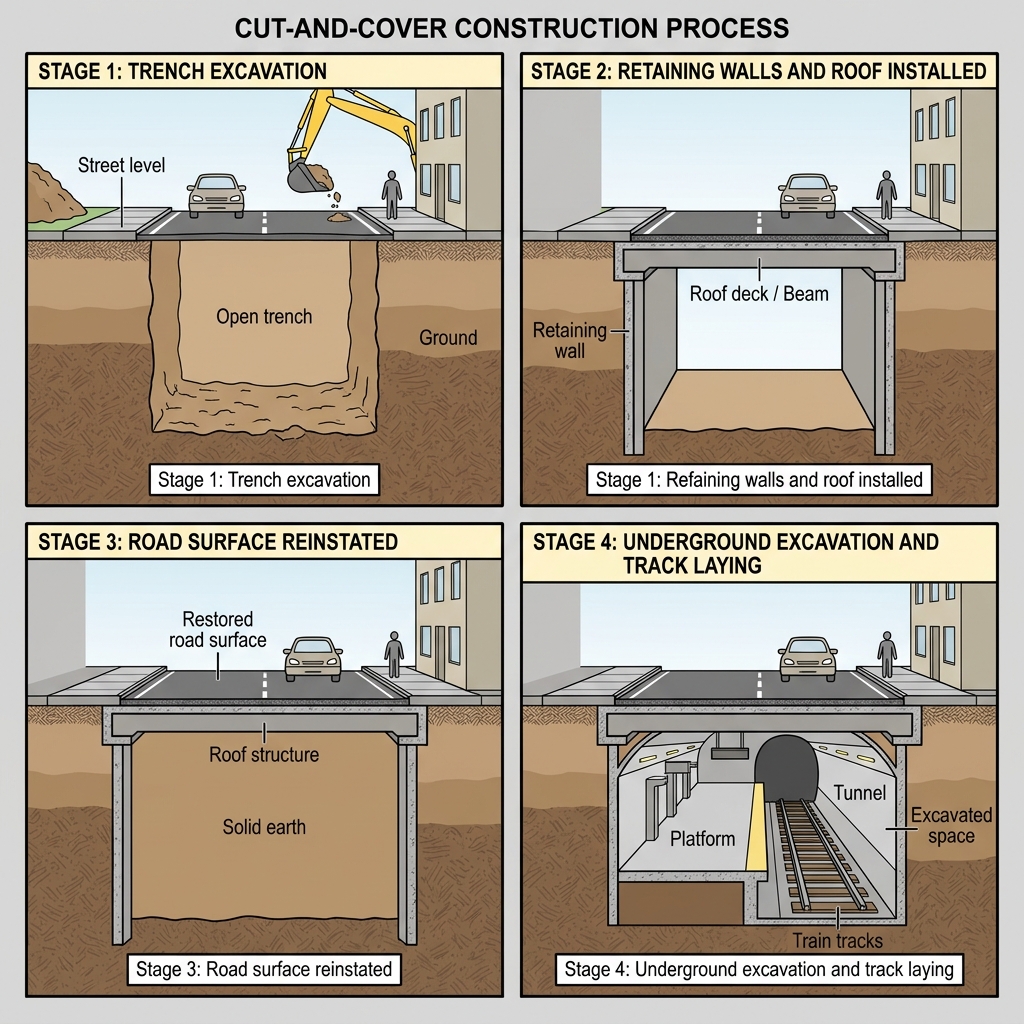
Prompt: The diagram below shows the process of constructing an underground railway station using the cut-and-cover method.
Example Answer:
The diagram illustrates the four stages of the cut-and-cover method used to construct an underground railway station beneath an urban street, from the initial trench excavation through to the laying of tracks below.
Overall, the cut-and-cover process is a linear sequence in which the road surface is removed, the structure of the station is built, and the surface is reinstated so that traffic can resume above while excavation continues underneath.
In stage one, an excavator digs a large open trench down from street level, removing the road surface and a volume of earth. In stage two, retaining walls are built up the sides of the trench, and a flat roof deck and beam are installed across the top, creating a covered concrete structure within the open hole.
In stage three, the road surface is reinstated above the new roof so that traffic can continue. Beneath the restored road, the area inside the retaining walls is excavated downwards in stage four to create the platform level. Train tracks are laid in the excavated space, and a tunnel is extended to connect to the wider rail network.
Question 30
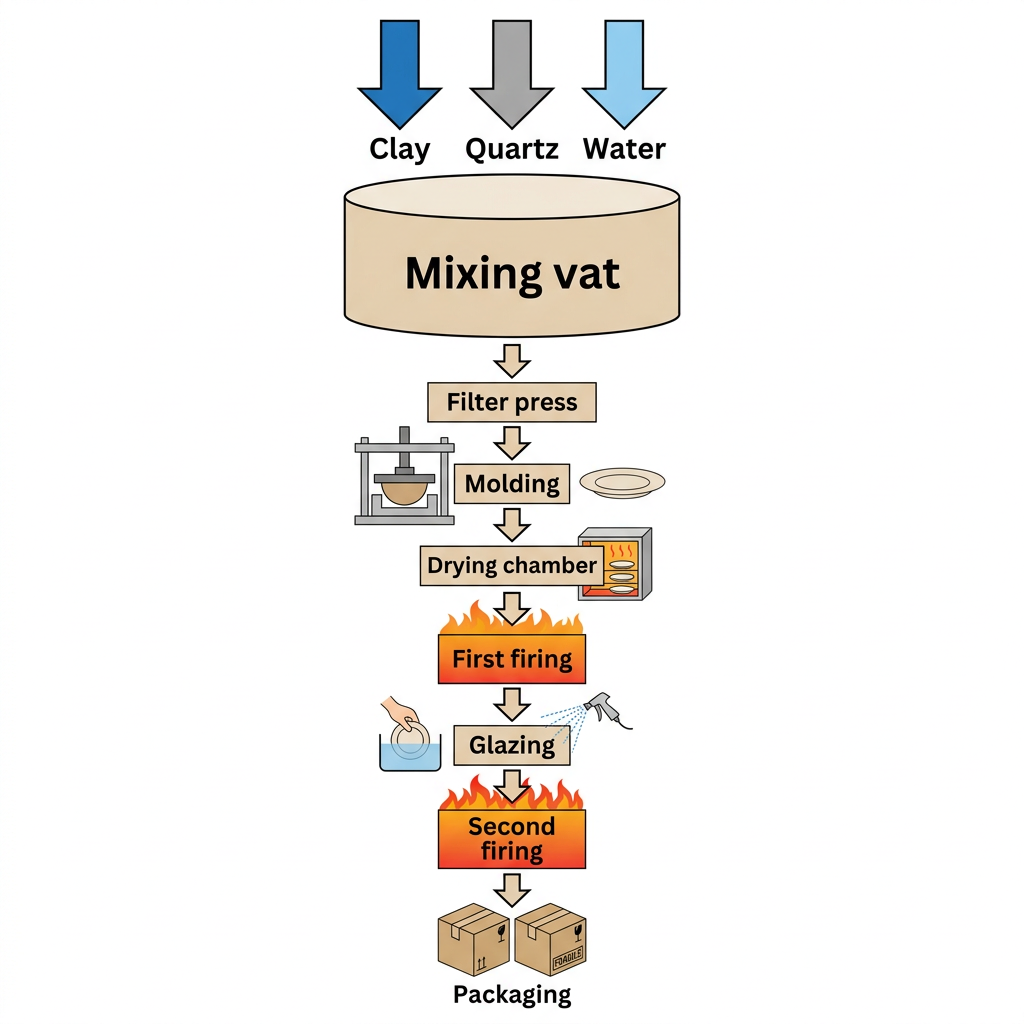
Prompt: The flowchart below illustrates the process of manufacturing ceramic plates in a factory.
Example Answer:
The flowchart illustrates the eight main stages involved in the factory manufacture of ceramic plates, from the three raw materials at the top through to the packaged finished product at the bottom.
In broad terms, ceramic plate production is a strictly linear process. It begins with the combination of clay, quartz, and water and ends with packaged plates ready for delivery, passing through two separate firing stages along the way.
In stage one, the three raw materials, clay, quartz, and water, are fed into a mixing vat and combined into a uniform liquid paste. The paste is then transferred to a filter press in stage two, which removes excess water. In stage three, the solid material is shaped between moulds to form individual plates.
Next, the moulded plates are moved to a drying chamber to remove moisture, after which they are placed in a kiln for a first firing. A glaze is then applied by dipping. The plates are returned to the kiln for a second firing, which seals the glaze. At the final stage, the finished plates are packaged into boxes for distribution.