
25 IELTS Reading Passage 3 Practice Tests with Answers
IELTS Reading Passage 3 is the most demanding of the three passages in the IELTS Academic Reading test. The text usually comes from university-level academic writing, covering subjects such as the sciences, social sciences, history, or technology, with abstract argument and dense vocabulary. Question types include matching headings, multiple choice, summary completion, and short answer. Passage 3 tests how well you can follow complex arguments under time pressure.
This article gives you 25 IELTS Reading Passage 3 practice tests. Each test is a complete passage with all of its questions and the answers. Across the 25 tests, you will get 350 sub-questions of focused practice.
If you want the format, scoring rules, and strategies explained in depth, read our complete guide to IELTS Reading first, then use the questions below to practice.
Passage 1
Documenting Canopy Invertebrates
A. The rainforest canopy, often described as the eighth continent, represents one of the most biologically complex and least understood habitats on Earth. For decades, the sheer physical challenge of reaching the upper foliage of towering trees hindered comprehensive biological surveys. While the ground-level flora and fauna were extensively chronicled, the upper strata remained largely inaccessible. Biologists recognized that an enormous proportion of the world’s terrestrial invertebrate life resided in this elevated ecosystem, yet the methodologies to systematically gather these specimens were in their infancy, leaving a significant gap in both taxonomic logs and ecological models.
B. Initially, researchers relied on rather rudimentary and destructive methods. The most straightforward approach to retrieving canopy-dwelling invertebrates was felling the tree itself. While this yielded immediate access to the foliage, it fundamentally destroyed the microhabitats under investigation, drastically altering the immediate environment and making long-term ecological monitoring impossible. Alternatively, scientists employed single-rope climbing techniques adapted from mountaineering. Although this non-destructive method allowed for direct observation and targeted hand-collecting of specimens, it was intensely time-consuming. A climber could only survey a highly restricted area, and the physical disturbance of ascending often prompted mobile insects to flee before they could be captured.
C. A revolutionary shift in specimen collection occurred with the advent of canopy fogging. This technique involves dispersing a biodegradable, highly localized insecticidal mist into the upper branches using a motorized machine. As the mist permeates the foliage, invertebrates momentarily lose their grip and precipitate into a network of suspended, funnel-shaped collecting trays deployed beneath the target area. Fogging dramatically accelerated the pace of discovery, allowing researchers to harvest thousands of specimens spanning hundreds of species in a single morning. It proved exceptionally effective at capturing elusive, nocturnal, or highly camouflaged species that routinely evaded visual detection by climbers.
D. Despite its efficiency, canopy fogging is not without substantial methodological drawbacks. The primary criticism leveled against fogging is its indiscriminate nature. When specimens tumble into the collecting funnels, they are entirely divorced from their specific microhabitats. A taxonomist cannot determine whether a particular beetle was feeding on a leaf, hiding under bark, or resting inside a flower. Furthermore, the mist relies on gravity; thus, invertebrates that live deep within rolled leaves, bore into wood, or construct secure silk retreats are largely unaffected and remain uncollected. Consequently, while fogging provides a massive quantitative yield, it often sacrifices qualitative ecological context.
E. To mitigate these limitations, modern canopy biologists employ a suite of complementary gathering devices. Flight intercept traps are frequently hoisted into the branches to capture actively flying insects. These devices consist of a transparent vertical barrier; when an insect collides with the unseen barrier, it falls into a preservative-filled trough below. Unlike fogging, which provides a single snapshot in time, intercept traps can be left in place for weeks, offering longitudinal data on insect activity. Additionally, localized beating techniques—striking branches with a stick so that insects drop onto a handheld fabric tray—permit collectors to associate specific insects with precise botanical hosts, bridging the contextual gap left by fogging.
F. Ultimately, the choice of collection protocol is dictated by the overarching goals of the research. Studies aiming to estimate total biodiversity or discover new species frequently prioritize the sheer volume provided by fogging. Conversely, detailed behavioral or symbiotic investigations necessitate the precision of hand-collecting and targeted trapping. As canopy research matures, the consensus is that a multi-tiered approach is essential. By integrating broad-scale harvesting with meticulous, targeted sampling, entomologists can construct a more accurate, multidimensional portrait of canopy ecosystems, ensuring that specimens are not merely amassed, but meaningfully contextualized within their arboreal landscape.
Questions 27-30
Do the following statements agree with the views of the writer in Reading Passage 3?
YES if the statement agrees with the views of the writer
NO if the statement contradicts the views of the writer
not given if it is impossible to say what the writer thinks about this
- Early biological surveys of rainforests focused mainly on species living at ground level.
- Felling trees was considered the most effective method for long-term ecological studies.
- Canopy fogging was originally developed for agricultural pest control.
- Fogging fails to capture insects that build protective silk shelters.
Show answers
1. Early biological surveys of rainforests focused mainly on species living at ground level. — YES
2. Felling trees was considered the most effective method for long-term ecological studies. — NO
3. Canopy fogging was originally developed for agricultural pest control. — NOT GIVEN
4. Fogging fails to capture insects that build protective silk shelters. — YES
Questions 31-35
Classify the following statements as referring to:
A Tree felling
B Rope climbing
C Canopy fogging
D Flight intercept traps
Write the correct letter, A, B, C, or D, for each question.
- It provides data over an extended period of time.
- It causes mobile specimens to escape due to physical disruption.
- It produces a large number of specimens but lacks detailed habitat context.
- It permanently ruins the ecosystem being studied.
- It is particularly useful for exposing well-hidden or nocturnal species.
Show answers
1. It provides data over an extended period of time. — D. Flight intercept traps
2. It causes mobile specimens to escape due to physical disruption. — B. Rope climbing
3. It produces a large number of specimens but lacks detailed habitat context. — C. Canopy fogging
4. It permanently ruins the ecosystem being studied. — A. Tree felling
5. It is particularly useful for exposing well-hidden or nocturnal species. — C. Canopy fogging
Questions 36-40
Complete the summary using the list of words, A-G, below.
A Biodiversity
B Interactions
C Environment
D Volume
E Hosts
F Behavior
G Location
- When the primary aim is to assess overall _________ or find unidentified insects, canopy fogging is highly favored.
- However, for detailed research into insect _________, methods like hand-collecting are necessary.
- Because fogging cannot demonstrate the exact _________ of a specimen, scientists use complementary tools.
- By striking branches, researchers can successfully link insects to specific _________.
- Ultimately, combining various techniques provides a better understanding of the complex canopy _________.
Show answers
1. When the primary aim is to assess overall _________ or find unidentified insects, canopy fogging is highly favored. — A. Biodiversity
2. However, for detailed research into insect _________, methods like hand-collecting are necessary. — F. Behavior
3. Because fogging cannot demonstrate the exact _________ of a specimen, scientists use complementary tools. — G. Location
4. By striking branches, researchers can successfully link insects to specific _________. — E. Hosts
5. Ultimately, combining various techniques provides a better understanding of the complex canopy _________. — C. Environment
Passage 2
Non-Invasive Genetic Sampling in Wildlife Ecology
A. For decades, wildlife biologists studying secretive or wide-ranging terrestrial mammals faced a daunting challenge. Traditional methods for estimating population sizes and understanding the genetics of species like snow leopards, wolverines, or grizzly bears required live-trapping and physical immobilization. Not only are these techniques exceptionally labor-intensive and financially exorbitant, but they also subject the animals to considerable physiological stress and carry a persistent risk of injury or even mortality. Furthermore, some elusive species are so skilled at avoiding traps that researchers can spend months in the field without capturing a single individual. In response to these significant ethical and practical hurdles, the field of wildlife ecology has increasingly turned to non-invasive genetic sampling (NIGS). This approach allows researchers to collect biological material, and consequently DNA, without ever capturing, handling, or even directly observing the animal in question.
B. The most universally applied NIGS technique globally is the collection of scat (feces). When an animal digests its food, epithelial cells from the intestinal lining are naturally shed and passed along with the waste material. By systematically collecting these fecal samples along known trails or transects, researchers can extract the animal's DNA in a laboratory setting. Furthermore, scat is a multi-purpose resource; beyond host genetics, it provides invaluable, multifaceted data regarding the animal's diet, internal parasite load, stress hormone levels, and gut microbiome composition. However, the viability of scat samples is heavily dependent on ambient environmental conditions. In hot, humid tropical rainforests, DNA degrades rapidly due to intense bacterial activity, UV exposure, and moisture, requiring researchers to locate and preserve samples in specialized buffers within hours of deposition. Conversely, in cold, arid environments like the Arctic or high-altitude deserts, DNA in scat can remain intact and viable for genetic sequencing for many months.
C. Another highly effective method, particularly favored for studying ursids (bears) and wild felids, involves the use of hair snares. These passive devices typically consist of a section of barbed wire, adhesive sticky pads, or stiff brushes set up strategically in the animal's natural habitat. To encourage the animal to interact with the snare, researchers utilize pungent scent lures or place the devices at 'rubbing trees' which the animals naturally use for territorial marking. As the animal rubs against the snare, a small tuft of hair is snagged and left behind. The primary advantage of this method over scat collection is the superior quality of the genetic material; the hair follicle (the root) contains highly concentrated, relatively pristine DNA compared to the often-degraded and contaminated DNA found in scat. Successful deployment, however, requires an intimate, expert understanding of the target species' behavior, seasonal movements, and preferred travel routes, without which the snares may sit untouched indefinitely.
D. A more recent and arguably revolutionary addition to the NIGS toolkit is the analysis of environmental DNA (eDNA). Originally developed for aquatic ecosystems to detect fish and amphibians from water samples, eDNA techniques are now being rigorously adapted for terrestrial mammals. Animals constantly shed minute amounts of genetic material into their surroundings through sloughed skin cells, saliva left on browsed branches, and urine. Researchers can now collect soil from fresh footprints, gather water from small terrestrial drinking pools, or even scoop snow from winter tracks to test for the molecular presence of specific species. This method is extraordinarily sensitive and can confirm the presence of a rare or highly mobile species in a given area even if the individual passed through several days prior, entirely without the need for the animal to leave a visible, macroscopic biological sample like scat or hair.
E. Once the collected samples are safely transported back to the laboratory, the rigorous analytical phase begins. Because non-invasive samples typically yield incredibly small quantities of highly degraded DNA, specialized and stringent extraction protocols are required to isolate the genetic material. Scientists use a process called Polymerase Chain Reaction (PCR) to amplify specific genetic markers, essentially copying the DNA millions of times until it is readable. By examining these markers, researchers can create a unique genetic profile, or genotype, for each individual animal. This level of individual identification is critical for broader ecological analysis. It allows ecologists to employ spatial capture-recapture statistical models, which accurately estimate total population size and population density by analyzing the frequency with which the exact same individuals are 'recaptured' via their localized DNA deposits at different sampling locations over a season.
F. Despite its immense utility and ethical advantages, non-invasive genetic sampling is not without its notable limitations. The primary and most persistent concern is the extraordinarily high risk of sample contamination. Because the target DNA is present in such minute initial amounts, even a stray breath, a microscopic skin flake, or a droplet of sweat from a human researcher or laboratory technician can easily ruin a sample or yield false results. Additionally, the complex laboratory procedures required to successfully extract and amplify degraded DNA are significantly more costly and time-consuming than analyzing high-quality blood or tissue samples obtained through traditional trapping. Nevertheless, as laboratory technologies become progressively more efficient, automated, and affordable, the reliance on NIGS is universally expected to grow. It offers an unparalleled window into the lives and demographics of the world's most critically endangered and elusive wildlife without disrupting their natural behaviors or habitats.
Questions 27-31
Reading Passage 3 has six paragraphs, A-F.
Which paragraph contains the following information?
Write the correct letter, A-F, in boxes 27-31 on your answer sheet.
- an explanation of how individual genetic profiles are used to calculate overall animal numbers
- examples of the types of non-genetic information that can be extracted from a specific sample type
- a comparison of the financial and temporal costs between NIGS lab work and traditional sample analysis
- reference to a technique originally created for use in water-based environments
- an explanation of why researchers must strategically place collection devices based on animal habits
Show answers
1. an explanation of how individual genetic profiles are used to calculate overall animal numbers — E
2. examples of the types of non-genetic information that can be extracted from a specific sample type — B
3. a comparison of the financial and temporal costs between NIGS lab work and traditional sample analysis — F
4. reference to a technique originally created for use in water-based environments — D
5. an explanation of why researchers must strategically place collection devices based on animal habits — C
Questions 32-35
Do the following statements agree with the claims of the writer in Reading Passage 3?
In boxes 32-35 on your answer sheet, choose:
- YES if the statement agrees with the claims of the writer
- NO if the statement contradicts the claims of the writer
- not given if it is impossible to say what the writer thinks about this
- Traditional live-trapping methods present a risk of physical harm to the animals being studied.
- DNA extracted from scat is generally of higher quality than DNA extracted from hair follicles.
- The use of scent lures is the most expensive part of setting up hair snares.
- Human DNA can easily compromise the results of non-invasive genetic samples.
Show answers
1. Traditional live-trapping methods present a risk of physical harm to the animals being studied. — YES
2. DNA extracted from scat is generally of higher quality than DNA extracted from hair follicles. — NO
3. The use of scent lures is the most expensive part of setting up hair snares. — NOT GIVEN
4. Human DNA can easily compromise the results of non-invasive genetic samples. — YES
Questions 36-40
Complete the summary below.
Choose no more than two words from the passage for each answer.
Write your answers in boxes 36-40 on your answer sheet.
Environmental DNA (eDNA)
The collection of environmental DNA is a relatively new application in the study of terrestrial mammals. Originally designed to monitor species in _______ (36), this technique relies on the fact that animals continuously leave behind genetic material, such as saliva or _______ (37), in their environment. To gather this material, scientists might collect _______ (38) from tracks left in the winter or take water samples from drinking pools. Because it is highly _______ (39), the eDNA method can prove that a rare animal has visited an area even if several _______ (40) have passed since it was there, and without the need to find physical biological material like hair or feces.
Show answers
36. aquatic ecosystems
37. skin cells
38. snow
39. sensitive
40. days
Passage 3
The Science of Botanical Specimen Preparation
A. The discipline of botanical field research relies heavily on the creation and maintenance of herbaria—specialized facilities that function as extensive libraries of dried plant specimens. Unlike botanical gardens that cultivate living plants for public display and horticultural study, herbaria serve as critical reference libraries for taxonomy, ecology, and conservation. A well-preserved herbarium specimen can last for hundreds of years, providing a permanent, verifiable record of a plant species’ existence at a specific time and place in history. These collections form the foundational data for naming new species, mapping global biodiversity, and understanding evolutionary lineages.
B. The journey of a herbarium specimen begins in the wild, where scientists must make calculated decisions about what to harvest. Selecting the right specimen is a rigorous process; the chosen plant must exhibit typical foliage, and crucially, it must include reproductive structures such as flowers, fruits, or spores, as these are often required for accurate species identification. The scale of the plant determines the collection strategy. Collecting a tiny ephemeral herb involves taking the whole organism, roots and all, whereas documenting a towering canopy tree requires carefully selecting representative branchlets that capture the layout of the leaves and the nature of the bark.
C. Once severed from its parent plant, the specimen begins to wilt immediately, necessitating prompt preservation in the field. Botanists use a specialized portable device known as a field press to flatten and protect plants outdoors. The specimen is carefully arranged inside a fold of newsprint to display its essential features—ensuring, for instance, that both the upper and lower surfaces of leaves are visible. This newsprint is then sandwiched between layers of absorbent blotting paper and corrugated cardboard, which facilitate airflow. The entire stack is then tightly bound between two rigid wooden frames using heavy-duty straps, applying immense pressure to flatten the plant and prevent the leaves from shriveling.
D. However, a physical specimen is scientifically worthless without rigorous metadata. The moment a plant is pressed, detailed field notes must be recorded in a dedicated journal. These notes capture information that will be lost once the plant is dried and mounted. Essential data includes the exact geographical coordinates obtained via GPS, the elevation, and a comprehensive description of the surrounding habitat. Furthermore, the botanist must record transient physical characteristics, such as the plant's overall height, its scent, and colors that inevitably fade during drying, such as delicate flower hues or the bright sheen of a fresh berry. Without these details, the specimen is merely a flat, brown silhouette.
E. Upon returning from the field, the pressing frames are transferred to drying cabinets. This moisture removal stage demands a delicate balance regarding temperature and time. The cabinets push warm, dry air through the corrugated cardboard layers of the press. If the drying process is too slow, the plant material is highly susceptible to fungal infection, which can rot the specimen before it is preserved. Conversely, if the heat is too intense or the plant is dried too quickly, the cellular structure collapses violently, making the specimen excessively brittle, scorched, and discolored. The goal is a steady, controlled desiccation that locks the plant's morphology in place.
F. Once thoroughly dehydrated, specimens enter the mounting phase. Here, the fragile plant material is meticulously secured to acid-free paper using specialized adhesives or fine linen thread. A formal, permanent label containing all the transcribed field notes is then attached to the bottom right corner of the sheet. It is crucial to use archival materials at this stage to guarantee the longevity of the sample, ensuring it can withstand centuries of storage without degrading. The mounted specimens are then frozen for a short period to eradicate any dormant insect pests before being filed away into the herbarium's climate-controlled cabinets.
G. In the contemporary era, historical collections have undergone comprehensive digitization, transforming physical vaults into accessible online databases. High-resolution scanning allows researchers worldwide to examine specimens without risking damage to the fragile originals. These digitized records are invaluable for tracking climate change; by analyzing altered bloom dates documented over decades, ecologists can observe how shifting temperatures affect plant phenology. Furthermore, modern molecular techniques mean scientists can now extract DNA from the tissue of very old specimens to resolve complex evolutionary relationships, proving that these centuries-old collections are still unlocking new frontiers in biology.
Questions 27-31
Reading Passage 3 has seven paragraphs, A-G.
Which paragraph contains the following information?
Choose the correct letter, A-G, for questions 27-31.
- A reference to the consequence of incomplete field records.
- An explanation of how historical plant records help monitor environmental shifts.
- Examples of the physical components used to flatten and protect plants outdoors.
- The criteria for choosing a suitable plant to harvest.
- The delicate balance required regarding temperature and time during the moisture removal stage.
Show answers
1. A reference to the consequence of incomplete field records. — D
2. An explanation of how historical plant records help monitor environmental shifts. — G
3. Examples of the physical components used to flatten and protect plants outdoors. — C
4. The criteria for choosing a suitable plant to harvest. — B
5. The delicate balance required regarding temperature and time during the moisture removal stage. — E
Questions 32-35
Do the following statements agree with the claims of the writer in Reading Passage 3?
In boxes 32-35 on your answer sheet, select:
YES if the statement agrees with the claims of the writer
NO if the statement contradicts the claims of the writer
not given if it is impossible to say what the writer thinks about this
- Herbarium specimens are primarily collected to decorate botanical gardens.
- Researchers find it less physically demanding to collect small herbs than large trees.
- The color of a plant's flowers typically remains unchanged throughout the pressing and drying process.
- Archival quality paper is utilized to prevent the long-term deterioration of mounted plants.
Show answers
1. Herbarium specimens are primarily collected to decorate botanical gardens. — NO
2. Researchers find it less physically demanding to collect small herbs than large trees. — NOT GIVEN
3. The color of a plant's flowers typically remains unchanged throughout the pressing and drying process. — NO
4. Archival quality paper is utilized to prevent the long-term deterioration of mounted plants. — YES
Questions 36-40
Complete the summary below.
Choose no more than two words from the passage for each answer.
Write your answers in boxes 36-40 on your answer sheet.
The final stages of preserving botanical specimens involve careful preparation and modern technology. After the moisture has been removed, the plant is secured to _______ (36) using glue or thread. A formal label is also attached. It is crucial to use _______ (37) to guarantee the longevity of the sample. In recent years, collections have undergone _______ (38), allowing researchers worldwide to access high-resolution images. These modern databases are invaluable for tracking _______ (39) by analyzing altered bloom dates. Furthermore, scientists can now extract _______ (40) from the tissue of very old specimens to study genetic relationships.
Show answers
36. acid-free paper
37. archival materials
38. digitization
39. climate change
40. DNA
Passage 4
Measuring the Canopy's Hidden Multitudes
For decades, the high canopies of tropical and temperate forests were considered the "last biotic frontier." While ground-level ecosystems had been studied extensively, the upper reaches of the trees remained largely inaccessible. Yet, biologists estimate that a significant proportion of the world's insect species reside exclusively in the canopy. Documenting these populations is crucial for understanding ecosystem dynamics, pollination, and biodiversity. However, the physical challenge of reaching the canopy safely has necessitated the development of specialized collection techniques, each with its own specific strengths and limitations.
Among the simplest and oldest techniques are beating trays and sweep nets. A beating tray is essentially a stretched sheet of sturdy fabric held beneath a branch. The researcher strikes the branch sharply with a stick, dislodging beetles, caterpillars, and other stationary or slow-moving insects, which fall onto the fabric. Sweep netting involves passing a robust net through foliage to catch perched insects. Both methods are highly cost-effective and allow for live capture, so unwanted specimens can be released. However, their primary drawback is reach: they are typically restricted to the lower canopy or require researchers to climb individual trees, which restricts the volume of samples and the diversity of species collected.
To overcome the problem of height, researchers in the 1970s adapted insecticidal fogging for ecological sampling. This method involves using a machine to blast a plume of biodegradable, short-acting insecticide upwards into the canopy. Prior to fogging, dozens of funnel-shaped collection trays are suspended from lower branches or placed on the forest floor. As the fog rises, insects are knocked out and drop into the trays. Fogging is unparalleled in its ability to sample entire communities of canopy-dwelling arthropods simultaneously. Nevertheless, it has notable constraints. It is highly sensitive to weather; even a light breeze can blow the fog away from the target tree, and rain washes the insecticide away. Furthermore, it is non-selective and lethal, making it unsuitable for studies requiring live specimens or frequent repeated sampling in the same immediate area.
For continuous monitoring of flying insects, biologists often rely on flight intercept traps, particularly the Malaise trap. Designed like a small tent, the Malaise trap relies on the natural behavior of most flying insects, which tend to fly upwards when they encounter a barrier. Insects fly into the central mesh wall of the tent and crawl upward into a collection bottle filled with a preservative, such as ethanol, located at the highest peak. Once hoisted into the canopy using a pulley system, Malaise traps can be left unattended for weeks. They are exceptionally effective for catching flies and wasps but tend to under-sample heavier, slow-flying insects that might drop rather than climb when hitting a barrier.
Nocturnal canopy insects present a different challenge, which is frequently met using light traps. A standard light trap pairs a bright ultraviolet or mercury-vapor bulb with a collection chamber. Moths, certain beetles, and other night-flying insects drawn to the light circle the bulb until they strike a baffle and fall into the trap. While highly effective at gathering large numbers of specific nocturnal groups, light traps are inherently biased. They only capture phototactic species—those attracted to light—while ignoring others entirely. Moreover, their effectiveness fluctuates dramatically with environmental conditions; a bright full moon can outcompete the trap's light, significantly reducing the catch.
As technology advances, entomologists are beginning to integrate non-lethal and highly automated methods into their canopy research. Acoustic monitoring devices can record the distinct calls of crickets and cicadas, allowing species identification without capture. Meanwhile, environmental DNA (eDNA) swabbed from canopy leaves is being tested to detect the genetic traces insects leave behind, offering a non-invasive glimpse into localized biodiversity. Despite these promising innovations, the physical collection of specimens remains an essential cornerstone of ecological science. Without traditional sampling methods to build comprehensive genetic and morphological reference libraries, the massive datasets generated by new technologies would lack the context needed to truly understand the canopy's hidden multitudes. In the end, there is no substitute for the physical specimen when confirming a new species or studying anatomical adaptations.
Questions 27-30
Do the following statements agree with the information given in Reading Passage 3?
In boxes 27-30 on your answer sheet, write:
- TRUE if the statement agrees with the information
- FALSE if the statement contradicts the information
- not given if there is no information on this
Select the correct option for each statement.
- Ground-level ecosystems have historically received more scientific attention than forest canopies.
- The insect species found in the canopy are generally larger than those on the ground.
- Fogging is the most suitable method for researchers who need to capture live canopy insects.
- The effectiveness of Malaise traps is reduced when sampling heavy, slow-flying insects.
Show answers
1. Ground-level ecosystems have historically received more scientific attention than forest canopies. — TRUE
2. The insect species found in the canopy are generally larger than those on the ground. — NOT GIVEN
3. Fogging is the most suitable method for researchers who need to capture live canopy insects. — FALSE
4. The effectiveness of Malaise traps is reduced when sampling heavy, slow-flying insects. — TRUE
Questions 31-35
Classify the following statements as referring to A, B, C, or D.
Write the correct letter, A, B, C or D, in boxes 31-35 on your answer sheet.
- A Beating trays
- B Insecticidal fogging
- C Malaise traps
- D Light traps
Select the correct letter for each statement.
- This method is highly vulnerable to changes in the weather, such as wind and rain.
- This method is restricted to capturing species that exhibit a specific behavioral response to illumination.
- This method is best suited for the lower levels of a tree unless the researcher is able to climb.
- This method requires suspending a network of funnels to catch the specimens.
- This method takes advantage of an insect's natural instinct to move upwards when its path is blocked.
Show answers
1. This method is highly vulnerable to changes in the weather, such as wind and rain. — B
2. This method is restricted to capturing species that exhibit a specific behavioral response to illumination. — D
3. This method is best suited for the lower levels of a tree unless the researcher is able to climb. — A
4. This method requires suspending a network of funnels to catch the specimens. — B
5. This method takes advantage of an insect's natural instinct to move upwards when its path is blocked. — C
Questions 36-40
Label the diagram below.
Choose no more than two words from the passage for each answer.
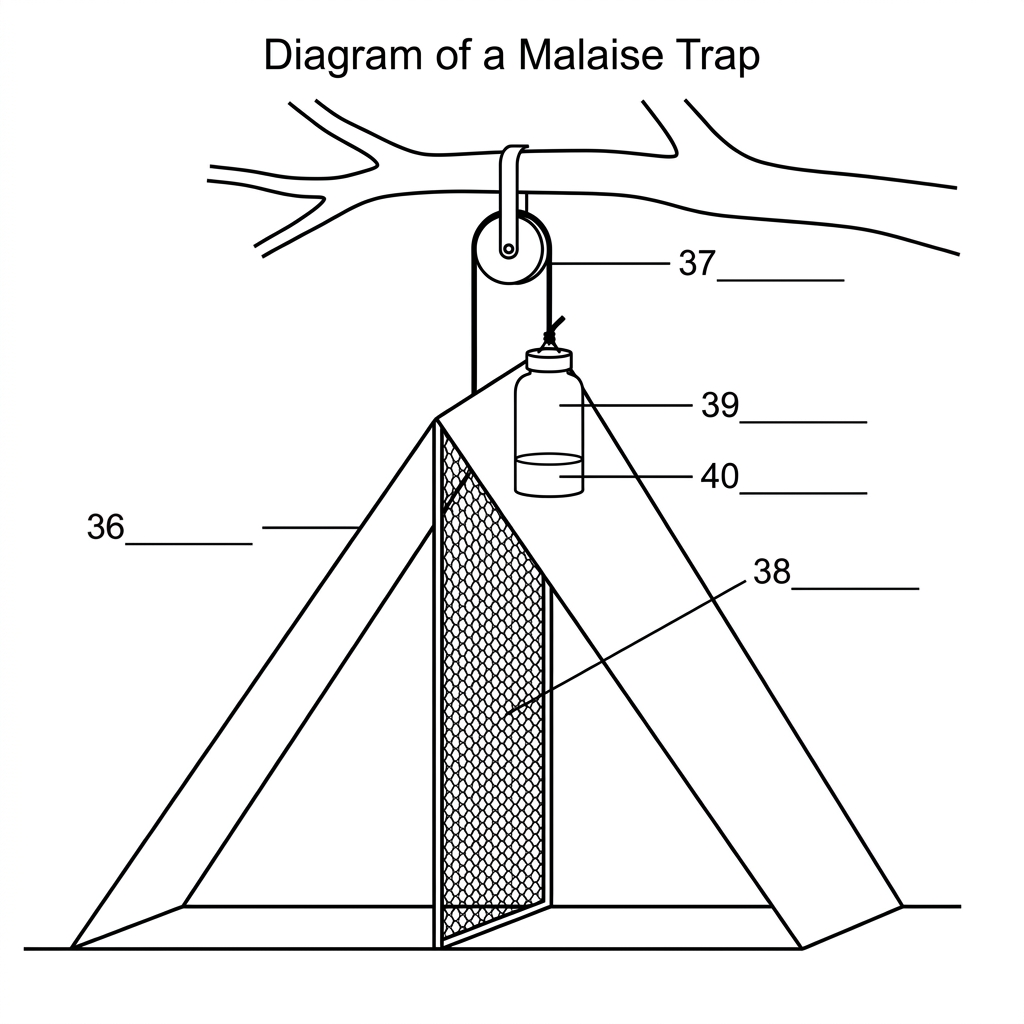
36. small
Show answer 36
tent
Show answer 37
pulley system
38. central
Show answer 38
mesh wall
Show answer 39
collection bottle
40. filled with a
Show answer 40
preservative
Passage 5
Extracting Tree-Ring Data (Dendrochronology)
A. The science of dendrochronology, or tree-ring dating, relies on the fact that trees in temperate zones produce one growth ring each year. However, extracting this data is far more complex than simply chopping down a tree and counting the concentric circles on the stump. Modern researchers require efficient, non-destructive methods to gather samples from living trees, deadwood, and historical timbers. The objective is rarely just to determine a tree’s age; rather, it is to compile a comprehensive timeline that reveals past climatic conditions, ecological events, and even human activity. The quality of this data depends entirely on the precision of the sampling and dating techniques employed.
B. The primary tool for sampling living trees is the increment borer. This is a specialized, hollow drill that is manually driven into the trunk of a tree, aimed directly at the center or pith. Once the borer has penetrated to the core, an extractor spoon is inserted into the hollow shaft, and a thin, cylindrical cross-section of wood—usually about 5 millimeters in diameter—is pulled out. This process leaves a small hole in the tree, which typically heals over with resin or can be plugged to prevent fungal infection. The increment borer allows dendrochronologists to sample hundreds of trees in a forest without causing significant harm to the ecosystem. Samples are carefully stored in protective straws or paper tubes and transported to the laboratory.
C. Once in the lab, the fragile cores must be prepared for analysis. They are glued into grooved wooden mounts and sanded down with progressively finer grit paper until the cellular structure of the wood is clearly visible under a microscope. This preparation is crucial because the boundaries between the light-colored earlywood (spring growth) and the dark-colored latewood (summer growth) must be sharply defined. Analysts then measure the width of each ring, often using a sliding stage micrometer connected to a computer, which records the exact dimensions down to a thousandth of a millimeter.
D. The core principle that gives dendrochronology its power is cross-dating. Simply counting rings is insufficient because trees can sometimes produce 'false rings' during a year of unusual weather, or fail to produce a ring at all ('missing rings') during severe droughts. Cross-dating involves comparing the ring-width patterns of multiple trees in a given region. Because trees in the same area experience the same broad climatic conditions, their growth patterns will synchronize. A particularly narrow ring caused by a historical drought will appear in the same relative position across all samples. By matching these patterns, researchers can identify and correct anomalies, extending their chronologies far beyond the lifespan of a single tree by overlapping records from living trees with those from dead logs and historical building materials.
E. To facilitate large-scale studies, researchers have developed different approaches to chronology building. The most common is the 'site chronology', which involves taking two cores from at least twenty trees of the same species within a uniform habitat. This helps filter out individual variations caused by local competition or disease, isolating the broader climatic signal. Alternatively, 'regional chronologies' aggregate site chronologies across vast geographical areas to track macro-climate shifts, such as the onset of the Little Ice Age. While site chronologies require careful site selection to ensure trees are highly sensitive to climate (for example, growing on steep, rocky slopes where moisture is the limiting factor), regional chronologies demand complex statistical software to harmonize disparate data sets.
F. Recent advancements have expanded the scope of tree-ring analysis beyond simple width measurements. X-ray densitometry is now frequently used to measure the density of the wood within each ring. Latewood density is heavily influenced by late-summer temperatures, making it an exceptionally accurate proxy for historical temperature reconstructions. Furthermore, isotopic analysis of the wood cellulose can reveal variations in carbon and oxygen isotopes, providing insights into past atmospheric composition and soil moisture levels. Although these high-tech methods require expensive equipment and intensive labor, they extract a much richer narrative from the same modest wooden cores obtained by the traditional borer.
Questions 27-30. Do the following statements agree with the information given in Reading Passage 3? In boxes 27-30 on your answer sheet, write:
- TRUE if the statement agrees with the information
- FALSE if the statement contradicts the information
- not given if there is no information on this
Select the correct category for each statement.
- The main purpose of extracting tree cores is usually to find out the exact age of the tree.
- Extracting a core sample with an increment borer causes significant, long-term damage to the living tree.
- Trees in tropical zones are more difficult to date using dendrochronology than those in temperate zones.
- False rings can be formed when a region experiences irregular weather patterns.
Show answers
1. The main purpose of extracting tree cores is usually to find out the exact age of the tree. — FALSE
2. Extracting a core sample with an increment borer causes significant, long-term damage to the living tree. — FALSE
3. Trees in tropical zones are more difficult to date using dendrochronology than those in temperate zones. — NOT GIVEN
4. False rings can be formed when a region experiences irregular weather patterns. — TRUE
Questions 31-36. Classify the following statements as referring to A, B, C, or D.
Write the correct letter, A, B, C or D, in boxes 31-36 on your answer sheet.
- A. core extraction
- B. core preparation
- C. cross-dating
- D. site chronology building
Select the correct letter for each statement.
- It requires fixing the wood sample onto a specific wooden base.
- It necessitates sampling multiple individuals of a single species in one area.
- It helps scientists rectify anomalies such as rings that failed to grow.
- It is carried out by hand using a hollow tool.
- It involves using abrasive materials to reveal clear boundaries in the wood.
- It relies on synchronizing the growth patterns of multiple wood samples.
Show answers
1. It requires fixing the wood sample onto a specific wooden base. — B
2. It necessitates sampling multiple individuals of a single species in one area. — D
3. It helps scientists rectify anomalies such as rings that failed to grow. — C
4. It is carried out by hand using a hollow tool. — A
5. It involves using abrasive materials to reveal clear boundaries in the wood. — B
6. It relies on synchronizing the growth patterns of multiple wood samples. — C
Questions 37-40. Label the diagram below. Choose no more than two words from the passage for each answer.
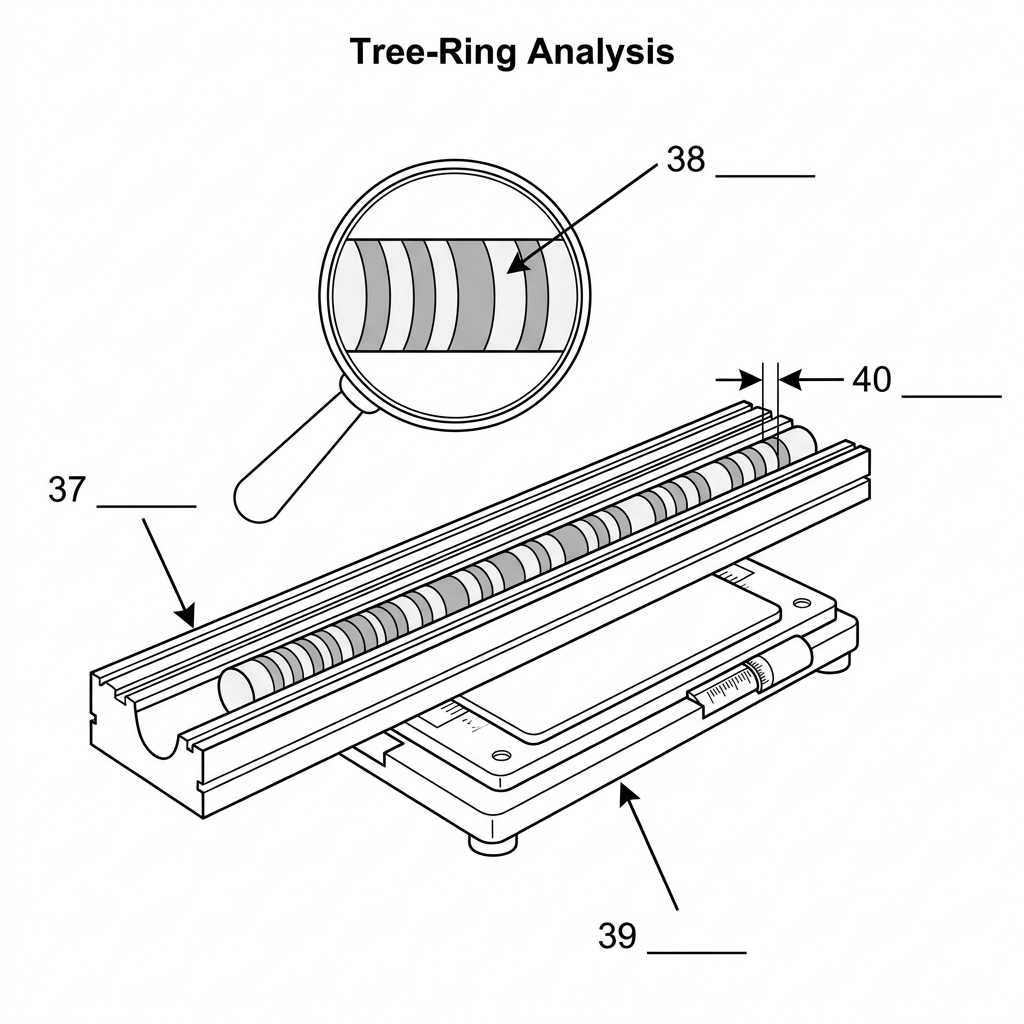
37. grooved
Show answer 37
wooden mounts or wooden mount or mounts
Show answer 38
earlywood
39. sliding
Show answer 39
stage micrometer or micrometer
40. exact
Show answer 40
dimensions or dimension
Passage 6
Canopy Biology: Discovering the Treetop Ecosystems
A
For centuries, the rainforest canopy was largely a mystery to science, frequently referred to in biological literature as the 'last biotic frontier'. Because the canopy intercepts up to ninety percent of the sunlight that strikes the forest, it acts as the primary site of photosynthesis and drives the energy dynamics of the entire ecosystem. Early naturalists and botanists could only study this vibrant, high-altitude environment by examining fallen branches after storms or by felling entire trees. This latter approach was a destructive practice that ruined the very habitat they wished to observe and offered only a chaotic, displaced view of canopy life. The dense lower foliage, towering unbranched trunks, and perilous heights made the treetops almost entirely inaccessible to systematic human observation. Yet, scientists suspected that the canopy held a vast amount of the planet's terrestrial biodiversity, prompting a relentless quest for better, non-destructive access methods.
B
The first major breakthrough in canopy access occurred with the adoption of the single-rope technique (SRT). Originally developed by spelunkers for downward cave exploration, SRT was adapted by pioneering biologists in the late 1970s to climb tall trees safely. Researchers use a crossbow or catapult to shoot a lightweight fishing line over a sturdy upper branch, which is then used to haul up a strong climbing rope. By ascending this fixed rope using mechanical friction devices, researchers could reach the canopy without driving metal spikes into the tree trunks, a practice that leaves trees vulnerable to infection. This non-destructive method is highly adaptable and remains widely used by field biologists today. However, its primary drawback is that researchers are suspended from a rope in mid-air. This precarious position limits their mobility, causes significant physical fatigue, and severely restricts the amount of heavy measurement equipment they can carry into the branches.
C
To overcome the physical limitations and narrow scope of rope climbing, scientists and engineers began constructing canopy walkways. These elaborate networks of suspension bridges and observation platforms are permanently attached to the trunks and large branches of emergent trees. Modern walkways are designed with adjustable steel cables that accommodate the natural growth and swaying of the trees without causing structural damage. Walkways allow for continuous, comfortable observation and permit non-climbing experts—such as meteorologists, entomologists, and even students—to work safely in the treetops. Despite their considerable convenience and safety, walkways are inevitably confined to a fixed location. Scientists can only study the immediate area accessible from the bridges, which may not adequately represent the immense diversity of the wider forest ecosystem.
D
In the 1980s, an inventive and visually striking solution called the canopy raft, or 'radeau des cimes', was introduced by a team of French researchers. This large, lightweight hexagonal platform is constructed of durable netting stretched over inflatable PVC tubes. A dirigible, or hot-air blimp, is used to fly the raft over the forest and lower it directly onto the top of the canopy. Because the raft's weight is distributed evenly across a large surface area, it rests lightly on the outer layer of the forest without breaking the fragile upper branches. This enables researchers to walk safely across the very top foliage, a zone where sunlight is most intense and where a disproportionate number of flowers and insects are found. While it provides unparalleled access to the uppermost canopy, the raft is highly dependent on favorable weather conditions and requires an expensive, logistically complex blimp for its placement and periodic relocation.
E
For long-term, highly intensive study of a specific forest plot, the construction crane has proven to be the ultimate access tool. By erecting a towering industrial crane in the middle of a forest, researchers gain three-dimensional movement through a massive cylindrical volume of space. The crane's gondola can be lowered with pinpoint accuracy to almost any leaf, branch, or trunk within the reach of its jib. This provides a highly stable platform, allowing scientists to take exact micro-climate readings, measure photosynthesis rates, and monitor individual leaves or insect colonies over multiple seasons. The major disadvantages of this method are that cranes are virtually immovable once installed, and they are extremely expensive to transport, assemble, and maintain in remote tropical jungles.
F
The deployment of these diverse access methods has fundamentally revolutionized our understanding of forest ecology. The canopy is no longer viewed merely as a structural extension of the trees, but as a complex micro-environment in its own right. Researchers have discovered that dead leaves, dust, and organic matter get trapped in the forks of branches and decompose, forming nutrient-rich arboreal soil high above the ground. This specialized soil supports a vast array of epiphytes—plants such as orchids and bromeliads that grow on other plants rather than rooting in the forest floor. The stable yet isolated conditions in the treetops foster complex interactions between plants, insects, and animals that are rarely observed below. Ultimately, these treetop discoveries have confirmed that the canopy plays a critical role in the global ecological balance and harbors a massive portion of the world's terrestrial biodiversity.
Questions 27-30
Do the following statements agree with the views of the writer in Reading Passage 3?
YES if the statement agrees with the claims of the writer
NO if the statement contradicts the claims of the writer
not given if it is impossible to say what the writer thinks about this
- Early naturalists avoided cutting down trees out of concern for the environment.
- The single-rope technique was initially invented for use in rainforests.
- Modern canopy walkways are designed to adjust as the trees grow.
- The canopy raft can only be used during specific times of the year.
Show answers
1. Early naturalists avoided cutting down trees out of concern for the environment. — NO
2. The single-rope technique was initially invented for use in rainforests. — NO
3. Modern canopy walkways are designed to adjust as the trees grow. — YES
4. The canopy raft can only be used during specific times of the year. — NOT GIVEN
Questions 31-35
Classify the following statements as referring to the access methods below.
A. Single-rope technique
B Canopy walkways
C Canopy raft
D Construction crane
- It enables scientists to safely explore the uppermost foliage where sunlight is strongest.
- It offers a stable platform for monitoring the same leaves over a long period.
- It prevents the need to drive metal spikes into the trunks of trees.
- It allows people without specialized climbing skills to conduct research in the trees.
- It relies on a crossbow or catapult to position the initial equipment.
Show answers
1. It enables scientists to safely explore the uppermost foliage where sunlight is strongest. — C. Canopy raft
2. It offers a stable platform for monitoring the same leaves over a long period. — D. Construction crane
3. It prevents the need to drive metal spikes into the trunks of trees. — A. Single-rope technique
4. It allows people without specialized climbing skills to conduct research in the trees. — B. Canopy walkways
5. It relies on a crossbow or catapult to position the initial equipment. — A. Single-rope technique
Questions 36-40
Complete the summary below.
Choose no more than two words from the passage for each answer.
The Impact of Canopy Research
The use of new access methods has completely changed our perspective on forest ecology. Scientists now recognize the canopy as a distinct _______ (36) with unique characteristics. They have found that decaying organic matter accumulates in the branches to create _______ (37), which provides a rooting medium for plants high above the ground. These plants, collectively known as _______ (38), thrive without touching the forest floor. The unique conditions in the canopy promote intricate _______ (39) among various species. These findings have demonstrated that the treetops contain a significant amount of the planet's _______ (40).
Show answers
36. micro-environment
37. arboreal soil
38. epiphytes
39. interactions
40. biodiversity
Passage 7
Preserving the Plant Kingdom: Herbarium Practices
A. The herbarium—a library of dried and pressed plant specimens—remains a cornerstone of botanical research. While modern science has introduced advanced molecular techniques, the fundamental practices of collecting and preserving plants have changed surprisingly little since they were popularized in the 16th century. A well-maintained herbarium serves multiple purposes: taxonomists rely on these collections to identify new species and study morphological variations, while ecologists use them to track shifts in flowering times and plant distribution over decades or centuries. However, the needs of these two disciplines can sometimes conflict. Taxonomists often prefer extensive series of a single plant group from various regions to understand species boundaries, whereas ecologists might prioritize a broad but shallow sampling of all flora within a specific ecosystem to gauge biodiversity.
B. To build a comprehensive collection, botanists employ systematic field collecting methods. The most crucial tool is the plant press. When a specimen is selected, it must include all parts necessary for identification—typically leaves, stems, flowers, and fruits, as well as roots for smaller herbaceous plants. In the field, the plant is carefully arranged inside a folded sheet of newsprint, which is then sandwiched between corrugated cardboard ventilators and absorbent blotters. This stack is bound tightly with straps. The arrangement of the plant at this stage is critical, as it will be permanently fixed in this position once dry. Botanists must also record detailed field notes, including the plant's exact location, elevation, surrounding habitat, and any transient characteristics like scent or flower color that will fade upon drying.
C. Once collected, the specimens undergo a rigorous drying process to prevent fungal growth and decay. In humid environments, such as tropical rainforests, air drying is insufficient, and artificial heat must be applied. Field researchers often construct a portable drying apparatus. This typically involves placing the loaded plant press over a low heat source. A protective skirt or canvas is draped around the press to channel the warm air upward through the corrugated cardboard ventilators. As the warm air rises, it draws moisture out of the plant tissue, exiting through the top of the press. This continuous airflow is essential to dry the specimens rapidly without cooking them, which would destroy cellular structures and alter their natural colors.
D. Following the drying phase, specimens are transported to the herbarium for mounting and cataloging. Each dried plant is carefully attached to a sheet of archival, acid-free paper. Mounting techniques vary, but the most common method involves gluing the specimen to the paper and reinforcing heavier stems with narrow strips of linen tape. The original field notes are transcribed onto a formal herbarium label, which is affixed to the bottom right corner of the sheet. It is vital that the mounting process is reversible, as future researchers may need to detach a flower or leaf for detailed microscopic examination.
E. In the modern era, herbaria face the ongoing challenge of preservation, primarily against insects like the herbarium beetle, which can decimate a collection. Historically, chemical fumigants like mercuric chloride were widely used, but these have been largely abandoned due to their toxicity to humans. Today, most institutions employ freezing as a primary pest control method. Incoming specimens are sealed in plastic and frozen at -20°C for several days to kill any pests or eggs. Furthermore, the digitization of herbaria has revolutionized access. High-resolution imaging and DNA extraction from decades-old leaves allow researchers worldwide to study specimens without physically handling the delicate originals.
Questions 27-30
Do the following statements agree with the information given in Reading Passage 3?
In boxes 27-30 on your answer sheet, write:
- TRUE if the statement agrees with the information
- FALSE if the statement contradicts the information
- not given if there is no information on this
- Taxonomists and ecologists generally require the same type of specimen collections.
- The earliest herbaria were established by medical practitioners.
- The shape of the specimen is permanently established during the initial pressing in the field.
- Chemical fumigants are still widely used by modern herbaria to control insects.
Show answers
1. Taxonomists and ecologists generally require the same type of specimen collections. — FALSE
2. The earliest herbaria were established by medical practitioners. — NOT GIVEN
3. The shape of the specimen is permanently established during the initial pressing in the field. — TRUE
4. Chemical fumigants are still widely used by modern herbaria to control insects. — FALSE
Questions 31-36
Classify the following statements as referring to A, B, C, or D.
Write the correct letter, A, B, C, or D, in boxes 31-36 on your answer sheet.
- A. Field collecting
- B. Heat drying
- C. Mounting
- D. Pest control
- It involves using strips of material to secure the plant.
- It requires recording characteristics that will eventually disappear.
- It utilizes cold temperatures to protect the collection.
- It relies on airflow to remove moisture rapidly.
- It ensures that the procedure can be undone if necessary.
- It includes gathering the underground parts of certain plants.
Show answers
1. It involves using strips of material to secure the plant. — C
2. It requires recording characteristics that will eventually disappear. — A
3. It utilizes cold temperatures to protect the collection. — D
4. It relies on airflow to remove moisture rapidly. — B
5. It ensures that the procedure can be undone if necessary. — C
6. It includes gathering the underground parts of certain plants. — A
Questions 37-40
Label the diagram below.
Choose no more than two words from the passage for each answer.
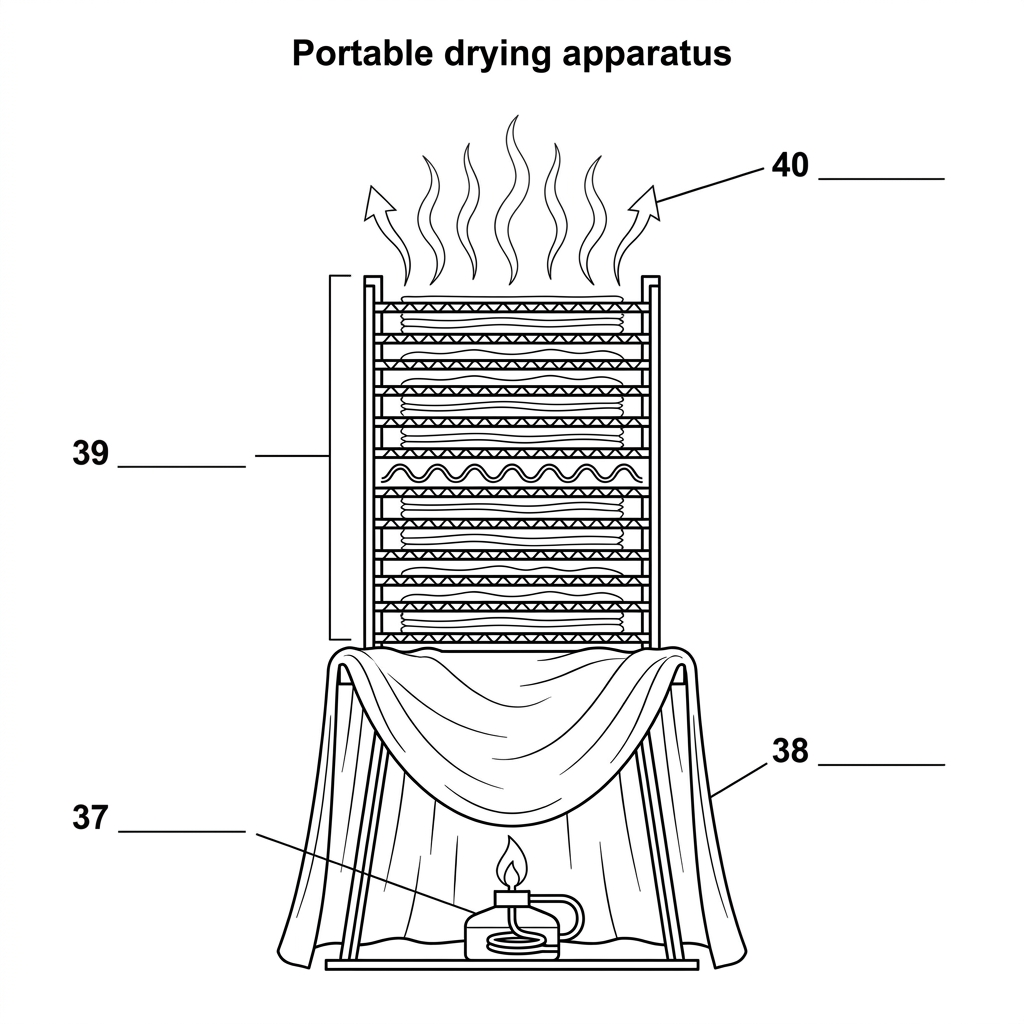
37. low
Show answer 37
heat source
Show answer 38
protective skirt or canvas
39. corrugated
Show answer 39
cardboard ventilators
Show answer 40
moisture
Passage 8
Sampling the Deep: Techniques in Benthic Exploration
A. For centuries, the deep ocean floor, or benthic zone, remained entirely inaccessible to scientists. While terrestrial biologists could simply walk into a forest to collect specimens, marine researchers faced thousands of meters of crushing water pressure and total darkness. Today, understanding deep-sea ecosystems is considered critical for climate and biodiversity studies, yet collecting accurate samples remains a formidable engineering challenge. Unlike a net dragged through the water column to catch swimming fish, benthic sampling requires devices that can effectively scoop, punch, or gently pluck sediments and organisms from a seabed that cannot even be seen from the surface.
B. The most traditional and widely used tools for benthic collection are grab samplers, such as the Van Veen grab. Lowered on a heavy cable, this device consists of two hinged clamshell buckets locked open. When the sampler strikes the ocean floor, the tension on the cable is released, triggering the buckets to snap shut and securely scoop up a precise surface area of mud and bottom-dwelling organisms. While grab samplers are inexpensive, reliable, and excellent for quantitative surveys of surface fauna, they have a notable drawback. The bow wave created as the heavy metal device plummets toward the bottom often blows away the highly delicate, topmost 'flocculent' layer of sediment, potentially losing fragile microscopic organisms before the jaws even close.
C. When researchers need to penetrate deeper into the seabed to capture deep-burrowing infauna or to study historical climate conditions, they utilize corers. A gravity corer is essentially a heavy metal tube dropped vertically into the mud. For deeper penetration, scientists use a piston corer. This sophisticated device utilizes an internal mechanism—a tightly fitted piston—that moves upward as the tube enters the sediment. This action creates a vacuum effect, minimizing internal friction and preventing the mud from compacting. Piston corers can extract continuous sediment profiles dozens of meters long, allowing geologists to read the historical environmental records trapped in the stratigraphy of the deep ocean mud.
D. For highly targeted or delicate collection, scientists increasingly rely on Remotely Operated Vehicles (ROVs). Controlled via a tether from the surface vessel, these robotic submarines provide high-definition visual feeds, allowing researchers to observe the ecosystem intact. ROVs are equipped with robotic manipulator arms that can deploy 'push cores'—small plastic tubes gently pressed into specific sediment features by the robot's mechanical hands. Furthermore, the robotic arms can carefully collect extremely fragile specimens, such as glass sponges, which would be completely destroyed by the violent impact of a traditional grab sampler. The primary limitation of ROVs is their exorbitant operating cost, which restricts their use to well-funded expeditions.
E. Upon retrieval, processing the sediment on deck must commence immediately. Benthic organisms are adapted to near-freezing temperatures and extreme pressure; bringing them to the warm surface can cause rapid biological degradation and physical barotrauma. First, the sediment core is carefully extruded from its plastic liner and sliced into distinct horizontal layers. The mud from each layer is then washed gently through a fine-mesh sieve to separate the benthic organisms from the surrounding silt. Once isolated, the specimens are transferred into glass vials and fixed in a chemical preservative, usually formalin or ethanol. However, if the specimens are intended for later genetic analysis, chemical fixation is avoided; instead, they are immediately placed into a deep freezer to prevent DNA degradation. Finally, meticulous record-keeping is essential, so every vial is labeled with the precise GPS coordinates of the sampling site.
F. Looking ahead, the future of benthic sampling may involve leaving the sea floor largely undisturbed. Environmental DNA (eDNA) analysis is a rapidly advancing technique where researchers simply sample the seawater hovering just above the ocean floor. By filtering and sequencing the shed genetic material floating in the water, scientists can identify the diverse array of species inhabiting the area below. Although eDNA cannot provide physical specimens for physiological study, it offers a non-destructive sampling method that may revolutionize our ability to map deep-sea biodiversity on a global scale.
Questions 27-31
Reading Passage 3 has six paragraphs, A-F.
Which paragraph contains the following information?
Choose the correct letter, A-F, for questions 27-31.
- A mention of the physical damage caused to specimens when brought to the surface
- An explanation of how geological history can be extracted from mud
- A sampling method that avoids taking any physical sediment from the ocean floor
- The accidental loss of the uppermost sediment layer during collection
- The ability to visually select and harvest specific fragile targets
Show answers
1. A mention of the physical damage caused to specimens when brought to the surface — E
2. An explanation of how geological history can be extracted from mud — C
3. A sampling method that avoids taking any physical sediment from the ocean floor — F
4. The accidental loss of the uppermost sediment layer during collection — B
5. The ability to visually select and harvest specific fragile targets — D
Questions 32-35
Classify the following descriptions as referring to:
A Grab samplers
B Piston corers
C ROVs
Choose the correct letter, A, B, or C, for questions 32-35.
- Utilizes an internal mechanism to minimize friction during sediment penetration.
- Operates using hinged buckets that close upon impact with the seabed.
- Provides researchers with real-time video feeds during the collection process.
- Is considered a cost-effective and reliable method for quantitative surveys of surface fauna.
Show answers
1. Utilizes an internal mechanism to minimize friction during sediment penetration. — B
2. Operates using hinged buckets that close upon impact with the seabed. — A
3. Provides researchers with real-time video feeds during the collection process. — C
4. Is considered a cost-effective and reliable method for quantitative surveys of surface fauna. — A
Questions 36-40
Complete the flow-chart below.
Choose no more than two words from the passage for each answer.
- The sediment core is extruded and carefully sliced into distinct _______ (36)
- To separate the mud from the organisms, the material is gently washed through a _______ (37)
- Standard preservation: Specimens are fixed using formalin or _______ (38)
- Genetic preservation: To prevent DNA degradation, specimens are placed directly in a _______ (39)
- For accurate record-keeping, every vial is labeled with the precise _______ (40)
Show answers
36. horizontal layers
37. fine-mesh sieve
38. ethanol
39. deep freezer
40. GPS coordinates
Passage 9
Decoding the Past: The Science of Ice Core Extraction
A. In the sprawling, desolate expanses of Antarctica and Greenland, scientists are engaged in a monumental effort to collect some of the most fragile and valuable biological and atmospheric specimens on Earth: ice cores. As snow falls in these polar regions, it rarely melts. Instead, it accumulates year after year, with the weight of new snow compressing the older layers beneath it. The snow first turns into a granular material known as firn. At depths of 50 to 150 meters, the pressure completely seals the pore spaces between the ice grains, transforming the firn into solid ice. During this transition, the ice traps dust, atmospheric chemicals, and, crucially, tiny bubbles of ambient air. These microscopic pockets serve as perfect time capsules, preserving the exact composition of the atmosphere at the time the snow fell.
B. Extracting these specimens requires sophisticated logistics and engineering. Establishing a drilling camp in some of the most extreme environments on Earth means operating in temperatures that frequently plummet below -40°C, usually limiting the working season to a few short summer months. Early drilling efforts in the mid-20th century relied on thermal drills, which essentially melted their way down through the ice sheets. While effective at shallow depths, these were exceedingly slow and energy-intensive. Today, electromechanical drills are the preferred technology for deep-ice extraction. These advanced hollow drills cut a cylindrical core, typically one to three meters long, pulling it to the surface before being lowered again. Using this method, researchers can cut through miles of ice to reach the bedrock, accessing ice that fell as snow hundreds of thousands of years ago.
C. Once brought to the surface, the physical handling of ice cores presents a major challenge. Deep ice is under immense pressure from the miles of ice above it. When a core is brought to the surface, the sudden release of this environmental pressure causes the ice to physically expand, a phenomenon known as relaxation. This expansion creates a highly fragile section of the core—usually extracted from depths between 500 and 1,500 meters—known as the brittle zone. Ice from this zone is under such internal stress that it can easily shatter into useless shards if handled roughly. To mitigate this, scientists must store these specific cores in temporary, sub-surface field trenches for up to a year, allowing for gradual relaxation before they can be safely transported to laboratories at ultra-low temperatures.
D. In the laboratory, the ice is meticulously sliced and distributed for various types of analysis. One of the primary investigations involves isotope analysis. By measuring the ratio of Oxygen-18 to Oxygen-16 in the frozen water molecules, researchers can determine the ambient temperature at the time the snow fell, rather than calculating historical precipitation levels. Because Oxygen-18 is heavier than Oxygen-16, it requires more energy to evaporate from the ocean and condenses more quickly as the air cools. Consequently, a higher proportion of Oxygen-18 in an ice core layer indicates a warmer historic climate, while a lower proportion points to an ice age.
E. Equally important to paleoclimatology is the extraction of trapped gases. The tiny bubbles encased in the solid ice are actual samples of the ancient atmosphere. To access these without contaminating them with modern ambient air, scientists must process the ice inside a highly controlled vacuum chamber. The ice is either mechanically crushed or carefully melted within this vacuum. This precise process releases the ancient air, allowing mass spectrometers to measure past concentrations of greenhouse gases, such as carbon dioxide and methane, with astonishing accuracy.
F. However, the data extracted from the ice and trapped gases is only useful if it can be accurately dated. Establishing a reliable chronological timeline for these cores is crucial. For the upper, younger sections of the ice, scientists can often count annual layers visually, much like a dendrochronologist counts tree rings. Seasonal variations in dust accumulation and snow crystal size create visible bands. For deeper, older ice where the sheer weight has compressed annual layers to the thickness of a piece of paper, researchers rely on absolute time markers. Layers of volcanic ash, known as tephra, are particularly useful. When a known historical eruption is chemically identified in the ice, it provides an exact date that anchors the chronology of the surrounding core.
G. The broader impact of this specimen collection is profound. Deep ice cores, such as those extracted from the EPICA Dome C project in Antarctica, have provided a continuous, unbroken record of Earth’s climate stretching back over 800,000 years. This unparalleled dataset allows scientists to clearly map the natural historical cycles of ice ages and intervening warm periods. More importantly, by comparing these ancient, natural atmospheric rhythms with data from the last century, ice cores provide the most definitive evidence we have of the unprecedented rate and scale of modern climate shifts.
Questions 27-31
Do the following statements agree with the information given in Reading Passage 3?
In boxes 27-31 on your answer sheet, write:
YES if the statement agrees with the claims of the writer
NO if the statement contradicts the claims of the writer
not given if it is impossible to say what the writer thinks about this
- The transformation of snow into solid ice happens more quickly in Antarctica than in Greenland.
- Electromechanical drills are currently the preferred tool for reaching the deepest layers of ice.
- Ice cores become less fragile as they are brought up from deep high-pressure environments.
- The ratio of Oxygen-18 to Oxygen-16 is used to calculate the amount of precipitation in a given year.
- Volcanic ash layers in ice cores help scientists verify the exact age of specific sections.
Show answers
1. The transformation of snow into solid ice happens more quickly in Antarctica than in Greenland. — NOT GIVEN
2. Electromechanical drills are currently the preferred tool for reaching the deepest layers of ice. — YES
3. Ice cores become less fragile as they are brought up from deep high-pressure environments. — NO
4. The ratio of Oxygen-18 to Oxygen-16 is used to calculate the amount of precipitation in a given year. — NO
5. Volcanic ash layers in ice cores help scientists verify the exact age of specific sections. — YES
Questions 32-36
Reading Passage 3 has seven paragraphs, A-G.
Which paragraph contains the following information?
Write the correct letter, A-G, in boxes 32-36 on your answer sheet.
NB You may use any letter more than once.
- An explanation of how ancient atmosphere is released from the ice without contamination
- Reference to the physical changes ice undergoes immediately after being extracted
- A comparison of modern climate data with natural historical cycles
- The mechanism by which falling snow captures atmospheric evidence
- A method of establishing a chronological timeline using visual markers
Show answers
1. An explanation of how ancient atmosphere is released from the ice without contamination — E
2. Reference to the physical changes ice undergoes immediately after being extracted — C
3. A comparison of modern climate data with natural historical cycles — G
4. The mechanism by which falling snow captures atmospheric evidence — A
5. A method of establishing a chronological timeline using visual markers — F
Questions 37-40
Complete the summary below.
Choose no more than two words from the passage for each answer.
Write your answers in boxes 37-40 on your answer sheet.
The Handling and Analysis of Ice Cores
When ice cores are extracted from deep underground, they enter a state known as the _______ (37) due to a sudden decrease in pressure. To prevent the samples from shattering, researchers must allow them time for _______ (38) before they are shipped. Once in the laboratory, scientists examine the ice to uncover climate history. They measure the _______ (39) of oxygen isotopes to estimate past temperatures. Furthermore, they analyze tiny bubbles of _______ (40) trapped in the ice, releasing them by either melting or crushing the samples in a vacuum chamber.
Show answers
37. brittle zone
38. relaxation
39. ratio
40. ancient air
Passage 10
Sampling Airborne Pollen
Collecting airborne pollen can be as straightforward as leaving a coated slide on a windowsill, or as complex as deploying advanced mechanical devices to measure atmospheric concentrations over exact timeframes. The exact method chosen depends heavily on the primary objective of the research. For medical studies, particularly those monitoring allergies, the goal is to determine the daily or hourly concentration of specific, highly allergenic plant species. For long-term ecological or climate studies, the most crucial factor is obtaining a comprehensive profile of all pollen diversity present in a landscape. Unfortunately, these objectives are not always compatible. Medical researchers and ecologists rarely utilize identical pollen sampling techniques. The medical field often ignores obscure taxa in favour of widespread allergens, while ecologists require broad spectrums that may obscure specific daily peaks, reducing their utility for allergy forecasting.
To capture a comprehensive understanding of airborne pollen, researchers utilize several distinct methods. The most traditional is the use of gravimetric traps. This passive method involves placing a simple open container, often called a Tauber trap, on the ground or a low post. The trap relies entirely on gravity, collecting whatever pollen falls out of the air and settles into the liquid preservative at the bottom. Gravimetric traps are remarkably cheap to manufacture and maintain, making them ideal for deploying in large numbers across a wide area for year-long ecological surveys. However, they have a notable disadvantage: they are biased towards heavier particles, successfully capturing larger pollen grains while lighter grains are carried away by wind currents.
When precise temporal data is required, volumetric traps are the preferred tool. These devices actively suck in a measurable amount of air through an air intake orifice at a constant rate, mimicking human breathing. Inside the trap, the air stream accelerates and the suspended pollen grains are forced to impact onto a strip of sticky tape. This tape is typically mounted on a rotating drum that turns at a steady speed, usually completing one rotation every seven days. Because the drum rotates continuously, researchers can examine the tape to determine precise data on the exact time of day a particular pollen type was captured. Furthermore, a vacuum pump housed at the base of the unit ensures the airflow remains constant. Volumetric traps are essential for medical monitoring, though they require continuous power and regular maintenance.
In dense forests or rugged terrain where carrying mechanical equipment is impractical, researchers increasingly rely on natural traps. Certain species of mosses and lichens act as natural sponges, trapping ambient pollen in their complex structures over many years. Collecting these species by hand allows scientists to gather long-term pollen data without installing any artificial equipment. Back in the laboratory, the moss is subjected to a chemical wash to dissolve the organic matter, leaving only the resilient pollen shells behind. Thus, this method involves extracting samples directly from living organisms rather than man-made devices.
Finally, to understand the broader dynamics of atmospheric transport, scientists employ high-altitude sampling. This involves mounting specialized collection filters onto aircraft or meteorological weather balloons. High-altitude sampling is particularly useful for tracking the movement of pollen across vast distances, sometimes revealing that grains have travelled hundreds of kilometres from their source. While this method is highly specialized and costly, it provides invaluable data on how wind currents distribute genetic material across continents.
Questions 27-30
Do the following statements agree with the information given in Reading Passage 3?
In boxes 27-30 on your answer sheet, write:
- TRUE if the statement agrees with the information
- FALSE if the statement contradicts the information
- not given if there is no information on this
- Medical researchers and ecologists generally utilize identical pollen sampling techniques.
- Medical monitoring primarily focuses on pollen from highly allergenic plant species.
- Climate change has increased the volume of airborne pollen in urban areas.
- Gravimetric traps are expensive to manufacture and maintain.
Show answers
1. Medical researchers and ecologists generally utilize identical pollen sampling techniques. — FALSE
2. Medical monitoring primarily focuses on pollen from highly allergenic plant species. — TRUE
3. Climate change has increased the volume of airborne pollen in urban areas. — NOT GIVEN
4. Gravimetric traps are expensive to manufacture and maintain. — FALSE
Questions 31-36
Classify the following statements as referring to:
- A gravimetric traps
- B volumetric traps
- C natural traps
- D high-altitude sampling
Write the correct letter, A, B, C, or D, in boxes 31-36 on your answer sheet. You may use any letter more than once.
- Sucks in a measurable amount of air.
- Relies on gravity for pollen collection.
- Useful for tracking the movement of pollen across vast distances.
- Captures heavier particles more easily than lighter ones.
- Provides precise data on the time of day pollen was captured.
- Involves extracting samples from living organisms.
Show answers
1. Sucks in a measurable amount of air. — B
2. Relies on gravity for pollen collection. — A
3. Useful for tracking the movement of pollen across vast distances. — D
4. Captures heavier particles more easily than lighter ones. — A
5. Provides precise data on the time of day pollen was captured. — B
6. Involves extracting samples from living organisms. — C
Questions 37-40
Label the diagram below.
Choose no more than two words from the passage for each answer.
Write your answers in boxes 37-40 on your answer sheet.
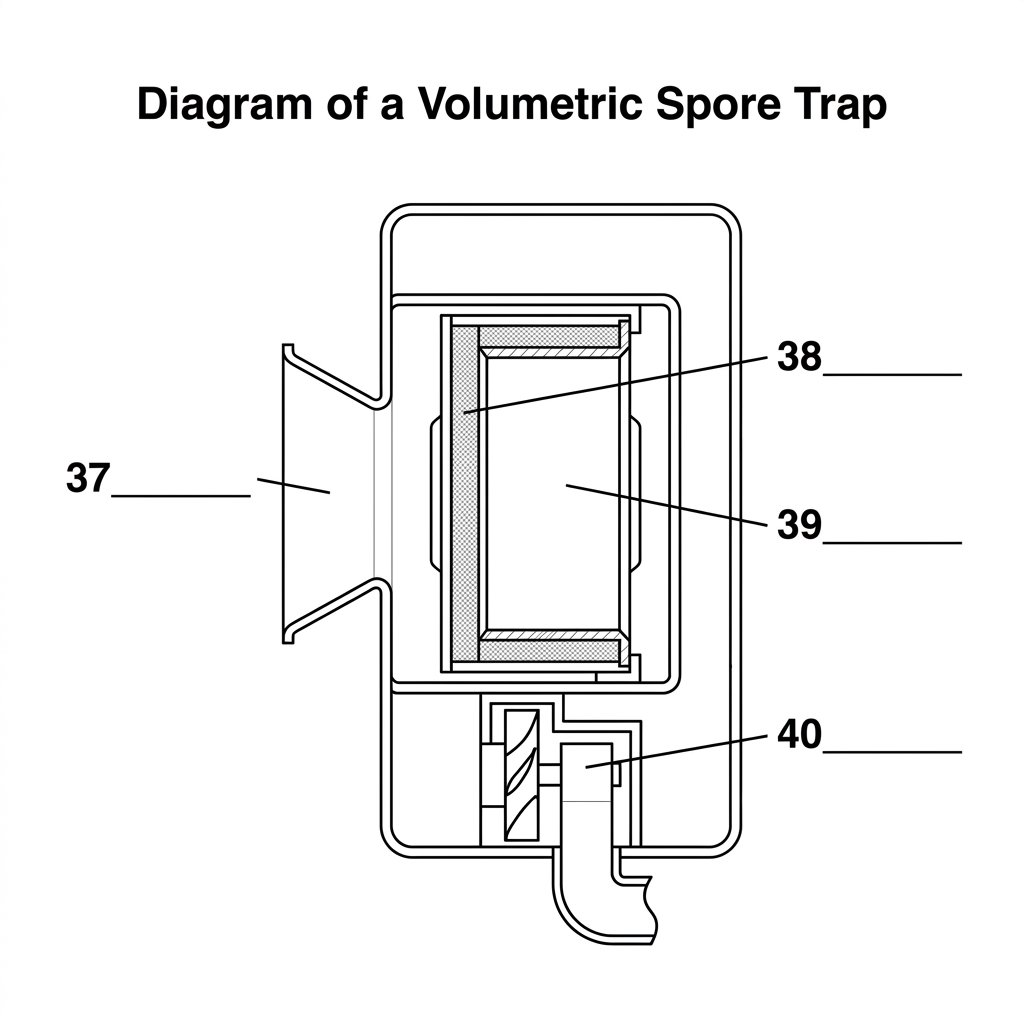
37. ____________
Show answer 37
air intake
38. a strip of ____________
Show answer 38
sticky tape
39. a ____________
Show answer 39
rotating drum
40. ____________
Show answer 40
vacuum pump
Passage 11
Collecting Fungal Specimens
Collecting fungal specimens can be as straightforward as plucking a single mushroom during a walk, or as complex as conducting a systematic survey of all the macrofungi in a specific forest ecosystem to estimate their relative abundance. The exact techniques employed depend heavily on the ultimate goal of the collection. For taxonomic research, or classification, an unbroken series of specimens representing different stages of development—from the immature "button" stage to the fully mature fruiting body—is highly desirable. This allows scientists to map the morphological variations within a single species. For ecological studies, however, the primary objective is to sample and identify as many different species as possible within a given area. Unfortunately, these two approaches frequently clash. A taxonomist might ignore dozens of common species to focus exclusively on finding different life stages of a rare group currently under review, whereas an ecologist might collect only one or two mature representatives of each species, thereby diminishing the sample's utility for detailed taxonomic scrutiny.
To secure as comprehensive a range of fungal species as possible, a variety of collection strategies must be applied. The most common is manual extraction. This involves carefully searching habitats where fungi typically thrive: on the forest floor, emerging from decaying logs, attached to the bark of living trees, or even growing on the remains of other fungi. When collecting a specimen by hand, it is imperative to extract the entire fruiting body, including the base that is hidden underground. Many species possess a distinctive cup-like structure at the base, known as a volva, which is a critical identifying feature. Therefore, mycologists use a sturdy trowel or a specialized foraging knife to dig beneath the specimen rather than simply snapping it off at the surface. Once extracted, the fungi should never be placed in sealed plastic bags, as the trapped moisture accelerates decay and turns the specimens to mush. Instead, they are typically wrapped in wax paper or placed in rigid, compartmentalized baskets to allow for airflow and prevent crushing.
Another essential method utilized in the field or immediately after returning to the laboratory is the creation of a spore print. Spores are the microscopic reproductive units of fungi, and the color of a fungal spore deposit is one of the most vital clues for identification. To obtain a spore print, the cap of the mushroom is severed from the stem and placed gill-side down on a piece of paper or glass. A cup or bowl is usually placed over the cap to prevent air currents from blowing the microscopic spores away. Over a period of several hours, the spores drop onto the surface, revealing colors that range from pure white and pale pink to rust-brown and jet black.
Because fleshy fungi decay rapidly, long-term preservation requires immediate drying. Unlike plant specimens, which are pressed flat, mushrooms must be dried in their three-dimensional form to retain their structural features. This is typically achieved using a field dehydrator. The specimens are placed on wire mesh screens over a gentle, continuous heat source. The temperature must be carefully regulated; if it is too low, the fungi will rot before they dry, but if it is too high, they will cook, ruining the cellular structures required for future microscopic examination. Once thoroughly desiccated, the lightweight, brittle specimens are transferred to specialized archival envelopes known as herbarium packets, along with detailed labels noting the date, location, and habitat of the collection.
Finally, mycologists are increasingly interested in the vast network of fungi that never produce visible mushrooms. These subterranean networks, consisting of thread-like structures called mycelium, can be sampled using a soil corer. A soil corer is a hollow, cylindrical metal tube that is driven into the earth to extract a vertical profile of the soil. By taking these soil plugs back to the laboratory, researchers can extract environmental DNA (eDNA) to identify the presence of fungal species that would otherwise remain completely hidden from a surface-level survey. This technique has revolutionized ecological mapping, though it requires expensive laboratory equipment to sequence the genetic material retrieved.
Questions 27-30
Do the following statements agree with the information given in Reading Passage 3?
In boxes 27-30 on your answer sheet, write:
- TRUE if the statement agrees with the information
- FALSE if the statement contradicts the information
- not given if there is no information on this
- Taxonomic research requires comparing different developmental stages of a single fungal species.
- Ecologists usually discover new species of fungi faster than taxonomists.
- Storing collected mushrooms in plastic bags is recommended to keep them moist.
- A single fungal specimen is usually sufficient for both ecological mapping and detailed classification.
Show answers
1. Taxonomic research requires comparing different developmental stages of a single fungal species. — TRUE
2. Ecologists usually discover new species of fungi faster than taxonomists. — NOT GIVEN
3. Storing collected mushrooms in plastic bags is recommended to keep them moist. — FALSE
4. A single fungal specimen is usually sufficient for both ecological mapping and detailed classification. — FALSE
Questions 31-36
Classify the following statements as referring to
- A manual extraction
- B creating a spore print
- C using a field dehydrator
- D using a soil corer
Write the correct letter, A, B, C, or D, in boxes 31-36 on your answer sheet.
- Prevents the natural decay process by removing moisture.
- Is used to collect fungi that lack visible fruiting bodies.
- Requires protecting the specimen from wind or air currents.
- Involves digging below the surface to ensure the base is intact.
- Relies on capturing microscopic reproductive units on a flat surface.
- Requires a steady source of low-level heat.
Show answers
1. Prevents the natural decay process by removing moisture. — C
2. Is used to collect fungi that lack visible fruiting bodies. — D
3. Requires protecting the specimen from wind or air currents. — B
4. Involves digging below the surface to ensure the base is intact. — A
5. Relies on capturing microscopic reproductive units on a flat surface. — B
6. Requires a steady source of low-level heat. — C
Questions 37-40
Label the diagram below.
Choose no more than two words from the passage for each answer.
Write your answers in boxes 37-40 on your answer sheet.
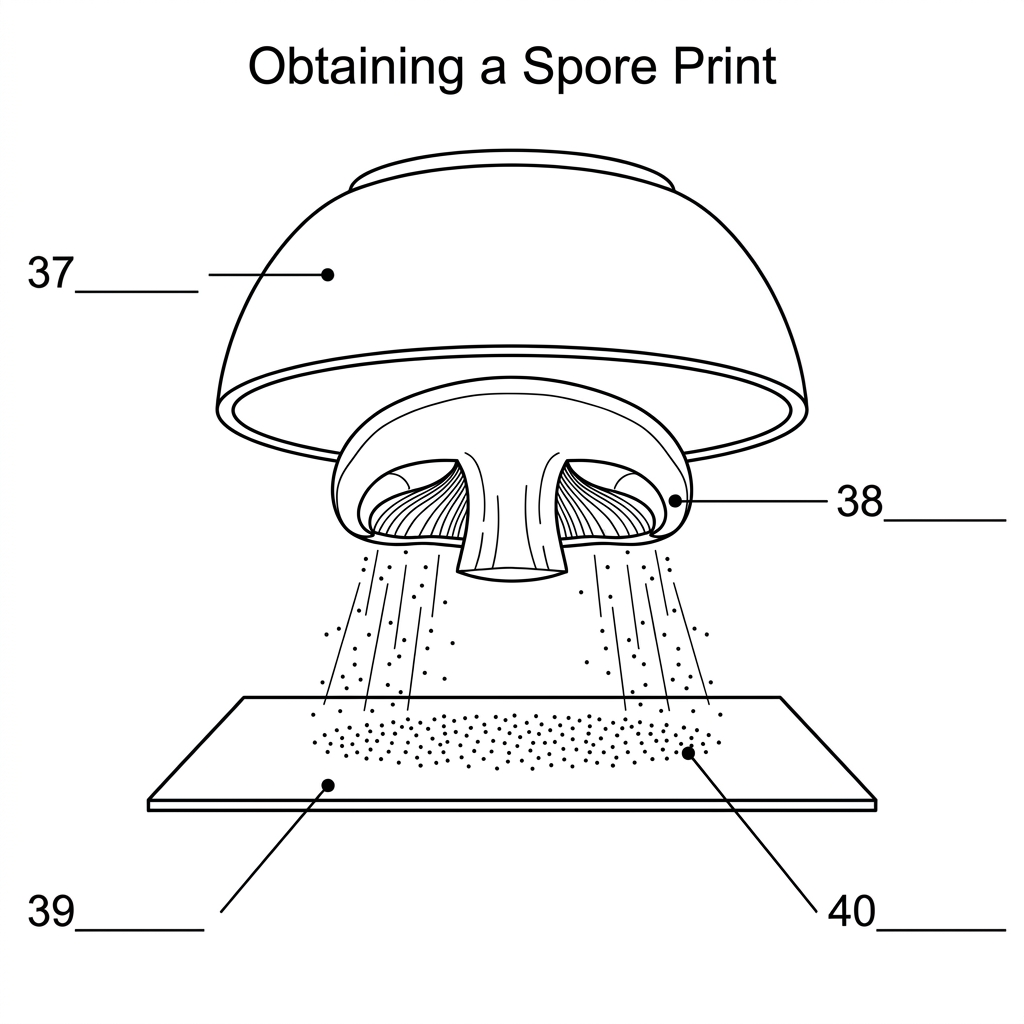
37. a cup or
Show answer 37
bowl
38. the severed
Show answer 38
cap
39. piece of
Show answer 39
paper or glass
40. falling
Show answer 40
spores
Passage 12
Preserving the World's Botanical Heritage: The Evolution of Seed Banks
A. The imperative to safeguard plant diversity has transformed seed storage from a rudimentary agricultural practice into a highly sophisticated scientific discipline. Today's seed banks are complex facilities designed to act as an insurance policy against the escalating loss of natural habitats and shifting climatic conditions. While early human societies stored seeds primarily to ensure the next season's crop yield, contemporary ex-situ conservation facilities focus on preserving the vast genetic heritage of wild plant species, ensuring that even if a species vanishes from the wild, its genetic blueprint remains secure.
B. The historical transition from basic seed saving to global conservation networks culminated in the creation of comprehensive repositories. The most famous of these is the Svalbard Global Seed Vault, situated deep within an icy mountain in Norway. Contrary to the misconception that it operates as a primary distribution centre, Svalbard functions strictly as a backup for regional and national seed banks. It provides a fail-safe against localized disasters, ensuring that unique botanical collections are not permanently lost due to institutional failures or environmental catastrophes.
C. The scientific rigor of seed banking begins in the field. Field collectors face the daunting task of capturing the maximum genetic variation of a species. To achieve this, protocols strictly dictate that gathering seeds from a single concentrated area is insufficient and highly discouraged. Instead, botanists must sample from multiple geographically distinct populations. This broad sampling strategy guarantees a wide genetic base, which is vital because a diverse gene pool equips future plant populations with the resilience needed to adapt to emerging diseases and changing environmental stressors.
D. Once harvested, seeds are transported to the bank where they undergo a meticulous preparation phase. The initial step involves cleaning the material to remove any dirt, stems, and debris that might harbour fungi or pests. Following this, the seeds are subjected to a carefully controlled drying process. It is critical that researchers reduce the moisture of the seeds to a highly specific level—usually around 5 percent. Only after this exact moisture content is achieved can the seeds be sealed in airtight containers and placed in freezers at a standard temperature of -20°C, a state in which they can theoretically survive for centuries.
E. However, depositing seeds in a freezer is not the end of the procedure. Seeds are living entities, and their ability to sprout diminishes over time. Consequently, banks must conduct regular germination tests to assess whether the stored batches are still alive. A sample of seeds is periodically withdrawn and placed in incubators to see how many successfully sprout. If the proportion of viable seeds drops below a strict threshold—typically 85 percent—the accession must undergo regeneration. This involves taking the remaining viable seeds, growing them into mature plants in a greenhouse, and harvesting a fresh batch of seeds to replace the aging stock.
F. Despite the efficiency of this standard process, certain plant species present profound challenges. These species produce what botanists call 'recalcitrant' seeds. Unlike orthodox seeds, recalcitrant seeds—which include those of many tropical trees like mangoes and rubber plants—cannot survive the standard drying and freezing methods. If their water content is reduced, they simply die. Preserving these species requires entirely different approaches, such as maintaining living collections in botanical gardens or utilizing advanced cryopreservation techniques where extracted plant embryos are snap-frozen in liquid nitrogen.
G. Looking ahead, the role of seed banks is expanding beyond mere preservation. The ultimate objective of maintaining these vast botanical archives is not solely to act as a static museum of plant life, but to actively support the restoration of degraded ecosystems. By integrating their genetic resources with active habitat restoration projects, seed banks aim to reintroduce resilient plant populations into the wild, actively repairing the environmental damage of the past century and ensuring a dynamic future for the world's flora.
Questions 27-31
Do the following statements agree with the information given in Reading Passage 3?
In boxes 27-31 on your answer sheet, select:
TRUE if the statement agrees with the information
FALSE if the statement contradicts the information
not given if there is no information on this
Select TRUE, FALSE, or not given for each of the following statements.
- Contemporary ex-situ conservation facilities are primarily focused on improving agricultural crop yields.
- To ensure resilience, field collectors must obtain seeds from several different populations.
- The Svalbard Global Seed Vault was built to replace regional seed banks.
- Seeds must be dried to a precise moisture level before they are frozen.
- The exact cost of running a global seed bank is currently unknown.
Show answers
1. Contemporary ex-situ conservation facilities are primarily focused on improving agricultural crop yields. — FALSE
2. To ensure resilience, field collectors must obtain seeds from several different populations. — TRUE
3. The Svalbard Global Seed Vault was built to replace regional seed banks. — FALSE
4. Seeds must be dried to a precise moisture level before they are frozen. — TRUE
5. The exact cost of running a global seed bank is currently unknown. — NOT GIVEN
Questions 32-36
Reading Passage 3 has seven paragraphs, A-G.
Which paragraph contains the following information?
Choose the correct letter, A-G.
- a description of the procedure for assessing whether stored seeds are still alive
- an explanation of why certain plant species cannot be preserved using standard seed bank methods
- reference to the ultimate objective of maintaining stored plant material
- the contrast between historical agricultural seed retention and contemporary conservation aims
- the reason why gathering seeds requires a broad sampling strategy
Show answers
1. a description of the procedure for assessing whether stored seeds are still alive — E
2. an explanation of why certain plant species cannot be preserved using standard seed bank methods — F
3. reference to the ultimate objective of maintaining stored plant material — G
4. the contrast between historical agricultural seed retention and contemporary conservation aims — A
5. the reason why gathering seeds requires a broad sampling strategy — C
Questions 37-40
Complete the flowchart below.
Choose one word only from the passage for each answer.
The Standard Seed Banking Process
- Collection: Gather seeds from various _______ (37) to ensure a wide genetic base.
- Preparation: Remove debris and reduce the _______ (38) of the seeds to around 5 percent.
- Storage: Keep seeds sealed in freezers at severely low temperatures.
- Monitoring: Conduct regular _______ (39) tests on stored batches.
- Renewal: Grow plants to produce new seeds if viability falls below a strict _______ (40).
Show answers
37. populations
38. moisture
39. germination
40. threshold
Passage 13
Surveying Lepidoptera: Methods for Butterflies and Moths
Lepidoptera, the insect order comprising butterflies and moths, represents one of the most diverse groups of organisms on the planet. Documenting these species requires carefully designed sampling strategies, which generally vary depending on the ultimate goal of the researcher. For taxonomists aiming to describe new species, map genetic lineages, or study minute morphological variations, obtaining pristine adult specimens is paramount. Conversely, conservation ecologists are primarily focused on measuring species richness and tracking population dynamics over time, meaning they must capture and identify a broad representative sample of the local fauna, often releasing the individuals unharmed after recording them. These divergent goals dictate that the choice of collection method is critical, as no single technique can effectively sample an entire Lepidopteran community across different habitats and flight times.
For day-flying butterflies and some diurnal moths, active capture using a sweep net remains the most fundamental and widely practiced technique. Collectors actively search habitats where Lepidoptera are foraging or seeking mates, such as forest edges, sunlit hilltops, and floral patches. Once successfully netted, the insect is typically transferred into a small, semi-transparent glassine envelope. This restricts the insect's movement and prevents it from shedding the delicate microscopic scales on its wings, which form distinctive patterns essential for accurate species identification. Because sweep netting relies entirely on the collector’s visual acuity, reflexes, and physical agility, it is inherently selective and strongly biased towards capturing larger, more conspicuous species, while smaller dull-colored species may inadvertently be overlooked.
To survey nocturnal moths, researchers overwhelmingly rely on light traps. Most moths use celestial light sources, such as the moon, for navigation. Artificial ultraviolet (UV) lights disrupt this navigational mechanism, drawing the insects toward the light source in a spiraling flight path. A standard light trap consists of a UV bulb suspended above a smooth funnel that leads into a large collection bucket containing a mild anesthetic or preservative. Alternatively, researchers may simply hang a large white sheet behind the light bulb and manually collect the resting moths in individual vials. While light traps are exceptionally efficient for rapidly assessing local moth abundance and diversity, their effectiveness is heavily influenced by ambient weather conditions; catch volumes drop significantly on cold, windy, or brightly moonlit nights when the artificial light has less drawing power.
However, not all Lepidoptera are attracted to light or floral nectar. A significant proportion of tropical forest butterflies, as well as certain specialized moth families, feed exclusively on decomposing organic matter such as rotting fruit, tree sap, or animal waste. To capture these elusive canopy and understory species, researchers employ bait traps. A typical bait trap consists of a large mesh cylinder suspended from a tree branch. A small, flat platform at the base of the cylinder holds a pungent mixture, often comprising fermented bananas, brown sugar, and stale beer. Insects are drawn to the odor and enter the trap through a narrow gap left between the platform and the bottom of the mesh cylinder to feed. When startled or finished feeding, their natural instinct is to fly directly upward, permanently trapping them in the closed upper section of the mesh cylinder until the researcher lowers the trap to extract them.
Finally, for taxonomists requiring absolutely flawless specimens and ecologists studying complex ecological interactions, rearing Lepidoptera from their immature stages is highly rewarding. This process involves meticulously searching specific host plants for microscopic eggs or feeding caterpillars (larvae) and bringing them into a controlled laboratory environment. The larvae are provided with a continuous supply of fresh leaves until they pupate and eventually emerge as adults. Although this method is incredibly time-consuming, requires extensive botanical knowledge, and yields far fewer individuals than automated trapping, it guarantees completely undamaged adult wings. Furthermore, rearing provides vital scientific data regarding exactly which plant species a caterpillar relies on for survival. It also frequently reveals the presence of parasitoid wasps or flies that emerge from the pupa instead of the expected butterfly, offering researchers crucial insights into the natural mortality rates and food-web dynamics of the local population.
Questions 27-30
Do the following statements agree with the information given in Reading Passage 3?
In boxes 27-30 on your answer sheet, write:
TRUE if the statement agrees with the information
FALSE if the statement contradicts the information
not given if there is no information on this
Select TRUE, FALSE, or not given for the following statements.
- Taxonomists and ecologists generally prefer identical sampling methods for capturing Lepidoptera.
- Sweep netting tends to result in the capture of the most easily visible species.
- The fundamental design of light traps has changed significantly over the last fifty years.
- Catch rates in light traps remain consistent regardless of environmental factors.
Show answers
1. Taxonomists and ecologists generally prefer identical sampling methods for capturing Lepidoptera. — FALSE
2. Sweep netting tends to result in the capture of the most easily visible species. — TRUE
3. The fundamental design of light traps has changed significantly over the last fifty years. — NOT GIVEN
4. Catch rates in light traps remain consistent regardless of environmental factors. — FALSE
Questions 31-35
Classify the following statements as referring to:
A Sweep netting
B Light trapping
C Bait trapping
D Rearing from larvae
Write the correct letter, A, B, C, or D, in boxes 31-35 on your answer sheet.
- It takes advantage of the insects' natural instinct to fly upwards when disturbed.
- It provides researchers with information about food-web relationships and natural predators.
- It requires the collector to be physically active in specific habitats.
- It is an effective way to obtain specimens with absolutely no physical damage.
- It relies on a visual disruption to draw insects into a collection area.
Show answers
1. It takes advantage of the insects' natural instinct to fly upwards when disturbed. — C
2. It provides researchers with information about food-web relationships and natural predators. — D
3. It requires the collector to be physically active in specific habitats. — A
4. It is an effective way to obtain specimens with absolutely no physical damage. — D
5. It relies on a visual disruption to draw insects into a collection area. — B
Questions 36-40
Label the diagram below.
Choose no more than two words from the passage for each answer.
Write your answers in boxes 36-40 on your answer sheet.
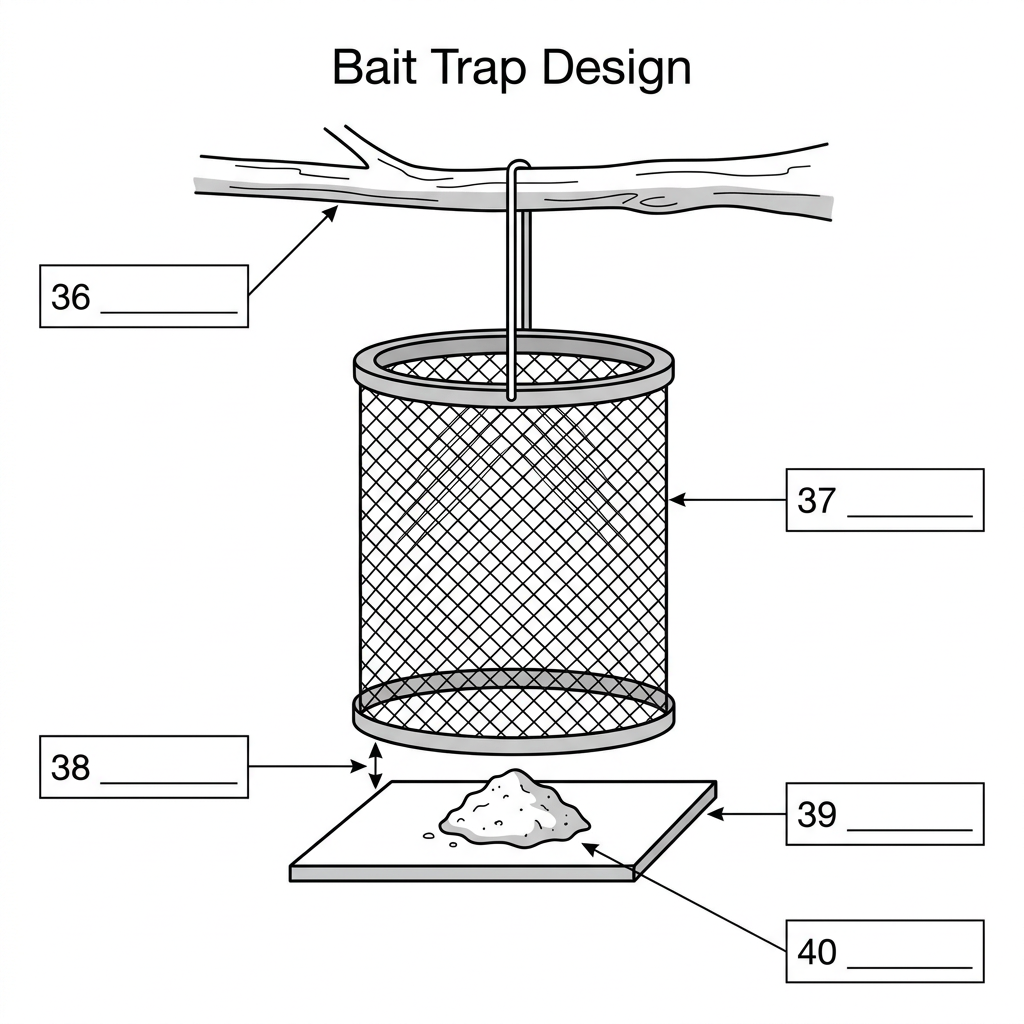
36. Trap is suspended from a _______________
Show answer 36
tree branch or branch
37. Closed upper section is a _______________
Show answer 37
mesh cylinder or cylinder
38. Insects enter through a _______________
Show answer 38
narrow gap or gap
39. Bait rests on a small, flat _______________
Show answer 39
platform
40. Trap contains a _______________ such as fermented bananas
Show answer 40
pungent mixture or mixture
Passage 14
Unlocking the Canopy: Methodologies in Epiphyte Research
For centuries, the forest canopy was widely regarded by biologists as the 'last biotic frontier.' While ground-level flora and fauna were meticulously catalogued, the upper reaches of the world's forests remained largely inaccessible. This was particularly problematic for the study of epiphytes—plants such as certain orchids, ferns, and mosses that grow upon other plants rather than rooting in the soil. Epiphytes contribute enormously to forest biodiversity and play crucial roles in nutrient cycling. However, early naturalists were severely restricted in their methodology. Unable to safely ascend the giant emergent trees of the tropics, they often resorted to felling trees entirely. This approach was not only ecologically destructive but also fundamentally flawed for ecological studies, as the violent impact with the ground destroyed the delicate spatial arrangement of the specimens, making it impossible to map their natural vertical distribution.
The transition toward non-destructive sampling began in earnest in the late 1970s and 1980s with the adaptation of single-rope techniques (SRT). Originally developed to facilitate the exploration of deep underground cave systems, SRT was modified by pioneering canopy researchers to allow safe ascent into the treetops. Using specialized harnesses and mechanical ascenders, a researcher could access the canopy without damaging the host tree. While SRT remains a foundational skill for epiphyte researchers today, it possesses distinct limitations. A climber is essentially restricted to the single vertical transect defined by their rope. Lateral movement between branches or across the canopy is highly arduous and often dangerous, meaning the collection of specimens is intensely localized.
To overcome the limitations of vertical immobility, the 1990s saw the introduction of canopy cranes. Setting up a canopy crane is a major logistical undertaking that involves several distinct phases. First, researchers must conduct a precise topographic survey of the chosen site to ensure the ground can safely support the massive concrete base required. Next, the tower sections are transported, sometimes via helicopter, and assembled to surpass the forest's maximum height. Once the central tower is erected, a rotating horizontal jib is attached to the top. Finally, a specialized gondola—a basket capable of carrying scientists and their equipment—is suspended from this jib, allowing it to be carefully lowered into the foliage. Cranes permit continuous, long-term data collection and physiological monitoring of epiphytes within a specific, localized forest sector. However, they are entirely immobile once built, restricting research to a single hectare or two of forest.
For broader spatial coverage, researchers developed canopy rafts, the most famous being the French Radeau des Cimes. This revolutionary device is a large, lightweight inflatable platform that is transported and gently dropped onto the very top of the forest canopy by a dirigible (airship). The raft serves as a basecamp, facilitating extended, multi-person habitation directly on the upper forest surface. It is exceptionally well-suited for collecting sun-loving epiphytes that thrive in the extreme upper canopy. Yet, the sheer logistical scale, immense cost, and strict dependence on perfect weather conditions make the canopy raft an exceedingly rare tool in the modern biologist's arsenal.
In recent years, the explosion of remote sensing technology and unmanned aerial vehicles (UAVs), commonly known as drones, has offered a low-cost, highly mobile alternative to traditional access methods. Drones equipped with miniature robotic arms or remote cutting tools can now snip branches and retrieve epiphyte samples from virtually any location in the forest. When paired with LiDAR, drones can precisely map the 3D structure of the canopy before sampling. Nevertheless, while drones are excellent for targeted retrieval, they lack the nuanced observational capacity of a trained human taxonomist. A drone cannot easily ascertain the subtle microclimatic variations—such as moisture gradients or the presence of symbiotic fungi—that a human researcher instinctively notes while physically present in the canopy.
Ultimately, the choice of methodology profoundly influences the data collected. A taxonomist seeking a single intact specimen of a newly discovered orchid may find a drone perfectly adequate. Conversely, an ecologist attempting to understand how epiphyte communities respond to varying light and humidity levels requires the precise, repetitive access granted by a canopy crane. The future of epiphyte research does not lie in the supremacy of one method over another, but in the intelligent synthesis of multiple access technologies.
Questions 27-31
Do the following statements agree with the views of the writer in Reading Passage 3?
In boxes 27-31 on your answer sheet, write:
YES if the statement agrees with the views of the writer
NO if the statement contradicts the views of the writer
not given if it is impossible to say what the writer thinks about this
- Early naturalists felled trees partly because they lacked non-destructive climbing technology.
- Single-rope techniques (SRT) were originally developed specifically for botanical canopy research.
- Canopy cranes are currently the most widespread method used by tropical ecologists.
- The Radeau des Cimes is considered an optimal tool for studying epiphytes in the lower, shaded levels of the forest.
- Drones are currently unable to fully replicate the observational skills of a human researcher.
Show answers
1. Early naturalists felled trees partly because they lacked non-destructive climbing technology. — YES
2. Single-rope techniques (SRT) were originally developed specifically for botanical canopy research. — NO
3. Canopy cranes are currently the most widespread method used by tropical ecologists. — NOT GIVEN
4. The Radeau des Cimes is considered an optimal tool for studying epiphytes in the lower, shaded levels of the forest. — NO
5. Drones are currently unable to fully replicate the observational skills of a human researcher. — YES
Questions 32-36
Classify the following statements as referring to:
A Single-rope techniques (SRT)
B Canopy cranes
C Canopy rafts
D Drones
- Offers a low-cost, highly mobile alternative to traditional access methods.
- Permits continuous, long-term data collection within a specific, localized forest sector.
- Limits the researcher's movement primarily to a single vertical path.
- Facilitates extended, multi-person habitation directly on the upper forest surface.
- Was historically adapted from a recreational underground exploration method.
Show answers
1. Offers a low-cost, highly mobile alternative to traditional access methods. — D
2. Permits continuous, long-term data collection within a specific, localized forest sector. — B
3. Limits the researcher's movement primarily to a single vertical path. — A
4. Facilitates extended, multi-person habitation directly on the upper forest surface. — C
5. Was historically adapted from a recreational underground exploration method. — A
Questions 37-40
Complete the flow chart below.
Choose no more than two words from the passage for each answer.
Write your answers in boxes 37-40 on your answer sheet.
- Phase 1: Perform a _______ (37) of the chosen site to guarantee stability for the base.
- Phase 2: Transport materials and assemble the tower to exceed the forest's _______ (38).
- Phase 3: Attach a _______ (39) to the top of the completed tower structure.
- Phase 4: Suspend a _______ (40) from the structure to carry scientists safely into the foliage.
Show answers
37. topographic survey
38. maximum height
39. horizontal jib
40. gondola
Passage 15
Sampling the Forest Canopy
For decades, the high canopy of the world's tropical rainforests was considered the 'last biotic frontier'. Biologists knew that a vast proportion of the world's insect species resided in the treetops, but accessing this zone to collect specimens was prohibitively difficult. Today, entomologists use a variety of specialized methods to survey canopy-dwelling insects, particularly Lepidoptera (butterflies and moths) and Coleoptera (beetles). The exact method deployed depends on whether the researcher’s primary goal is ecological—requiring a broad, representative sample of species abundance and diversity—or taxonomic, which usually demands high-quality, perfectly intact specimens for classification.
One of the earliest and most widespread techniques for mass collection is canopy fogging. This involves using a modified machine to blow a warm, insecticidal mist high into the branches. As the mist settles, insects are incapacitated and plummet onto a series of large, funnel-like collection trays suspended near the forest floor. Fogging is exceptionally efficient for capturing vast numbers of beetles and ants, providing invaluable data on relative abundance. However, it is less effective for active fliers like butterflies, which often detect the disturbance and escape the mist. Furthermore, the specimens collected are frequently damaged by their fall or become hopelessly entangled with leaves and debris, reducing their value to taxonomists.
To target nocturnal insects, researchers rely heavily on light trapping. By suspending ultraviolet (UV) lights in the canopy over a white sheet, entomologists can attract thousands of night-flying insects, particularly moths. While highly effective, light trapping has distinct limitations. It produces a biased sample, as it only captures positively phototactic species (those attracted to light). Additionally, the method is highly weather-dependent. Heavy rain can destroy delicate wings, and bright natural moonlight competes directly with the artificial UV source, significantly reducing the catch on nights with a full moon.
During the day, bait trapping is a favored method for sampling fruit-feeding butterfly guilds. Bait trapping relies on suspending a mesh cylinder in the canopy using a long suspension line tossed over a sturdy branch. The bottom of the trap consists of a flat base plate, upon which researchers place a mixture of fermenting fruit or decaying matter. The scent drifts through the canopy, drawing in specific groups of butterflies that enter beneath the cylinder and instinctively fly upward into the mesh when trying to leave, becoming trapped. One significant advantage of bait traps is that they are passive and can be left in the tree canopy for several days with minimal maintenance. The primary disadvantage is their narrow focus; they yield a biased catch consisting only of species attracted to those specific smells.
Finally, the advent of canopy walkways and construction cranes has allowed for direct aerial netting. Researchers stationed high in the trees can manually catch insects using fine mesh nets. While this method is time-consuming and yields far fewer individuals than fogging, it ensures high-quality, intact specimens crucial for taxonomy. More importantly, direct netting from walkways allows researchers to record behavioral observations, noting exactly which flowers an insect visits or how it interacts with predators—data completely lost in passive trapping methods.
Ultimately, no single sampling technique can provide a comprehensive picture of canopy entomology. A rigorous ecological survey must synthesize data from fogging, light traps, baits, and direct netting to offset the inherent biases of each method.
Questions 27-30
Do the following statements agree with the information given in Reading Passage 3?
In boxes 27-30 on your answer sheet, write:
- TRUE if the statement agrees with the information
- FALSE if the statement contradicts the information
- not given if there is no information on this
Select TRUE, FALSE, or not given for each statement.
- Canopy fogging is highly effective for capturing fast-flying insects like butterflies.
- Light traps are more successful during nights with a full moon.
- Bait traps are generally left in the canopy for several days.
- Canopy walkways have significantly reduced the overall cost of entomological research.
Show answers
1. Canopy fogging is highly effective for capturing fast-flying insects like butterflies. — FALSE
2. Light traps are more successful during nights with a full moon. — FALSE
3. Bait traps are generally left in the canopy for several days. — TRUE
4. Canopy walkways have significantly reduced the overall cost of entomological research. — NOT GIVEN
Questions 31-36
Classify the following statements as referring to:
Write the correct letter, A, B, C or D, in boxes 31-36 on your answer sheet.
- A Canopy fogging
- B Light trapping
- C Bait trapping
- D Aerial netting
Match each statement to the correct sampling method.
- Enables researchers to watch how insects behave.
- Results in a biased catch of only species attracted to specific smells.
- Uses a chemical mist to dislodge insects.
- Its effectiveness can be reduced by natural atmospheric conditions.
- Collects large quantities of specimens that fall onto trays.
- Yields the highest physical quality of individual specimens for classification.
Show answers
1. Enables researchers to watch how insects behave. — D
2. Results in a biased catch of only species attracted to specific smells. — C
3. Uses a chemical mist to dislodge insects. — A
4. Its effectiveness can be reduced by natural atmospheric conditions. — B
5. Collects large quantities of specimens that fall onto trays. — A
6. Yields the highest physical quality of individual specimens for classification. — D
Questions 37-40
Label the diagram below.
Choose no more than two words from the passage for each answer.
Write your answers in boxes 37-40 on your answer sheet.
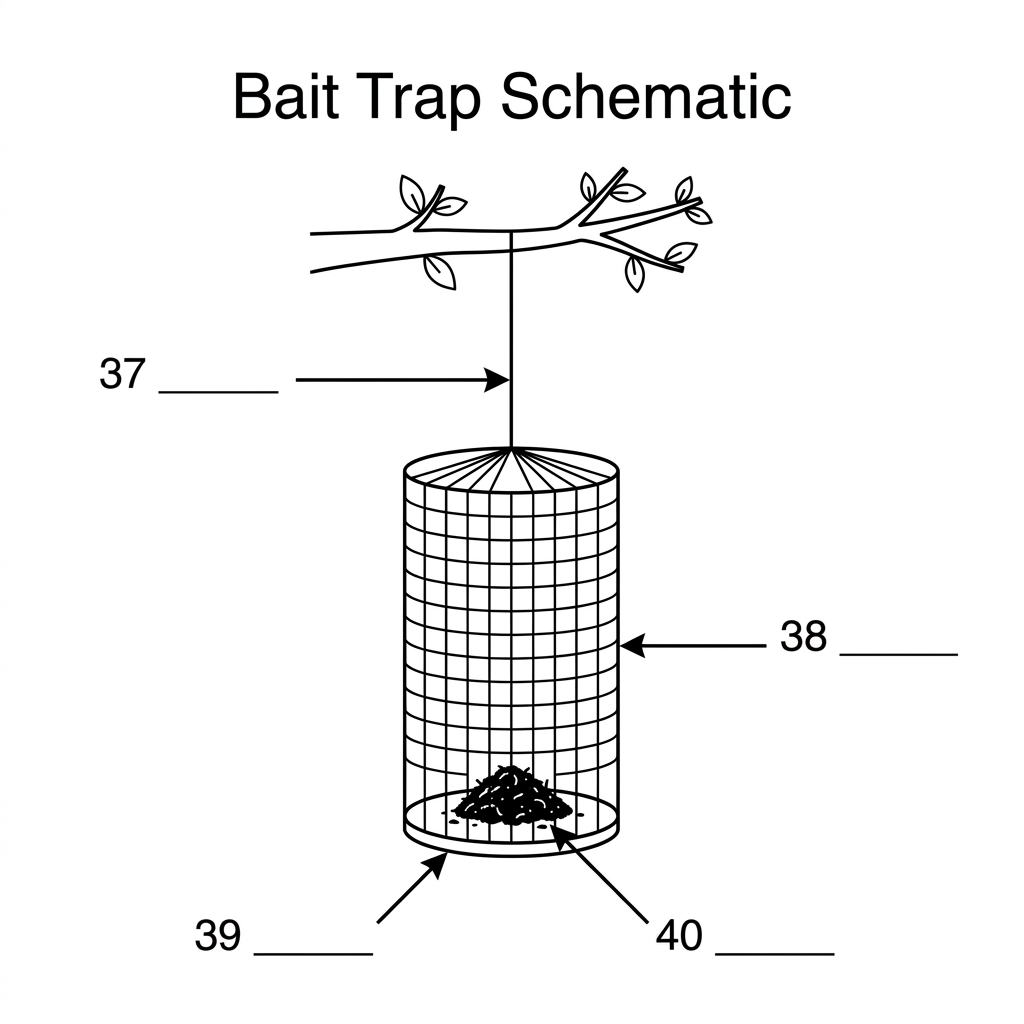
37. The cord attaching the trap to the tree branch: ________
Show answer 37
suspension line
38. The exterior netting: ________
Show answer 38
mesh cylinder
39. The flat bottom surface: ________
Show answer 39
base plate
40. The targeted attractant inside: ________
Show answer 40
fermenting fruit
Passage 16
Preserving the Green Record: Botanical Specimen Collection
Collecting plant specimens can range from simply pressing a single leaf in a book to conducting exhaustive botanical surveys of an entire forest to estimate species diversity. The exact methodology depends heavily on the final purpose of the collection. For taxonomy and classification, long series of specimens from a single population, which contain all morphological features including roots, stems, leaves, flowers, and fruits, are highly desirable. This allows taxonomists to determine the natural variation within a species. For ecological studies, however, the primary goal is often to obtain identifiable samples of as many different species present in a habitat as possible. Unfortunately, these dual purposes are not always compatible. Taxonomists may overlook broader biodiversity in favor of an intensive study of one specific plant family, whereas ecologists often collect only a fragmented or limited specimen of each species, which reduces their utility for rigorous taxonomic investigation.
To capture a comprehensive botanical record, several preservation methods are employed. The most universal is field pressing. This involves placing a newly collected plant between layers of absorbent paper. To facilitate airflow, sheets of corrugated cardboard are interspersed between the paper layers. The entire stack is then strapped tightly. Applying immediate pressure is crucial as it prevents the plant tissues from shriveling and halts fungal decay. In particularly humid environments, such as tropical rainforests, natural air drying is insufficient. Here, field researchers employ portable heaters or drying cabinets to force warm air through the corrugations, rapidly drawing moisture out of the specimens.
While pressing is effective for flat leaves and delicate petals, it is highly destructive to the three-dimensional morphology of certain plant structures. Fleshy fruits, tubers, and the intricate blooms of specific orchids are therefore subjected to liquid preservation. These specimens are submerged in vials or jars containing a solution of alcohol, water, and occasionally glycerol. While this method successfully retains the physical shape and structural integrity of the plant, it acts as a solvent for natural pigments. Consequently, liquid-preserved specimens quickly lose their original color, turning a uniform translucent white or brown.
In modern botanical research, the extraction of genetic material has become as important as physical morphology. Traditional pressing and liquid preservation methods, however, can degrade cellular structures. To address this, collectors now routinely perform silica drying in the field. Small leaf fragments are torn from the live plant and immediately buried in tubes of silica gel. This rapidly desiccates the tissue, preserving the DNA intact for future molecular sequencing.
Once dried and transported back to a facility, the specimens undergo archival mounting. The pressed plants are carefully glued or sewn onto sheets of acid-free, archival paper. A detailed label containing the collector's field notes—such as the GPS coordinates, altitude, surrounding vegetation, and the plant's original color—is affixed to the bottom corner. These mounted specimens form the core of a herbarium, serving as a permanent library of planetary plant life.
Questions 27-30
Do the following statements agree with the information given in Reading Passage 3?
In boxes 27-30 on your answer sheet, choose:
TRUE if the statement agrees with the information
FALSE if the statement contradicts the information
not given if there is no information on this
- Taxonomists prefer to collect plants from multiple different populations simultaneously.
- Ecologists regularly collect plant specimens without including the roots.
- Field pressing is considered the most universally used method for preserving plants.
- Liquid preservation maintains the natural color of the plant specimen permanently.
Show answers
1. Taxonomists prefer to collect plants from multiple different populations simultaneously. — FALSE
2. Ecologists regularly collect plant specimens without including the roots. — NOT GIVEN
3. Field pressing is considered the most universally used method for preserving plants. — TRUE
4. Liquid preservation maintains the natural color of the plant specimen permanently. — FALSE
Questions 31-35
Classify the following statements as referring to:
A Field pressing
B Liquid preservation
C Silica drying
D Archival mounting
Write the correct letter, A, B, C, or D, in boxes 31-35 on your answer sheet.
- It results in the specimen losing its natural color.
- It involves attaching the specimen to acid-free materials.
- It relies on immediate desiccation to protect genetic material.
- It is the best way to maintain the three-dimensional shape of fleshy fruits.
- It utilizes pressure to stop plant tissues from shriveling.
Show answers
1. It results in the specimen losing its natural color. — B
2. It involves attaching the specimen to acid-free materials. — D
3. It relies on immediate desiccation to protect genetic material. — C
4. It is the best way to maintain the three-dimensional shape of fleshy fruits. — B
5. It utilizes pressure to stop plant tissues from shriveling. — A
Questions 36-40
Complete the flow-chart below.
Choose no more than two words from the passage for each answer.
- Plant is placed between layers of _______ (36).
- Sheets of _______ (37) are interspersed to allow air circulation.
- Immediate pressure is applied to prevent shriveling and _______ (38).
- In humid environments, _______ (39) are used to force warm air through the stack.
- The dried specimen is finally ready for _______ (40) at a facility.
Show answers
36. absorbent paper
37. corrugated cardboard
38. fungal decay
39. portable heaters or drying cabinets
40. archival mounting
Passage 17
Assessing Arboreal Insect Diversity: The Canopy Fogging Technique
For decades, entomologists seeking to understand forest biodiversity relied heavily on ground-level sampling. While logistically simple and requiring minimal specialized equipment, this method drastically underrepresents the true ecological richness of tropical environments, as the vast majority of insect species reside high above in the canopy layer. To reach this elusive zone, early researchers frequently resorted to tree felling. Cutting down a mature tree certainly allows scientists to thoroughly examine the foliage and capture wood-boring insects embedded deeply within the timber. However, it is fundamentally destructive, devastating the very habitat being studied, and the violent impact of the fall often dislodges or crushes many of the resident specimens.
The introduction of canopy fogging in the late 1970s revolutionized arboreal studies. By projecting a targeted mist of biodegradable insecticide into the tree crown, scientists can quickly gather immense quantities of free-living insects. The primary advantage of this technique is that it is non-destructive to the flora; it leaves the structural integrity of the forest canopy completely intact, allowing for repeated sampling of the same area over time.
The mechanics of a fogging operation are straightforward but require precise setup. The fogging machine, typically a modified thermal fogger, is hoisted into the lower branches using a pulley system. To ensure researcher safety and minimize disturbance, it is operated via a remote timer. When activated, a dense plume of the biodegradable insecticide is released. The mist is carried upwards into the highest branches by rising warm air. As the insects succumb to the vapor, they lose their grip and drop. They are then channeled into a series of large collecting trays that are suspended beneath the branches. At the narrow base of each tray is a sample bottle filled with alcohol, which serves to instantly preserve the specimens for later taxonomic identification.
Despite its immense value, canopy fogging is not without its limitations. It is highly weather-dependent; the technique demands perfectly windless conditions to prevent the insecticidal vapor from drifting away from the target tree. Consequently, fogging operations are almost exclusively conducted at dawn, before the sun heats the ground and creates disruptive thermal winds. Furthermore, while the mist is incredibly effective against free-foraging insects like ants and beetles, it cannot penetrate solid wood or thick plant tissues. As a result, wood-boring grubs and certain tightly adhering scale insects frequently remain unaffected and unrecorded by this method.
Nevertheless, fogging remains an indispensable tool. It has been instrumental in generating modern estimates of global biodiversity and has revealed the astonishing complexity of tropical food webs that function entirely independent of the forest ground level.
Questions 27-31
Do the following statements agree with the information given in Reading Passage 3?
In boxes 27-31 on your answer sheet, write:
- YES if the statement agrees with the claims of the writer
- NO if the statement contradicts the claims of the writer
- not given if it is impossible to say what the writer thinks about this
- Early researchers frequently destroyed trees to study canopy insects.
- Canopy fogging was originally adapted from an agricultural pest control method.
- Fogging allows researchers to capture every type of insect living in the target tree.
- Fogging operations must be carried out early in the morning due to weather constraints.
- The insecticide used in modern fogging operations causes long-term damage to the plant life.
Show answers
1. Early researchers frequently destroyed trees to study canopy insects. — YES
2. Canopy fogging was originally adapted from an agricultural pest control method. — NOT GIVEN
3. Fogging allows researchers to capture every type of insect living in the target tree. — NO
4. Fogging operations must be carried out early in the morning due to weather constraints. — YES
5. The insecticide used in modern fogging operations causes long-term damage to the plant life. — NO
Questions 32-35
Classify the following statements as referring to
- A Ground-level sampling
- B Tree felling
- C Canopy fogging
- It fails to accurately represent the true number of species in tropical habitats.
- It permits the collection of insects that live inside the trunk and branches.
- It allows researchers to conduct multiple surveys in the exact same location over a period of time.
- It results in the physical ruin of the environment being investigated.
Show answers
1. It fails to accurately represent the true number of species in tropical habitats. — A
2. It permits the collection of insects that live inside the trunk and branches. — B
3. It allows researchers to conduct multiple surveys in the exact same location over a period of time. — C
4. It results in the physical ruin of the environment being investigated. — B
Questions 36-40
Label the diagram below.
Choose no more than two words from the passage for each answer.
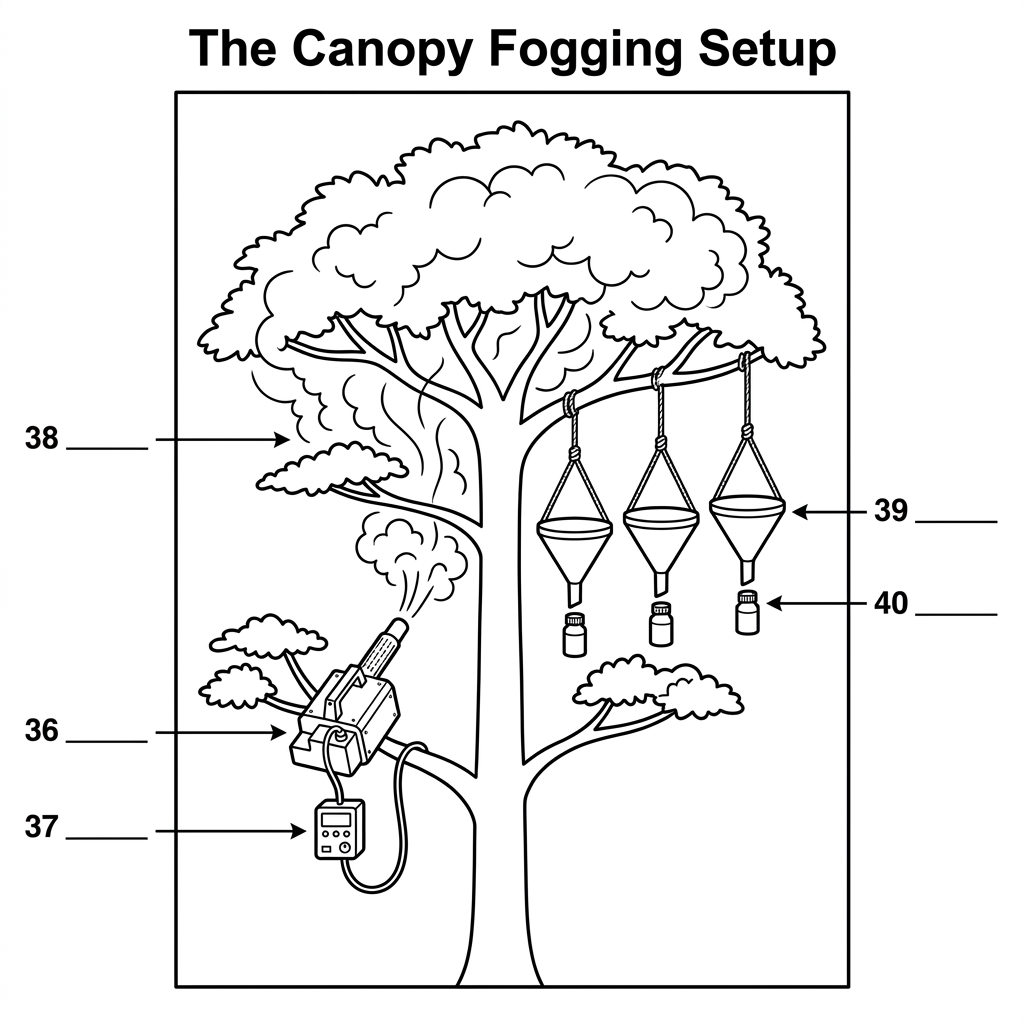
36. modified
Show answer 36
thermal fogger
37. operated by a
Show answer 37
remote timer
38. carried up by rising
Show answer 38
warm air
39. insects fall into large
Show answer 39
collecting trays
40. preserved in a ________ containing alcohol
Show answer 40
sample bottle
Passage 18
The Practice of Botanical Specimen Collection
Collecting botanical specimens is a fundamental practice in plant sciences, serving as the physical foundation for taxonomy, ecological mapping, and conservation efforts. The ultimate destination for these collections is a herbarium—a specialized biological library of dried, pressed plant material. However, the exact methodology varies depending on the collector’s primary objective. The dual needs of field researchers often diverge. Taxonomists require deep, exhaustive series from a single population to study minute morphological variations. Ecologists, on the other hand, prioritize broad biodiversity sweeps, seeking identifiable samples of as many different species as possible within a habitat. Bridging these distinct requirements demands a rigorous, standardized approach to fieldwork.
To be scientifically useful, a botanical specimen must be carefully selected to provide maximum diagnostic information. A common mistake made by novices is collecting only vegetative parts, such as leaves and stems. Because vegetative features can vary wildly depending on environmental conditions like sunlight and soil composition, it is rarely possible to accurately identify a plant species without its reproductive structures. Consequently, collectors must strive to gather specimens bearing flowers, fruits, or seeds. Alongside the physical sample, rigorous documentation is essential. Botanists utilize field notebooks and GPS devices to record the precise coordinates, altitude, surrounding habitat, and temporary characteristics like flower scent or color, which inevitably fade during preservation.
Different types of plants necessitate distinct collection approaches. For woody trees and shrubs, collectors take branch cuttings that represent the typical leaf arrangement and include reproductive organs. Conversely, herbaceous plants—those lacking a woody stem—should be collected in their entirety. Extracting the complete root system alongside the aerial parts is crucial, as it demonstrates the plant's overall growth habit and underground storage structures like bulbs or rhizomes. Succulents and fleshy plants, such as cacti, present a unique challenge. Their high water content makes them particularly susceptible to rotting during the preservation process. To prevent this, they often require thermal treatment, such as blanching in boiling water, or chemical treatment with alcohol to break down cellular tissues and stop water retention before pressing.
The standard method for preserving most plant material relies on the traditional plant press. The goal of pressing is to extract moisture rapidly while flattening the plant to prevent wrinkling and fungal growth. The specimen is carefully arranged inside a folded sheet of newspaper, which holds the plant in the desired morphological position. This newspaper is then sandwiched between layers of highly absorbent blotting paper, which draws out the moisture. To ensure adequate airflow through the press, sheets of corrugated cardboard are inserted between the blotting paper layers. Finally, the entire stack is clamped between two rigid wooden frames, and sturdy straps are tightened to apply consistent, heavy pressure. The press is usually placed in a drying cabinet where warm air circulates to accelerate desiccation.
Once fully dried, the specimen undergoes curation. It is mounted onto archival-quality, acid-free paper using specialized botanical glues or linen tape. A detailed label is affixed to the sheet containing the transcribed field notes. Before being integrated into the main herbarium collection, newly mounted specimens undergo one final, crucial step: they are typically frozen for several days. This process eliminates destructive pests, such as the herbarium beetle, which can easily decimate unprotected dried collections.
Beyond traditional taxonomy, modern technology has vastly expanded the utility of herbarium collections. Advances in genomic sequencing allow scientists to extract DNA from historical specimens collected centuries ago. Furthermore, these archives are proving invaluable for tracking the historical effects of climate change. By examining the dates on historical collection labels, researchers can track temporal shifts in flowering times, demonstrating how diverse plant populations are actively responding to global warming. Thus, the careful collection and preservation of specimens remains as critical today as it was during the botanical expeditions of the eighteenth century.
Questions 27-30
Do the following statements agree with the information given in Reading Passage 3?
In boxes 27-30 on your answer sheet, choose:
TRUE if the statement agrees with the information
FALSE if the statement contradicts the information
not given if there is no information on this
- A taxonomist and an ecologist share the exact same priorities when collecting plant specimens.
- It is usually possible to accurately identify a plant species using only its leaves and stems.
- Field notebooks used by botanists are traditionally made of waterproof paper.
- Herbarium specimens can be used to study the historical effects of climate change.
Show answers
1. A taxonomist and an ecologist share the exact same priorities when collecting plant specimens. — FALSE
2. It is usually possible to accurately identify a plant species using only its leaves and stems. — FALSE
3. Field notebooks used by botanists are traditionally made of waterproof paper. — NOT GIVEN
4. Herbarium specimens can be used to study the historical effects of climate change. — TRUE
Questions 31-35
Classify the following statements as referring to:
A Trees and shrubs
B Herbaceous plants
C Succulents
Write the correct letter, A, B, or C, in boxes 31-35 on your answer sheet.
- Must be collected with their root systems intact.
- Require chemical or thermal treatment prior to pressing.
- Samples are taken by cutting branches.
- Are particularly susceptible to rotting due to high water retention.
- Show the complete growth habit in a single specimen.
Show answers
1. Must be collected with their root systems intact. — B
2. Require chemical or thermal treatment prior to pressing. — C
3. Samples are taken by cutting branches. — A
4. Are particularly susceptible to rotting due to high water retention. — C
5. Show the complete growth habit in a single specimen. — B
Questions 36-40
Complete the flow chart below.
Choose no more than two words from the passage for each answer.
- Plant material is prepared and selected for the pressing process.
- Specimen is arranged inside a folded sheet of _______ (36) to hold its position.
- Moisture is extracted from the plant using layers of _______ (37).
- Sheets of _______ (38) are added to the stack to facilitate airflow.
- The press is clamped tightly together using heavy _______ (39) to flatten the plant.
- Dried plants are glued to archival paper and then _______ (40) to destroy destructive pests.
Show answers
36. newspaper
37. blotting paper
38. corrugated cardboard or cardboard
39. straps
40. frozen
Passage 19
The Art and Science of Botanical Preservation
A. Botanical specimen collection is foundational to both plant taxonomy and ecological research. A herbarium acts as a vast library of preserved plant specimens, which are meticulously documented, dried, and stored for future study. While the process might look deceivingly simple—often involving little more than pressing a plant flat—it requires specific, historically refined techniques to maintain the structural integrity, morphological details, and, wherever possible, the original colour of the specimen. Without these physical archives, validating the existence of a new species or tracking evolutionary changes over time would be nearly impossible.
B. The traditional method of preservation relies heavily on the plant press. Freshly collected specimens are carefully arranged to display critical features, such as both the upper and lower surfaces of leaves, and the reproductive organs. They are then placed between sheets of absorbent paper, often referred to as blotters, and layers of corrugated cardboard known as ventilators. Straps or wooden boards are used to apply immense, even pressure. This physical compression flattens the plant while the ventilators allow air to circulate, extracting moisture rapidly. This rapid desiccation is crucial to prevent fungal growth and tissue decay. For bulky items like large fruits, tubers, or pine cones that cannot be flattened, separate drying boxes with gentle heat circulation are required.
C. In recent decades, the explosion of molecular biology has necessitated a parallel collection method alongside the traditional press: silica gel drying. Taxonomists now routinely tear off a few healthy, green leaves in the field and place them immediately into a sealed bag filled with indicating silica gel. This modern adaptation causes almost instantaneous desiccation at the cellular level. While traditional heat-drying methods might destroy fragile genetic material, the rapid moisture absorption of silica gel preserves the plant’s DNA from degrading. This ensures that researchers can sequence genes from specimens collected in remote jungles months or even years after the initial expedition.
D. Beyond taxonomy, ecological studies benefit immensely from historical herbarium records. Phenology—the study of the timing of recurring biological events like flowering or fruiting—can be accurately tracked by examining century-old specimens. By comparing the flowering dates of historical samples with modern ones, scientists can gauge the impact of shifting global temperatures. However, ecologists often lament a specific bias in early botanical archives. Early collectors, eager to impress their peers or museum curators, frequently prioritized finding perfect, atypical specimens—the largest flowers or the most dramatically coloured leaves—rather than taking a random sample representative of the average population. This selection bias can sometimes skew historical ecological baselines.
E. Once successfully dried and mounted on archival-quality paper, specimens face new, relentless threats inside the herbarium itself, primarily from biological pests such as the herbarium beetle and booklice. Historically, curators relied on highly toxic chemicals to deter these insects, frequently painting specimens with mercuric chloride or fumigating storage cabinets with arsenic compounds. While effective, these methods left a dangerous legacy for modern researchers handling the collections. Today, virtually all major institutions have abandoned chemical deterrents in favour of deep-freezing protocols. Newly arrived dried specimens, or any materials being returned from loan, are sealed in plastic and frozen at -20°C for at least a week before they are permitted to enter the main collection hall.
F. The future of botanical collecting and curation involves mass digitization. High-resolution imaging, combined with meticulous database entry of the label data, is transforming how herbaria function. This technological shift allows researchers worldwide to examine morphological traits, measure leaf dimensions, and read original collector notes via the internet without risking physical damage to fragile, centuries-old type specimens. While the physical specimen will always remain the ultimate standard of proof in botany, the virtual herbarium ensures that these irreplaceable archives are accessible to a global scientific community.
Questions 27-32
Reading Passage 3 has six paragraphs, A-F.
Choose the correct heading for paragraphs A-F from the list of headings below.
Write the correct number, i-viii, in boxes 27-32 on your answer sheet.
List of Headings
i. The value and limitations of early archives
ii. Extracting moisture through traditional pressure
iii. Transitioning to virtual botanical archives
iv. Modern techniques for genetic preservation
v. Protecting collections from biological threats
vi. The fundamentals of preserving plant life
vii. The dangers of chemical preservatives
viii. Why some species cannot be preserved
Choose the correct heading for each paragraph.
- Paragraph A
- Paragraph B
- Paragraph C
- Paragraph D
- Paragraph E
- Paragraph F
Show answers
1. Paragraph A — vi. The fundamentals of preserving plant life
2. Paragraph B — ii. Extracting moisture through traditional pressure
3. Paragraph C — iv. Modern techniques for genetic preservation
4. Paragraph D — i. The value and limitations of early archives
5. Paragraph E — v. Protecting collections from biological threats
6. Paragraph F — iii. Transitioning to virtual botanical archives
Questions 33-36
Complete the table below.
Choose no more than two words from the passage for each answer.
Write your answers in boxes 33-36 on your answer sheet.
Table Completion
| Method | Key Equipment / Process | Main Purpose / Issue |
|---|---|---|
| Traditional Method | Uses a plant press with absorbent paper and corrugated _______ (33) | Extracts moisture rapidly to prevent _______ (34) |
| Molecular Sampling | Leaves are placed in bags filled with _______ (35) | Prevents the degradation of plant DNA. |
| Pest Control | Specimens undergo _______ (36) protocols at -20°C | Replaces the dangerous historical use of toxic chemicals. |
Show answers
33. ventilators
34. fungal growth or tissue decay
35. silica gel
36. deep-freezing
Questions 37-40
Do the following statements agree with the views of the writer in Reading Passage 3?
In boxes 37-40 on your answer sheet, write:
YES if the statement agrees with the views of the writer
NO if the statement contradicts the views of the writer
not given if it is impossible to say what the writer thinks about this
Select YES, NO, or not given for each statement.
- Early collectors often gathered plant specimens that were representative of the average population.
- Heat-drying is still considered the best method for preserving plant DNA in the field.
- Mercuric chloride is no longer used to protect herbarium specimens from pests.
- Digitization is significantly reducing the financial costs of maintaining herbaria.
Show answers
1. Early collectors often gathered plant specimens that were representative of the average population. — NO
2. Heat-drying is still considered the best method for preserving plant DNA in the field. — NO
3. Mercuric chloride is no longer used to protect herbarium specimens from pests. — YES
4. Digitization is significantly reducing the financial costs of maintaining herbaria. — NOT GIVEN
Passage 20
Collecting Lichen Specimens
Collecting lichens can range from simply peeling a loose piece from a fallen branch to conducting a comprehensive inventory of all species in a specific forest. The chosen approach relies heavily on the ultimate goal of the fieldwork. For taxonomic classification, collectors need substantial samples from a single substrate to analyze morphological variations within a species. Conversely, ecological studies prioritize documenting as many distinct species as possible across a habitat. These distinct goals can sometimes clash. A taxonomist might ignore a wide variety of common lichens to focus on a specific genus, while an ecologist might gather only a tiny, inadequate fragment of each species, limiting its use for later microscopic study.
To obtain a comprehensive sample, collectors must systematically search various microhabitats. Hand collecting involves inspecting bark, exposed bedrock, soil crusts, and decaying logs. When extracting lichens from rocks, a specialized rock chisel and hammer are required to remove the specimen with a thin layer of the underlying stone attached, ensuring the delicate underside of the lichen remains intact. When possible, samples should be at least five centimeters across. Gathered specimens are immediately placed into folded paper packets. Plastic bags should never be used, as they trap moisture and encourage destructive mold growth before the samples can be processed.
Many lichens look identical to the naked eye and can only be differentiated chemically. Field researchers often use chemical spot tests directly on the specimens before deciding to collect them. By applying a tiny drop of bleach or potassium hydroxide to the lichen's surface, collectors can observe instant color changes—such as turning bright yellow or deep red—which indicate specific secondary metabolites. This prevents the unnecessary harvesting of redundant specimens and helps locate rare chemical variants.
Once brought indoors, extracting spores for cultivation or precise identification is sometimes necessary. A common technique for this is to construct a spore discharge trap. This is typically done by placing a small piece of damp lichen inside a sealed glass chamber. A piece of wet filter paper is secured to the ceiling of the chamber to maintain high humidity. The lichen sample is suspended just below this paper. As the specimen slowly dries out, it forcefully ejects its spores downward. These spores fall onto a sterile glass slide positioned directly beneath the lichen. A small pool of sterile water at the base of the chamber ensures the environment doesn't dry out too rapidly.
Long-term storage of the collected material requires careful preparation. Specimens must be thoroughly dried, often using gentle heat cabinets, though temperatures must remain below 40 degrees Celsius to avoid degrading the chemical compounds. Once completely dry, they are transferred to archival-quality, acid-free envelopes and stored in specialized herbarium cabinets. Unlike vascular plants, lichens do not need to be pressed flat, but they must be kept in strictly climate-controlled rooms with low humidity to prevent infestations by herbarium beetles.
Questions 27-30
Do the following statements agree with the information given in Reading Passage 3?
In boxes 27-30 on your answer sheet, write:
TRUE if the statement agrees with the information
FALSE if the statement contradicts the information
not given if there is no information on this
- Ecological research focuses on analyzing morphological variations within a single lichen species.
- Taxonomists frequently discover completely new lichen species during field surveys.
- It is recommended to include a piece of the substrate when collecting lichens from rocks.
- Plastic bags are preferred for transporting lichen specimens because they are lightweight.
Show answers
1. Ecological research focuses on analyzing morphological variations within a single lichen species. — FALSE
2. Taxonomists frequently discover completely new lichen species during field surveys. — NOT GIVEN
3. It is recommended to include a piece of the substrate when collecting lichens from rocks. — TRUE
4. Plastic bags are preferred for transporting lichen specimens because they are lightweight. — FALSE
Questions 31-36
Classify the following statements as referring to A, B, C, or D.
Write the correct letter, A, B, C, or D, in boxes 31-36 on your answer sheet.
A. hand collecting
B chemical spot testing
C using a spore discharge trap
D herbarium storage
- This method involves the use of specialized tools to extract material from hard surfaces.
- This is utilized to distinguish between visually similar specimens in the field.
- This requires the use of acid-free materials to maintain specimen integrity.
- It relies on a gradual drying process to release biological material.
- This technique helps avoid gathering excessive numbers of identical samples.
- It mandates strict environmental controls to deter insect damage.
Show answers
1. This method involves the use of specialized tools to extract material from hard surfaces. — A
2. This is utilized to distinguish between visually similar specimens in the field. — B
3. This requires the use of acid-free materials to maintain specimen integrity. — D
4. It relies on a gradual drying process to release biological material. — C
5. This technique helps avoid gathering excessive numbers of identical samples. — B
6. It mandates strict environmental controls to deter insect damage. — D
Questions 37-40
Label the diagram below.
Choose no more than three words from the passage for each answer.
Write your answers in boxes 37-40 on your answer sheet.
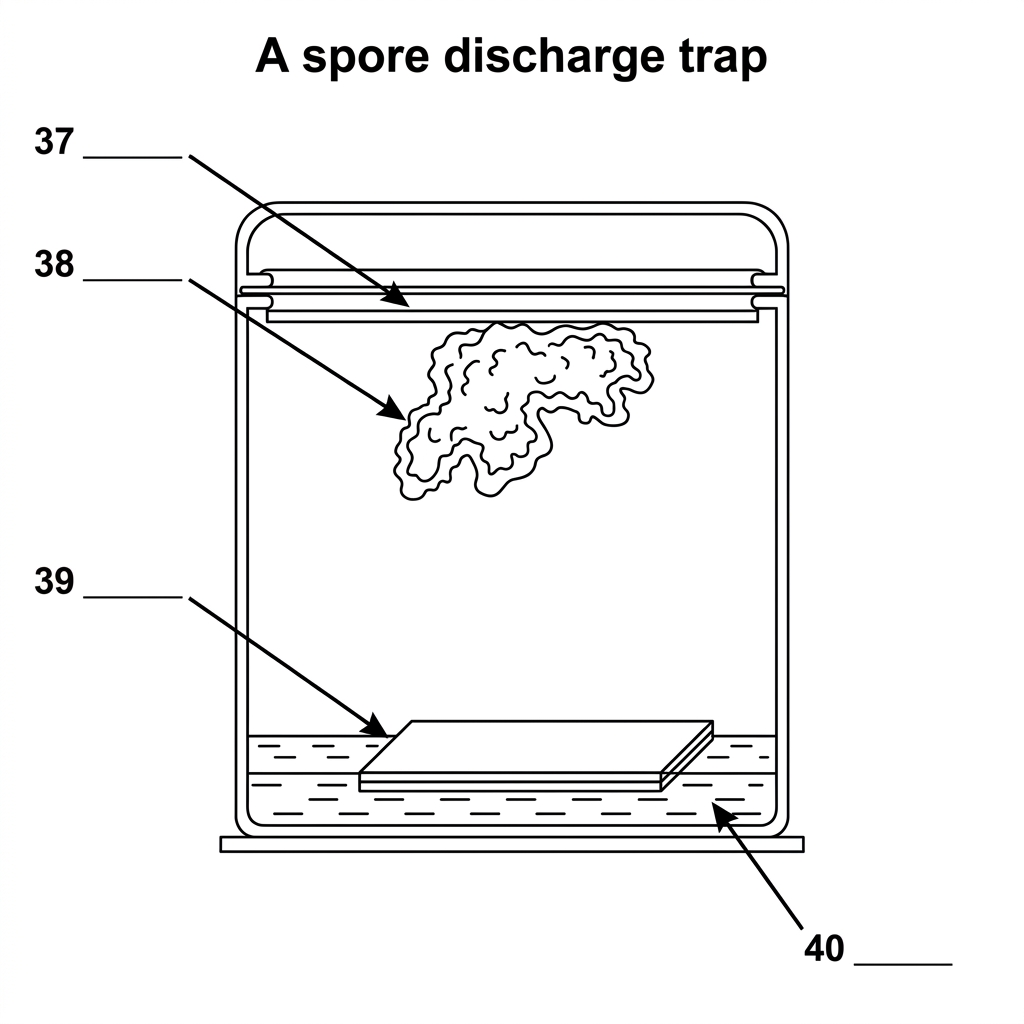
Show answer 37
wet filter paper or filter paper
Show answer 38
lichen specimen or lichen sample or damp lichen or specimen or sample
Show answer 39
sterile glass slide or glass slide or slide
Show answer 40
sterile water or water
Passage 21
Documenting Fungal Diversity
A
Fungi constitute one of the most diverse kingdoms of life, yet documenting them presents unique challenges compared to surveying plants or animals. Unlike flora, which is generally visible year-round, or fauna, which can be tracked, most fungi spend the majority of their life cycle hidden underground or within decaying wood as a network of thread-like structures called mycelium. The visible part of the organism, the fruiting body or 'mushroom', often appears only fleetingly under specific environmental conditions, such as after heavy rainfall. Consequently, compiling an exhaustive inventory of fungal species in a given ecosystem requires a combination of traditional field techniques and modern molecular approaches.
B
The most fundamental method of documenting fungi is the targeted collection of fruiting bodies. Field mycologists must carefully extract the entire specimen, as diagnostic features often reside at the base of the stem, such as a sac-like structure known as a volva or attached mycelial cords. A specialized digging tool, or trowel, is used to gently loosen the surrounding soil or substrate. For hypogeous fungi, which fruit entirely underground (such as truffles), researchers traditionally relied on trained animals like dogs or pigs to detect the volatile compounds they emit. Today, systematic raking of the leaf litter in suspected habitats is also employed, although it is highly labor-intensive and less efficient.
C
Once collected, specimens must undergo immediate processing to ensure their value for taxonomic classification. A critical step is the creation of a spore print. By removing the stem and placing the mushroom cap gills-down on a piece of paper—often half black and half white to contrast with different spore colors—researchers allow the spores to drop overnight. The resulting deposit reveals the color of the spores in mass, which is a primary characteristic used to differentiate major fungal families. In addition to spore prints, detailed field notes and high-resolution photographs must be taken while the specimen is fresh. This is because fungi inevitably lose their vibrant colors, textures, and three-dimensional shapes once preserved.
D
Preservation itself is a delicate process. Unlike plant specimens that can be pressed flat, fungal fruiting bodies are composed largely of water and are highly prone to rapid bacterial decay and maggot infestation. They must be dehydrated quickly using specialized field dryers that circulate warm air. Once fully dried, the rigid and brittle specimens are placed in archival boxes and stored in fungaria (fungal herbaria). While these dried samples are excellent for long-term genetic and microscopic analysis, their altered physical appearance underscores the necessity of the supplementary field data collected prior to dehydration.
E
Despite rigorous traditional collection efforts, it is estimated that less than 10 percent of the world's fungal species have been formally described. To capture the hidden majority that rarely or never produce macroscopic fruiting bodies, researchers now heavily rely on environmental DNA (eDNA) sampling. This technique involves taking small soil cores or wood shavings from an environment and extracting all the genetic material present. By sequencing specific 'barcode' regions of the DNA and comparing them to global databases, scientists can identify the presence of fungal species even when no physical mushroom is visible. While eDNA provides a vast amount of data regarding species richness and distribution, it cannot replace the collection of physical specimens, which remain essential for describing new species and understanding the organism's morphology and ecological function.
Questions 27-31
Do the following statements agree with the claims of the writer in Reading Passage 3?
In boxes 27-31 on your answer sheet, write:
YES if the statement agrees with the claims of the writer
NO if the statement contradicts the claims of the writer
not given if it is impossible to say what the writer thinks about this
- Fungi generally spend most of their life cycle visible above ground.
- The volva is a diagnostic feature that is found on the caps of certain mushrooms.
- Spore prints are used to determine which family a newly collected fungus belongs to.
- Fungal specimens require higher temperatures in field dryers than plant specimens do.
- Less than a tenth of global fungal species have been officially identified by scientists.
Show answers
1. Fungi generally spend most of their life cycle visible above ground. — NO
2. The volva is a diagnostic feature that is found on the caps of certain mushrooms. — NO
3. Spore prints are used to determine which family a newly collected fungus belongs to. — YES
4. Fungal specimens require higher temperatures in field dryers than plant specimens do. — NOT GIVEN
5. Less than a tenth of global fungal species have been officially identified by scientists. — YES
Questions 32-36
Complete the table below.
Choose no more than two words from the passage for each answer.
| Method | Process | Limitations/Notes |
|---|---|---|
| Targeted collection | Using a _______ (32) to gently loosen the soil to extract the whole specimen. | Important features may be located at the _______ (33) of the stem. |
| Hypogeous collection | Relying on trained animals or performing systematic _______ (34) of leaf litter. | Manual searching is very _______ (35). |
| Environmental DNA (eDNA) | Extracting genetic material from _______ (36) or wood shavings. | Cannot provide physical specimens needed for studying morphology and ecological function. |
Show answers
32. trowel or digging tool
33. base
34. raking
35. labor-intensive
36. soil cores
Questions 37-40
Choose the correct letter, A, B, C or D.
37. Why do researchers use paper that is half black and half white for spore prints?
A. To absorb excess moisture from the mushroom cap.
B. To separate major fungal families effectively.
C. To ensure the spore colors stand out clearly.
D. To prevent the spores from decaying overnight.
Show answer 37
C
38. According to Paragraph C, why is it crucial to photograph fungi before preservation?
A. Because drying alters their original appearance and shape.
B. Because taking photographs is faster than writing field notes.
C. Because fungi are often destroyed during the spore printing process.
D. Because genetic analysis requires a visual record.
Show answer 38
A
39. How does the preservation of fungi differ from that of plants?
A. Fungi must be flattened before being dried.
B. Fungi can only be preserved for short-term analysis.
C. Fungi are stored in archival boxes rather than fungaria.
D. Fungi must be preserved using warm air circulation.
Show answer 39
D
40. What is the primary advantage of using eDNA sampling according to the passage?
A. It identifies species without the need for visible fruiting bodies.
B. It eliminates the need for global databases.
C. It allows for detailed observation of fungal ecology.
D. It provides a cheaper alternative to traditional fieldwork.
Show answer 40
A
Passage 22
Compiling Botanical Specimens
Creating botanical specimens for a herbarium involves more than just picking a flower and pressing it in a book. It requires systematic collection and preservation techniques. The ultimate goal dictates the methodology. For genetic analysis, researchers might only need a small leaf sample preserved in silica gel to extract DNA. However, for a comprehensive taxonomic survey, a complete specimen featuring roots, stems, leaves, and reproductive structures like flowers or fruits is essential. Often, ecologists and taxonomists clash; the former might prioritize rapid sampling of many species to assess biodiversity, while the latter requires perfect, complete specimens of specific target groups, which takes significantly more time.
To gather a diverse array of plant life, several tools and techniques are employed. Hand collection is suitable for small herbaceous plants, where the entire organism, including the root system, can be gently dug up using a trowel. For shrubs and lower branches of trees, secateurs are used to snip representative twigs. When sampling the high forest canopy, researchers employ extendable pruning poles or even specialized climbing gear to reach epiphytes and high foliage. It is generally recommended to collect a few duplicates of each plant, provided the local population is large enough to sustain the loss. Specimens are immediately placed in large, airtight plastic bags to prevent wilting before they can be processed in the camp or laboratory.
Once collected, plants must be pressed to extract moisture while maintaining their structural integrity. The standard field press consists of two rigid wooden frames bound tightly with straps. Between these frames, researchers layer a repeating sequence of materials: corrugated cardboard to allow air circulation, absorbent blotting paper to draw out moisture, and a folded sheet of plain newsprint which houses the actual plant specimen. Arranging the plant inside the newsprint is a delicate art; leaves must be turned to show both the upper and lower surfaces, and thick stems might need to be sliced in half longitudinally so the specimen lies flat.
The subsequent drying phase is critical. If specimens dry too slowly, they are susceptible to mold and decay; if dried too rapidly with excessive heat, they become overly brittle and lose their natural coloration. In dry climates, natural air circulation might suffice, but in humid tropical environments, a portable field dryer is often necessary. This apparatus typically involves placing the plant press over a heat source—such as a small kerosene heater or electric bulbs—enclosed by a canvas skirt that funnels the rising warm air directly up through the corrugated cardboard layers of the press.
The final stage is mounting and labeling. The dried plant is affixed to a sheet of acid-free archival paper using specialized, pH-neutral adhesives or linen tape. A specimen is scientifically worthless without its accompanying metadata. A label is pasted in the bottom right corner, detailing the precise GPS coordinates, elevation, surrounding habitat, date of collection, and the collector's name. These mounted specimens are then stored in climate-controlled cabinets where, if properly protected from insect pests, they can last for centuries, providing an invaluable physical record of global plant diversity.
Questions 27-30
Do the following statements agree with the information given in Reading Passage 3?
In boxes 27-30 on your answer sheet, write:
- TRUE if the statement agrees with the information
- FALSE if the statement contradicts the information
- not given if there is no information on this
Select TRUE, FALSE, or not given for each statement.
- Ecologists generally spend less time on each specimen than taxonomists do.
- The discovery of new plant species often occurs during genetic analysis.
- It is advisable to gather multiple examples of a plant if the population is sufficiently large.
- Plastic bags are used to dry the plants out in the field.
Show answers
1. Ecologists generally spend less time on each specimen than taxonomists do. — TRUE
2. The discovery of new plant species often occurs during genetic analysis. — NOT GIVEN
3. It is advisable to gather multiple examples of a plant if the population is sufficiently large. — TRUE
4. Plastic bags are used to dry the plants out in the field. — FALSE
Questions 31-36
Classify the following statements as referring to
- A corrugated cardboard
- B blotting paper
- C newsprint
- D archival paper
Write the correct letter, A, B, C, or D, in boxes 31-36 on your answer sheet.
- directly encloses the botanical specimen
- draws out the water content from the plant
- provides a permanent backing for the dried plant
- facilitates the movement of air through the setup
- must be acid-free to ensure long-term preservation
- requires the plant's foliage to be carefully positioned inside it
Show answers
1. directly encloses the botanical specimen — C
2. draws out the water content from the plant — B
3. provides a permanent backing for the dried plant — D
4. facilitates the movement of air through the setup — A
5. must be acid-free to ensure long-term preservation — D
6. requires the plant's foliage to be carefully positioned inside it — C
Questions 37-40
Label the diagram below.
Choose no more than two words from the passage for each answer.
Write your answers in boxes 37-40 on your answer sheet.
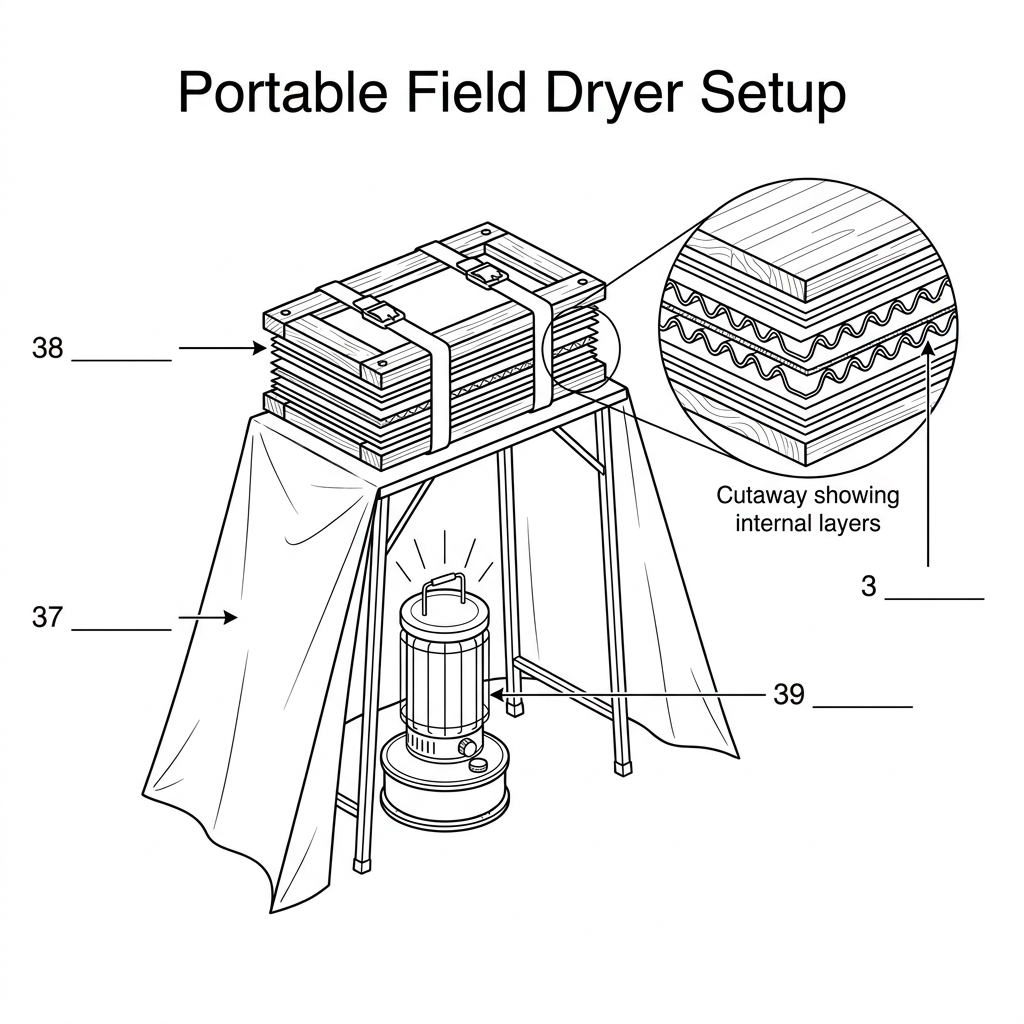
Show answer 37
canvas skirt
Show answer 38
plant press
Show answer 39
kerosene heater
layers of 40.
Show answer
corrugated cardboard
Passage 23
Exploring the High Frontier: Methods in Canopy Arthropod Research
For over a century, terrestrial arthropod research was inherently grounded. Biologists catalogued the rich life of the forest floor, largely ignoring the biological wealth suspended tens of metres above their heads. The forest canopy, often dubbed the 'high frontier', is now estimated to harbour more than half of all terrestrial biodiversity. However, studying canopy arthropods presents unique logistical challenges. The methods chosen dictate the type of data collected, varying widely depending on whether the objective is a comprehensive taxonomic inventory or an in-depth ecological study of species interactions. Often, these distinct goals require entirely different toolkits.
One of the earliest and most straightforward techniques is branch clipping. Researchers use extendable poles fitted with cutting blades to sever small branches, which are immediately caught in a net or bag. This low-tech method is highly selective and allows biologists to know exactly which tree, and even which part of the branch, the specimens inhabited. It is particularly effective for collecting sedentary organisms such as scale insects, aphids, and certain slow-moving beetle larvae. However, the disturbance caused by the clipping process means that highly mobile species quickly escape, resulting in a heavily skewed representation of the local fauna.
To overcome the limitations of evasive insects, researchers developed insecticidal fogging in the 1970s. A machine generates a warm cloud of biodegradable pyrethroid insecticide, which rises into the tree crown. Arthropods within the targeted area are stunned or killed and subsequently plummet into dozens of funnel-shaped collection trays suspended beneath the branches. Fogging is unparalleled for estimating overall species richness and understanding which species dominate a given canopy. Yet, it has severe limitations. Because the insects fall from various unknown heights, researchers cannot determine the exact microhabitat a specimen occupied. Furthermore, it yields no information about behaviour. Finally, fogging is strictly weather-dependent; even a mild breeze will disperse the fog away from the target tree, meaning it is usually conducted at dawn when the air is still.
For scientists whose focus is observing life rather than merely cataloguing the dead, canopy cranes provide an extraordinary, albeit rare, solution. Large construction cranes are erected in the middle of a forest, equipped with a gondola that can lower researchers directly into the foliage. This non-destructive access permits the meticulous observation of live interactions, such as pollination, predation, and herbivory. It enables the tagging and monitoring of individual insects over time. The primary drawback of canopy cranes is their exorbitant cost and immobility. They are geographically restricted to only a handful of permanent research plots worldwide, meaning the data gathered, while exceptionally detailed, represents only a few isolated forest ecosystems.
Another popular approach involves hoisting passive traps into the canopy. Flight interception traps (FITs) and Malaise traps consist of fine mesh barriers. When flying insects hit the mesh, they fall into a preservative-filled trough or crawl upwards into a collecting bottle. These are deployed via ropes and pulleys and left in the canopy for days or weeks. They are highly efficient at capturing active fliers like flies (Diptera) and wasps (Hymenoptera). Unlike fogging, passive traps require minimal active effort once installed and are less constrained by immediate weather conditions, though strong storms can tear the nets. The catch, however, is influenced heavily by the precise placement of the trap relative to flight paths, which are notoriously difficult to predict from the ground.
Ultimately, no single sampling method provides a flawless picture of canopy ecology. A stationary trap cannot document the crawling fauna of a thick branch, and a fogger cannot reveal how a predator hunts. Thus, modern canopy ecologists typically employ a mosaic of techniques, cross-referencing the broad, indiscriminate yields of fogging with the precise, observational data afforded by cranes and clipping.
Questions 27-30
Do the following statements agree with the information given in Reading Passage 3?
In boxes 27-30 on your answer sheet, choose:
TRUE if the statement agrees with the information
FALSE if the statement contradicts the information
not given if there is no information on this
- Historically, researchers preferred to study ground-level ecosystems due to their accessibility.
- Insecticidal fogging is an effective way to study the mating habits of canopy insects.
- Canopy cranes are currently the most widely used method for canopy research globally.
- Flight interception traps capture more female insects than male insects.
Show answers
1. Historically, researchers preferred to study ground-level ecosystems due to their accessibility. — TRUE
2. Insecticidal fogging is an effective way to study the mating habits of canopy insects. — FALSE
3. Canopy cranes are currently the most widely used method for canopy research globally. — FALSE
4. Flight interception traps capture more female insects than male insects. — NOT GIVEN
Questions 31-35
Look at the following statements (Questions 31-35) and the list of methods below.
Match each statement with the correct method, A, B, C, or D.
Write the correct letter in boxes 31-35 on your answer sheet.
A. Branch clipping
B. Insecticidal fogging
C. Canopy cranes
D. Flight interception traps (FITs)
- Requires specific meteorological conditions to be effective.
- Permits the observation of live insect interactions.
- Is primarily suited for insects that do not move frequently.
- Relies on leaving the equipment in place for an extended period.
- Obscures the precise microhabitat a specimen originally occupied.
Show answers
1. Requires specific meteorological conditions to be effective. — B
2. Permits the observation of live insect interactions. — C
3. Is primarily suited for insects that do not move frequently. — A
4. Relies on leaving the equipment in place for an extended period. — D
5. Obscures the precise microhabitat a specimen originally occupied. — B
Questions 36-40
Complete the table below.
Choose no more than two words from the passage for each answer.
Write your answers in boxes 36-40 on your answer sheet.
| Method | Advantages | Disadvantages |
|---|---|---|
| Branch clipping | Highly selective; allows biologists to know exactly which tree specimens inhabited | Disturbance causes highly mobile species to escape, resulting in a heavily _______ (36) representation of local fauna |
| Insecticidal fogging | Unparalleled for estimating overall _______ (37) | Cannot determine the exact _______ (38) a specimen occupied |
| Canopy cranes | Permits meticulous observation of live interactions | Primary drawback is their exorbitant cost and _______ (39) |
| Passive traps | Requires _______ (40) effort once installed | Catch is influenced heavily by precise placement |
Show answers
36. skewed
37. species richness
38. microhabitat
39. immobility
40. minimal active
Passage 24
The Art and Science of Herbarium Collections
For centuries, scientists have built vast archives of plant life known as herbaria. A herbarium is essentially a library of dried, pressed plant specimens, carefully preserved and catalogued for scientific study. While gathering plants might seem as simple as picking a wildflower, professional botanical collection is a rigorous and systematic process. The methods employed depend on the ultimate goal of the research, which generally falls into two categories: taxonomic classification and ecological surveying. For taxonomists, acquiring representatives that show the complete morphological variation of a species is crucial. Ecologists, on the other hand, prioritize documenting the broad diversity of flora present in a specific habitat at a given time.
The first step in building a herbarium collection takes place in the field. To be scientifically valuable, a botanical specimen must include as many parts of the plant as possible. Roots, stems, leaves, flowers, and fruits all provide vital morphological clues used in identification. Collectors use specific tools depending on the plant type; robust secateurs are used for woody shrubs, while trowels are essential for extracting the intact root systems of herbaceous plants. Because plants wilt rapidly after being uprooted, collectors typically carry a portable field press. Gathering multiple individuals from a population is recommended to ensure that the natural variation within the species is properly represented.
However, a physical plant specimen is virtually useless to science without accompanying field data. At the exact moment of collection, botanists must diligently record a range of information in a field notebook. Essential details include the precise geographic coordinates, the type of surrounding habitat, and the altitude. Collectors also note transient characteristics that will be lost once the plant is dried, such as the original colour of the petals, the presence of any distinct scents, and the names of associated species growing nearby.
Once the specimens and data are secured, the critical phase of pressing and drying begins. The goal is to extract moisture quickly while flattening the plant to display its botanical features clearly. Specimens are carefully arranged between sheets of absorbent newspaper, which are then sandwiched between pieces of corrugated cardboard to allow for air circulation. These stacks are placed inside a wooden press and strapped tightly. In the first few days, the newspaper must be changed daily to prevent the growth of mold or fungal decay, particularly when working in humid or tropical environments. Heat is sometimes applied using specialized drying cabinets to speed up the process.
After the plants are thoroughly dried, they are prepared for long-term storage through mounting. Each specimen is meticulously arranged on a sheet of heavy, acid-free archival paper. To secure the delicate dried plant without causing chemical damage, botanists use specialized archival glue or strips of linen tape. Finally, a formal label containing all the transcribed field data, the date of collection, and the collector’s name is permanently affixed to the bottom right corner of the sheet.
Today, herbaria serve purposes far beyond traditional taxonomy. These historical collections have become invaluable resources for modern scientific techniques. Researchers now routinely extract DNA from century-old specimens to study genetic shifts over time. Furthermore, by examining the recorded flowering dates on historical herbarium labels, scientists can track shifts in plant phenology, providing concrete evidence of how climate change is altering the life cycles of flora around the globe.
Questions 27-30
Do the following statements agree with the information given in Reading Passage 3?
In boxes 27-30 on your answer sheet, choose:
TRUE if the statement agrees with the information
FALSE if the statement contradicts the information
not given if there is no information on this
- Ecologists generally focus on collecting specimens that display complete morphological variation.
- A portable field press helps prevent freshly collected plants from wilting.
- Botanists prefer to use digital devices rather than notebooks to record field data.
- The original colour of a flower is preserved by the pressing and drying process.
Show answers
1. Ecologists generally focus on collecting specimens that display complete morphological variation. — FALSE
2. A portable field press helps prevent freshly collected plants from wilting. — TRUE
3. Botanists prefer to use digital devices rather than notebooks to record field data. — NOT GIVEN
4. The original colour of a flower is preserved by the pressing and drying process. — FALSE
Questions 31-36
Classify the following statements as referring to:
Write the correct letter, A, B, C or D, in boxes 31-36 on your answer sheet.
A Field collection
B Recording data
C Pressing and drying
D Mounting
- Noting down the specific scent of a plant.
- Using acid-free paper to prevent chemical degradation.
- Gathering the root systems of herbaceous vegetation.
- Applying heat to accelerate moisture extraction.
- Documenting the elevation of the collection site.
- Securing the specimen with linen tape.
Show answers
1. Noting down the specific scent of a plant. — B
2. Using acid-free paper to prevent chemical degradation. — D
3. Gathering the root systems of herbaceous vegetation. — A
4. Applying heat to accelerate moisture extraction. — C
5. Documenting the elevation of the collection site. — B
6. Securing the specimen with linen tape. — D
Questions 37-40
Complete the flow chart below.
Choose no more than two words from the passage for each answer.
- Gathering the Specimen Obtain multiple plant parts. Extract roots using _______ (37) if necessary.
- Documenting Details Note transient features and _______ (38) in a notebook.
- Removing Moisture Place the plants between layers of _______ (39) to absorb water. Apply pressure and change layers regularly to avoid mold.
- Final Preparation Fix the dried plant to archival paper. Attach a _______ (40) showing collection details to the corner.
Show answers
37. trowels
38. altitude
39. newspaper
40. label
Passage 25
Exploring the Forest Canopy
A
For more than a century, terrestrial biologists focused their research on the ground, largely ignoring the vibrant ecosystems thriving high above. The forest canopy, often described as the 'last biotic frontier', contains an estimated half of all terrestrial species, including countless undiscovered insects, epiphytes, and arboreal mammals. Historically, scientists were confined to examining leaves, branches, or organisms that had fallen to the forest floor. While this yielded some data, it provided an incomplete picture. To truly understand forest ecology, researchers realized they needed to access the canopy directly, prompting the development of various innovative techniques.
B
The most accessible and widely used method for reaching the canopy involves modified mountain climbing and caving gear. Single rope techniques (SRT) allow a researcher to shoot a line over a sturdy high branch using a slingshot or crossbow, haul up a climbing rope, and ascend using mechanical ascenders. The primary advantage of SRT is its minimal cost and portability; a researcher can pack the necessary gear into a single backpack and travel to remote locations. However, the technique demands significant physical fitness and poses safety risks. Furthermore, a climber is generally restricted to the trunk and thicker main branches, making it extremely difficult to sample the fragile outer canopy where the majority of photosynthesis and insect activity takes place.
C
To overcome the limitations of isolated tree climbs, researchers began constructing fixed walkways and observation towers. Suspended bridges, often made of aluminium and sturdy netting, are strung between large emergent trees. These permanent structures allow scientists to conduct long-term monitoring of a specific forest plot without the physical exertion of repeated climbs. They also safely accommodate heavy monitoring equipment and multiple researchers at once. Nevertheless, fixed walkways are expensive to build and maintain, and they offer zero flexibility; once installed, researchers are confined to studying only the narrow transect of the forest immediately accessible from the bridge.
D
In the 1980s, an ingenious solution for accessing the very top of the canopy was introduced: the canopy raft, or 'radeau des cimes'. This large, hexagonal platform made of inflated heavy-duty pontoons and a mesh trampoline is transported and gently lowered onto the treetops by a hot air balloon or dirigible. Researchers can walk safely across the mesh, directly accessing the delicate uppermost branches and leaves that are completely out of reach to climbers. The raft can be relocated to different areas of the forest every few days, providing excellent spatial variety. The main drawback is the immense logistical complexity and weather dependence, as balloons cannot be operated in high winds or heavy rain.
E
For intensive, highly precise studies in a single location, the canopy crane has become the ultimate tool. By erecting a standard industrial construction crane in the middle of a forest, researchers can use a specially designed gondola to access any point within the crane's massive reach—often encompassing over a hectare of forest. The crane provides true three-dimensional movement, allowing scientists to hover mere centimetres from a specific leaf without disturbing the surrounding foliage. While the data gathered from cranes is unparalleled in its precision, the initial setup is extraordinarily costly and highly disruptive to the environment, requiring a large clearing to be made simply to assemble the machinery. Consequently, only a handful of such cranes exist globally.
Questions 27-31
Classify the following statements as referring to A, B, C, or D.
Write the correct letter in boxes 27-31 on your answer sheet. You may use any letter more than once.
A. Single rope techniques
B. Fixed walkways
C. Canopy raft
D. Canopy cranes
- This method is highly vulnerable to adverse meteorological conditions.
- It restricts investigators to a highly localized, unchanging path of observation.
- It requires the least financial investment and is easily transported.
- It causes significant initial destruction to the habitat during its installation.
- It enables researchers to get extremely close to subjects without touching them.
Show answers
1. This method is highly vulnerable to adverse meteorological conditions. — C
2. It restricts investigators to a highly localized, unchanging path of observation. — B
3. It requires the least financial investment and is easily transported. — A
4. It causes significant initial destruction to the habitat during its installation. — D
5. It enables researchers to get extremely close to subjects without touching them. — D
Questions 32-36
Do the following statements agree with the information given in Reading Passage 3?
In boxes 32-36 on your answer sheet, write:
TRUE if the statement agrees with the information
FALSE if the statement contradicts the information
not given if there is no information on this
- In the past, scientists relied entirely on fallen materials to study canopy life.
- Single rope techniques allow researchers to easily access the outer canopy.
- The canopy raft is moved to a different forest location every day.
- The canopy raft was initially developed by researchers in France.
- Only a small number of canopy cranes have been built around the world.
Show answers
1. In the past, scientists relied entirely on fallen materials to study canopy life. — TRUE
2. Single rope techniques allow researchers to easily access the outer canopy. — FALSE
3. The canopy raft is moved to a different forest location every day. — FALSE
4. The canopy raft was initially developed by researchers in France. — NOT GIVEN
5. Only a small number of canopy cranes have been built around the world. — TRUE
Questions 37-40
Complete the summary below.
Choose one word only from the passage for each answer.
Write your answers in boxes 37-40 on your answer sheet.
The use of construction cranes offers unparalleled advantages for intensive research. Scientists are transported in a _______ (37) to almost any point within the crane's reach. Because it offers true three-dimensional movement, researchers can observe subjects closely without disturbing the nearby _______ (38). Despite these benefits, cranes are rare. The initial _______ (39) is extremely expensive, and the process of constructing the crane requires a large _______ (40) to be made, which destroys part of the habitat.
Show answers
37. gondola
38. foliage
39. setup
40. clearing