
25 IELTS Reading Passage 1 Practice Tests with Answers
IELTS Reading Passage 1 is the first of three passages in the IELTS Academic Reading test. The text usually covers a topic of general interest, such as the history of an everyday object, a piece of natural science, or a social trend. Question types include matching headings, true/false/not given, sentence completion, and short answer. Of the three passages, Passage 1 is usually the easiest in vocabulary and structure, but it still tests how well you scan for specific information.
This article gives you 25 IELTS Reading Passage 1 practice tests. Each test is a complete passage with all of its questions and the answers. Across the 25 tests, you will get 316 sub-questions of focused practice.
If you want the format, scoring rules, and strategies explained in depth, read our complete guide to IELTS Reading first, then use the questions below to practice.
Passage 1
The Evolution of Office Architecture
A. For much of the 20th century, the physical layout of the modern office was driven by a single objective: maximizing efficiency. Early office designs were heavily influenced by industrial models, particularly the principles of Taylorism in the 1920s, featuring rows of identical desks arranged in a grid, closely monitored by managers in peripheral offices. This approach, while orderly, treated administrative work much like a factory assembly line, where output was prized above all else. In the 1960s, the introduction of the cubicle—originally conceived by designer Robert Propst as the 'Action Office'—aimed to provide a degree of privacy and personalization. Propst envisioned a dynamic workspace that would empower workers. However, as corporations expanded and sought to minimize real estate costs, these partitions often devolved into what became known as 'cubicle farms'—dense, maze-like environments that left employees feeling isolated and disconnected from their colleagues.
B. In an attempt to dismantle corporate hierarchies and encourage teamwork, the late 20th century saw the widespread adoption of the open-plan office, a trend heavily championed by Silicon Valley tech startups. Walls and partitions were torn down to create vast, shared spaces. Proponents argued that this layout would democratize the workplace, breaking down the physical barriers between executives and entry-level staff. It was widely believed that removing walls would naturally lead to spontaneous conversations, often referred to as 'water-cooler moments,' thereby fostering a culture of innovation and rapid problem-solving. Companies invested heavily in playful furniture and open lounges to signal a flattened hierarchy.
C. Despite its noble intentions, the open-plan model has faced significant criticism from both employees and researchers. A growing body of research indicates that the lack of physical boundaries often leads to sensory overload. Background noise—from ringing phones to loud conversations and clattering keyboards—has been shown to severely disrupt concentration and increase employee stress levels. Paradoxically, rather than boosting interaction, open-plan environments frequently cause workers to withdraw. A landmark study published by Harvard University found that transitioning to an open-plan office actually reduced face-to-face interactions by 70%. Many employees resort to wearing noise-cancelling headphones and rely heavily on digital messaging platforms to communicate with colleagues sitting just a few meters away, actively avoiding face-to-face interactions so as not to disturb others.
D. Recognizing the shortcomings of both cubicles and open-plan layouts, architects and organizational psychologists have recently championed a new concept: Activity-Based Working (ABW). The fundamental premise of ABW is that employees perform a variety of distinct tasks throughout the day, each requiring a different type of physical environment. Instead of being tethered to a single assigned desk, workers are encouraged to move between different zones tailored to specific activities. A typical ABW office might feature soundproof 'focus rooms' for deep, solitary work, comfortable lounge areas for informal brainstorming, standing desks for quick check-ins, and traditional meeting rooms for formal presentations. This flexibility mirrors the complexity of modern knowledge work.
E. The psychological benefits of this agile approach are closely tied to the concept of autonomy. When individuals are given the freedom to choose where and how they work, their job satisfaction and overall morale tend to improve significantly. Giving workers control over their environment reduces burnout and enhances intrinsic motivation. Furthermore, modern ABW designs frequently incorporate elements of biophilic design, integrating natural light, indoor plants, and organic materials like wood and stone. Studies suggest that exposure to these natural elements within the office can reduce mental fatigue, lower blood pressure, and improve cognitive function, making the workplace a more supportive environment for complex problem-solving and creative thinking.
F. However, transitioning to an Activity-Based Working environment is not without its challenges. The shift requires a fundamental change in management culture. Traditionally, managers have relied on visual observation—seeing an employee physically present at their desk—as a proxy for productivity, a phenomenon known as 'presenteeism'. In an agile office, management must shift to measuring actual outcomes and trusting their staff to manage their own time. Additionally, the practice of 'hot-desking', where desks are shared and not permanently assigned, can sometimes trigger territorial behavior if not carefully managed. Employees may arrive early to claim a preferred spot by the window, or experience a sense of rootlessness without a permanent space to keep personal items like photographs, favorite mugs, or reference books.
G. Ultimately, the history of office architecture demonstrates that there is no single perfect layout that suits every organization. The physical workspace is a powerful tool that shapes organizational behavior, and its design must align with the company’s specific culture, operational needs, and the demographics of its workforce. As the nature of work continues to evolve, becoming increasingly complex and reliant on technology, the most successful offices will likely be those that remain adaptable. By prioritizing the diverse psychological and practical needs of the human beings who inhabit them, companies can create environments that not only drive productivity but also foster genuine well-being.
Questions 1-5
Do the following statements agree with the information given in Reading Passage 1?
TRUE if the statement agrees with the information
FALSE if the statement contradicts the information
not given if there is no information on this
- Early office designs were inspired by manufacturing processes.
- The cubicle was originally invented to save money on office furniture.
- Open-plan offices successfully increased the frequency of face-to-face conversations.
- Employees in Activity-Based Working offices are assigned a specific desk for the entire week.
- Incorporating natural elements into office design has been proven to enhance mental performance.
Show answers
1. Early office designs were inspired by manufacturing processes. — TRUE
2. The cubicle was originally invented to save money on office furniture. — NOT GIVEN
3. Open-plan offices successfully increased the frequency of face-to-face conversations. — FALSE
4. Employees in Activity-Based Working offices are assigned a specific desk for the entire week. — FALSE
5. Incorporating natural elements into office design has been proven to enhance mental performance. — TRUE
Questions 6-10
Complete the table below.
Choose no more than two words from the passage for each answer.
| Period | Design Model | Primary Goal / Feature |
|---|---|---|
| 1920s | Taylorism | Maximizing _______ (6) |
| 1960s | _______ (7) | Providing privacy and personalization |
| Late 20th century | Open-plan | Dismantling _______ (8) |
| Recent | _______ (9) | Using _______ (10) for deep, solitary work |
Show answers
6. efficiency
7. cubicle or Action Office
8. corporate hierarchies or hierarchies
9. ABW or agile approach
10. focus rooms
Questions 11-13
Choose the correct letter A, B, C or D.
11. According to paragraph C, how do workers often cope with the open-plan office environment?
A. By complaining to their managers about the noise levels.
B. By taking frequent breaks in lounge areas.
C. By using technology to block out noise and communicate.
D. By organizing spontaneous brainstorming sessions.
Show answer 11
C
12. The success of Activity-Based Working (ABW) depends heavily on:
A. Managers trusting their employees to work independently.
B. Providing every employee with a private 'focus room'.
C. Strictly monitoring employee attendance and productivity.
D. Eliminating all traditional meeting rooms.
Show answer 12
A
13. What is the main idea of the passage?
A. Activity-Based Working is the only effective office design for modern businesses.
B. Office layouts have evolved to better accommodate human needs and work styles.
C. The open-plan office was a complete failure and should be abandoned.
D. Technological advancements have made physical office spaces unnecessary.
Show answer 13
B
Passage 2
Reaching the Abyss: The Evolution of Deep-Sea Submersibles
A. For centuries, humans have sought to explore the deepest realms of the ocean. However, while early military submarines were designed to navigate just below the surface, reaching the abyssal depths posed a vastly different set of challenges. The crushing pressure, freezing temperatures, and absolute darkness of the deep sea required entirely new technological approaches. Consequently, the history of deep-sea scientific submersibles is marked by distinct engineering leaps, driven by the desire to observe marine life in its natural habitat rather than for warfare.
B. The first significant milestone in deep-ocean exploration occurred in the early 1930s with the invention of the Bathysphere. Developed by American naturalist William Beebe and engineer Otis Barton, the Bathysphere was essentially a hollow steel ball. Its spherical shape was specifically chosen because it evenly distributed the immense external water pressure. Unlike later vessels, the Bathysphere had no independent propulsion system. Instead, it was lowered into the ocean on a thick steel cable from a mother ship. While it allowed Beebe and Barton to observe deep-sea creatures never before seen, its primary drawback was an absolute lack of mobility. Furthermore, the occupants faced extreme danger; if the cable were to snap, the sphere would plummet to the ocean floor.
C. Recognizing the limitations of a tethered sphere, the Swiss physicist Auguste Piccard designed the bathyscaphe in the late 1940s. Functioning much like an underwater hot air balloon, the bathyscaphe consisted of a heavy steel cabin suspended below a massive float. Because gasoline is lighter than water and relatively incompressible, the float was filled with gasoline to provide buoyancy, while heavy iron shot was used as ballast to descend. The most famous bathyscaphe, the Trieste, made a historic dive to the bottom of the Mariana Trench in 1960. Although it provided independent movement without a tether, the bathyscaphe was exceedingly slow, bulky, and difficult to transport across the world's oceans.
D. The modern era of deep-sea exploration truly began in 1964 with the launch of Alvin, a deep-ocean vehicle operated by the Woods Hole Oceanographic Institution. Alvin represented a massive improvement in maneuverability and utility. It was much smaller than the Trieste and was constructed with specialized syntactic foam for buoyancy, making it far safer and easier to handle. Most importantly, Alvin was equipped with sophisticated robotic arms, allowing scientists to collect rock samples and capture marine organisms. Over its long career, Alvin has been instrumental in groundbreaking discoveries, including the location of the sunken Titanic and the discovery of hydrothermal vents teeming with unique biological communities.
E. Despite the successes of manned submersibles, placing humans in the deep ocean remains expensive and inherently risky. In recent decades, the focus has shifted heavily toward Remotely Operated Vehicles (ROVs) and Autonomous Underwater Vehicles (AUVs). ROVs are unoccupied robots connected to a surface ship by a tether, which transmits high-definition video and allows pilots on the ship to control the vehicle's tools in real-time. AUVs, on the other hand, operate without any tether. They are pre-programmed with specific instructions to independently map the seafloor using sonar. By removing the need for a pressure-resistant human cabin, these robotic systems can stay submerged for days at a time.
F. Looking ahead, the integration of artificial intelligence with autonomous vehicles promises to revolutionize oceanography. Future AUVs will be able to make independent navigation decisions, identifying unusual geological formations or biological hotspots without human intervention. As researchers strive to comprehend the deep ocean's role in regulating the global climate, these advanced technologies will be vital. The abyss remains one of the least explored frontiers on Earth, but the steady evolution of submersibles continues to illuminate the dark depths.
Questions 1-5
Do the following statements agree with the information given in Reading Passage 1?
Choose:
TRUE if the statement agrees with the information
FALSE if the statement contradicts the information
not given if there is no information on this
- Early military submarines were built primarily for the purpose of observing marine life.
- The Bathysphere's spherical design allowed it to resist high water pressure.
- William Beebe and Otis Barton funded the creation of the Bathysphere themselves.
- The Trieste was designed to be easily transported across the world's oceans.
- ROVs are controlled by pilots stationed on the surface ship.
Show answers
1. Early military submarines were built primarily for the purpose of observing marine life. — FALSE
2. The Bathysphere's spherical design allowed it to resist high water pressure. — TRUE
3. William Beebe and Otis Barton funded the creation of the Bathysphere themselves. — NOT GIVEN
4. The Trieste was designed to be easily transported across the world's oceans. — FALSE
5. ROVs are controlled by pilots stationed on the surface ship. — TRUE
Questions 6-9
Complete the sentences below.
Choose no more than two words from the passage for each answer.
ROVs can transmit _______ (6) to the surface in real-time.
Because they do not have a _______ (7), AUVs can move freely through the ocean.
Future AUVs will incorporate _______ (8) to make their own navigation decisions.
Submersible technology is helping researchers learn how the deep ocean affects the _______ (9).
Show answers
6. high-definition video
7. tether
8. artificial intelligence
9. global climate
Questions 10-13
Complete the table below.
Choose no more than two words from the passage for each answer.
| Vessel | Key Features | Major Drawback |
|---|---|---|
| Bathysphere | Lowered into the ocean on a thick _______ (10) | Suffered from an absolute lack of _______ (11) |
| Bathyscaphe | Used heavy iron shot to descend | Was exceedingly slow, _______ (12), and difficult to transport |
| Alvin | Equipped with sophisticated _______ (13) to collect samples |
Show answers
10. steel cable
11. mobility
12. bulky
13. robotic arms
Passage 3
The Uluburun Shipwreck
A. In the summer of 1982, a young Turkish sponge diver named Mehmet Çakır was working off the steep, rocky coast of Uluburun in southwestern Turkey. During one of his routine descents, he spotted what he later described to his captain as “metal biscuits with ears” scattered across the seabed. Unbeknownst to Çakır, he had just stumbled upon one of the most significant archaeological discoveries of the 20th century. Those “biscuits” were later identified by marine archaeologists as copper oxhide ingots, characteristic of the Late Bronze Age. This chance encounter initiated a massive underwater excavation that would span over a decade.
B. The Institute of Nautical Archaeology (INA), led first by George Bass and later by Cemal Pulak, commenced the excavation in 1984. The site proved to be exceptionally demanding. Resting on a steep slope at depths ranging from 44 to 52 metres, the wreck pushed the limits of standard scuba diving. Due to the extreme depth, divers were restricted to a mere 20 minutes of bottom time per day to avoid nitrogen narcosis and decompression sickness. Despite these severe time constraints, the team conducted over 22,000 individual dives over 11 consecutive summer campaigns, slowly and meticulously mapping and recovering the ancient vessel and its contents.
C. As the excavation progressed, the sheer volume and diversity of the cargo stunned researchers. The ship was essentially a floating emporium, carrying goods from at least seven distinct Late Bronze Age cultures, including Mycenaean, Canaanite, Cypriot, and Egyptian. The primary cargo consisted of ten tons of copper ingots and one ton of tin ingots—the exact ten-to-one ratio required to forge bronze, the defining alloy of the era. Alongside the metals were numerous Canaanite jars, intricately packed with over a ton of terebinth resin, a substance widely used in antiquity for incense and perfumes.
D. The discovery also provided unprecedented insights into ancient shipbuilding. By carefully clearing the sand, archaeologists uncovered the surviving remnants of the ship’s hull. They were thrilled to find that the vessel was constructed using a sophisticated “shell-first” method. Unlike modern ships, where a skeletal frame is built first and planks are attached later, the Uluburun ship was built by joining the outer cedar planks together edge-to-edge. This was achieved using tightly fitting “mortise and tenon” joints. Small slots, or mortises, were carved into the edges of the planks, and flat wooden pegs, known as tenons, were inserted to bridge the gap.
E. To ensure the hull remained completely watertight and secure, the shipbuilders drove smaller wooden pins through the planks and the tenons, locking the entire structure together. This remarkable craftsmanship demonstrated that Late Bronze Age shipwrights possessed highly advanced woodworking skills, completely altering previous assumptions about early naval architecture.
F. Beyond its physical construction, the Uluburun shipwreck fundamentally reshaped our understanding of ancient Mediterranean trade networks. Prior to the discovery, historians relied heavily on ancient texts, such as the Amarna letters found in Egypt, which described elaborate networks of royal gift exchange between powerful empires. The Uluburun ship provided the first concrete, physical evidence of these high-level diplomatic exchanges. The immense wealth and international character of the cargo suggest that the ship was likely on a royal dispatch, proving that the Mediterranean was a highly interconnected economic zone as early as 1300 BCE.
Questions 1-5
Do the following statements agree with the information given in Reading Passage 1?
In boxes 1-5 on your answer sheet, choose:
- TRUE if the statement agrees with the information
- FALSE if the statement contradicts the information
- not given if there is no information on this
- The Uluburun shipwreck was discovered by someone actively searching for ancient artifacts.
- The depth of the shipwreck restricted divers to 20 minutes of work per day.
- The cargo contained the correct proportions of copper and tin needed to create bronze.
- The terebinth resin found on the ship was originally manufactured in Egypt.
- The Amarna letters were recovered from the wreckage of the Uluburun ship.
Show answers
1. The Uluburun shipwreck was discovered by someone actively searching for ancient artifacts. — FALSE
2. The depth of the shipwreck restricted divers to 20 minutes of work per day. — TRUE
3. The cargo contained the correct proportions of copper and tin needed to create bronze. — TRUE
4. The terebinth resin found on the ship was originally manufactured in Egypt. — NOT GIVEN
5. The Amarna letters were recovered from the wreckage of the Uluburun ship. — FALSE
Questions 6-9
Reading Passage 1 has six paragraphs, A-F.
Which paragraph contains the following information?
Write the correct letter, A-F, in boxes 6-9 on your answer sheet.
- details regarding the specialized technique used to assemble the ship's exterior
- an explanation of why the excavation took more than a decade to complete
- the impact of the discovery on historians' views of early international commerce
- a description of the diverse origins of the goods carried on the vessel
Show answers
1. details regarding the specialized technique used to assemble the ship's exterior — D
2. an explanation of why the excavation took more than a decade to complete — B
3. the impact of the discovery on historians' views of early international commerce — F
4. a description of the diverse origins of the goods carried on the vessel — C
Questions 10-13
Label the diagram of the hull construction below based on the passage.
Choose no more than two words from the passage for each answer.
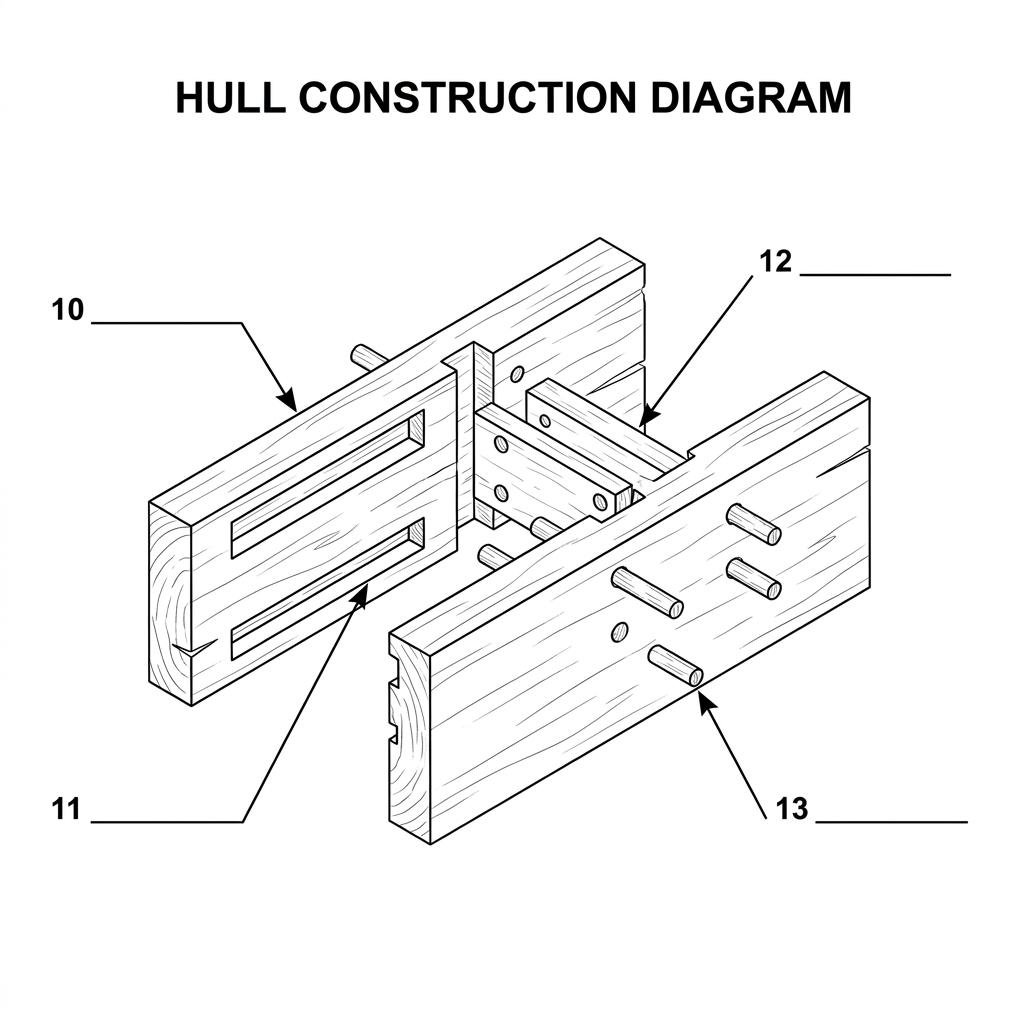
10. Outer planks made of: __________
Show answer 10
cedar
11. Small slots carved into plank edges: __________
Show answer 11
mortises or mortise
12. Flat wooden pegs linking the planks: __________
Show answer 12
tenons or tenon
13. Smaller items driven through to secure joints: __________
Show answer 13
wooden pins or pins
Passage 4
The Dawn of the Steerable Airship
For decades after the invention of the hot air balloon, aeronauts faced a frustrating limitation: they were entirely at the mercy of the wind. While balloons could achieve impressive altitudes, they could not be steered. The quest to develop a "dirigible" (from the French word meaning 'steerable') became the primary focus of aviation pioneers in the mid-19th century. Early attempts focused on elongated balloon shapes to reduce air resistance, but finding a suitable propulsion system proved to be a formidable challenge.
The first significant breakthrough occurred in 1852 when French engineer Henri Giffard constructed a 44-metre-long, cigar-shaped balloon equipped with a small steam engine. Giffard successfully flew over Paris at a modest speed of 9 kilometres per hour. However, the heavy weight of the steam engine and its requirement for large amounts of fuel meant that flights were painfully short. It became evident that steam power was a dead end for practical air travel, and progress stalled for several decades.
The true revolution in airship design was sparked by the invention of the lightweight internal combustion engine. In the late 1890s, the Brazilian-born inventor Alberto Santos-Dumont, living in Paris, began integrating petrol engines into small, non-rigid airships, commonly known as blimps. Santos-Dumont was a flamboyant figure who frequently flew his small airships around the streets of Paris, occasionally tying them to lampposts while he stopped for coffee. His crowning achievement came in 1901 with his airship Number 6, when he won the Deutsch Prize for successfully flying from Parc Saint Cloud, rounding the Eiffel Tower, and returning within thirty minutes.
The design of Number 6 was a marvel of early engineering. At the top was the main gas envelope, a large, elongated fabric bag filled with highly flammable hydrogen gas to provide lift. To maintain the shape of the envelope against the changing atmospheric pressure, a smaller internal air bag called a ballonet was placed inside. Suspended below the envelope by a complex network of piano wires was the gondola, a narrow wooden framework where the pilot stood. At the very rear of the gondola sat the petrol engine, which drove a wooden propeller, while a large fabric rudder was attached to the back of the envelope to allow for directional steering.
Following Santos-Dumont's successes, development split into two distinct paths. While non-rigid blimps continued to be refined, German inventor Count Ferdinand von Zeppelin pioneered the rigid airship. Unlike blimps, which relied on internal gas pressure to maintain their shape, Zeppelins featured a rigid internal framework made of duralumin, a lightweight aluminium alloy. Inside this metal skeleton were several separate gas cells, which meant a single puncture would not cause the entire craft to lose its lift. The entire framework was then covered in a stretched outer fabric skin.
Rigid airships dominated the golden age of passenger air travel in the 1920s and 1930s, offering luxurious transatlantic flights. However, their reliance on highly combustible hydrogen made them inherently dangerous. The spectacular fire that destroyed the Hindenburg in 1937 effectively ended the era of passenger airships. Today, modern non-rigid airships, filled with safe, non-flammable helium, are experiencing a minor resurgence, primarily used for aerial advertising, tourism, and carrying heavy cargo to remote locations where traditional aircraft cannot land.
Questions 1-4
Do the following statements agree with the information given in Reading Passage 1?
Choose:
TRUE if the statement agrees with the information
FALSE if the statement contradicts the information
not given if there is no information on this
- Early balloonists were able to completely control the direction of their flights.
- Henri Giffard's early airship was fitted with a steam engine.
- Alberto Santos-Dumont used his family's wealth to fund his airship experiments.
- Zeppelins relied on a single large gas cell to remain in the air.
Show answers
1. Early balloonists were able to completely control the direction of their flights. — FALSE
2. Henri Giffard's early airship was fitted with a steam engine. — TRUE
3. Alberto Santos-Dumont used his family's wealth to fund his airship experiments. — NOT GIVEN
4. Zeppelins relied on a single large gas cell to remain in the air. — FALSE
Questions 5-7
Answer the questions below using no more than three words from the passage for each answer.
5. What award did Santos-Dumont win for his 1901 flight?
Show answer 5
Deutsch Prize or the Deutsch Prize
6. What specific material was the internal skeleton of a Zeppelin made from?
Show answer 6
duralumin or aluminium alloy or lightweight aluminium alloy
7. Which gas is used in today's airships to ensure they are not a fire risk?
Show answer 7
helium or non-flammable helium or safe helium
Questions 8-11
Label the diagram below. Choose no more than two words from the passage for each answer.
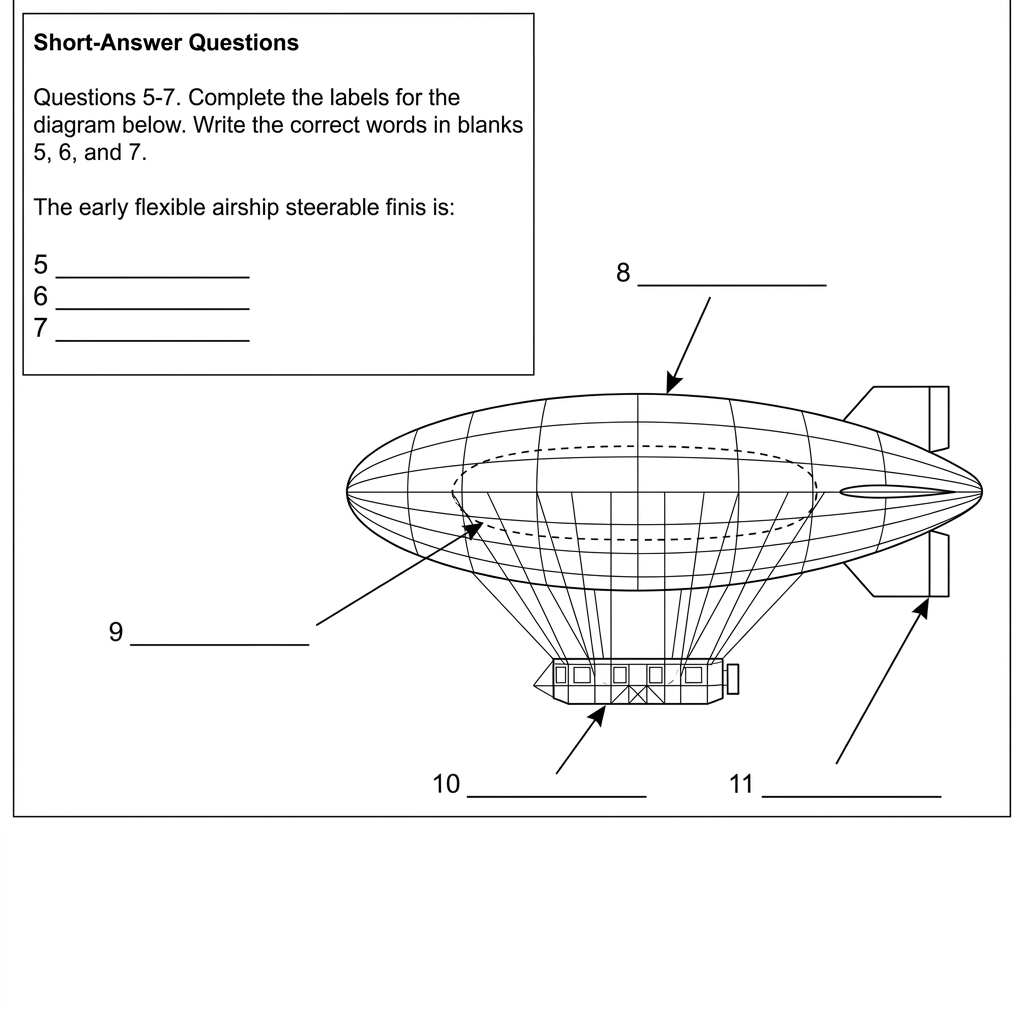
Show answer 8
gas envelope or envelope
Show answer 9
ballonet or air bag or internal bag
Show answer 10
gondola or wooden framework
Show answer 11
rudder or fabric rudder
Passage 5
The Sound of Security: Acoustic Design in Modern Prisons
For centuries, the architectural evolution of correctional facilities has been dominated by a single sensory imperative: sight. From the radial wings of the 19th century to modern high-tech control rooms, designs have prioritised clear lines of sight to maximise surveillance. However, this intense focus on the visual has led to the near-total neglect of another critical environmental factor: sound. Traditional prison construction relies heavily on concrete, steel, and cinderblock—materials chosen for their durability and low cost. Unfortunately, these hard, highly reflective surfaces create an acoustic nightmare, turning cell blocks into echoing chambers where sound continuously bounces and amplifies.
The psychological and physiological consequences of this acoustic environment are profound. The daily soundscape of a standard high-security facility consists of slamming metal doors, overlapping conversations, blaring televisions, and intermittent alarms. Research indicates that the constant ambient noise in a typical cell block rarely drops below 75 decibels during waking hours, frequently spiking well above 90 decibels. For inmates, this relentless barrage of noise contributes to chronic sleep deprivation, elevated stress hormones, and a state of perpetual hypervigilance. Correctional officers are similarly affected, often reporting severe fatigue, chronic headaches, and high rates of occupational burnout directly linked to the auditory strain of their workplace.
The turning point in recognising this issue occurred in the late 1990s, spearheaded by the research of acoustical engineer Dr Aris Thorne. Thorne conducted comprehensive decibel mappings across twenty state facilities. His findings were alarming: the average acoustic environment of a prison tier was comparable to that of a heavy manufacturing plant. Importantly, Thorne’s research correlated specific noise spikes with increased rates of inmate altercations. He argued persuasively that excessive noise directly escalated tension, leading to a breakdown in communication and a higher likelihood of physical confrontation. This marked the birth of 'Acoustic Penal Design'.
Implementing acoustic design in correctional settings, however, presents unique engineering challenges. Traditional sound-absorbing materials, such as standard acoustic ceiling tiles or soft foams, are entirely unsuitable for prison environments due to strict fire safety regulations and the risk of tampering. Consequently, architects have had to develop specialised materials. Modern solutions include heavy-gauge perforated metal panels backed with fire-retardant fibreglass, which absorb sound waves without compromising security. Additionally, acoustic-core doors have begun replacing hollow steel doors, significantly deadening the reverberation of door slams. In common areas, seamless rubberised flooring is increasingly specified instead of polished concrete to absorb foot traffic noise.
The practical benefits of these innovations were clearly demonstrated during the recent retrofitting of the Westgate Correctional Centre. In a controlled pilot programme, one wing of the facility was upgraded with acoustic baffles, rubberised flooring, and dampened cell doors, while an identical adjacent wing remained unaltered. After twelve months, the retrofitted wing reported a 35 percent reduction in violent infractions and a noticeable decrease in disciplinary actions. Furthermore, staff absenteeism in the acoustically treated wing dropped by nearly a quarter. Officers reported that the quieter environment allowed for normal, conversational interactions with inmates, fostering better relationships and enabling them to de-escalate conflicts before they turned violent.
The success of projects like Westgate has prompted a paradigm shift in correctional architecture. Administrators are increasingly acknowledging that acoustic control is not an unwarranted luxury, but rather a fundamental component of facility security and rehabilitation. By designing spaces that mitigate chaotic noise, authorities can create calmer environments that support educational programmes and mental health initiatives, ultimately contributing to a safer environment for both staff and inmates.
Questions 1-5
Complete each sentence with the correct ending, A-G, below.
Select the correct letter A-G from the dropdown for each question.
- A. sudden increases in noise and the frequency of physical altercations.
- B. a significant decrease in staff sick leave and violent infractions.
- C. their durability and affordability.
- D. their ability to reflect sound waves efficiently.
- E. strict fire safety regulations and the potential for tampering.
- F. elevated stress hormones and chronic fatigue in both staff and inmates.
- G. improved sightlines and visual surveillance.
Select the correct ending for each statement.
- Traditional prison construction materials were primarily selected for
- The constant high decibel levels in prisons lead to
- Dr Aris Thorne's research demonstrated a connection between
- Standard sound-absorbing materials cannot be used in prisons because of
- The retrofitting of the Westgate Correctional Centre resulted in
Show answers
1. Traditional prison construction materials were primarily selected for — C
2. The constant high decibel levels in prisons lead to — F
3. Dr Aris Thorne's research demonstrated a connection between — A
4. Standard sound-absorbing materials cannot be used in prisons because of — E
5. The retrofitting of the Westgate Correctional Centre resulted in — B
Questions 6-9
Do the following statements agree with the information given in Reading Passage 1?
In boxes 6-9 on your answer sheet, select:
- TRUE if the statement agrees with the information
- FALSE if the statement contradicts the information
- not given if there is no information on this
Select TRUE, FALSE, or not given for each statement.
- The architectural design of early prisons focused more on sound control than visual surveillance.
- The ambient noise in a standard cell block is usually below 75 decibels during the day.
- Dr Aris Thorne’s research was funded by a government correctional agency.
- Officers at the Westgate Correctional Centre found it easier to communicate with inmates after the acoustic upgrades.
Show answers
1. The architectural design of early prisons focused more on sound control than visual surveillance. — FALSE
2. The ambient noise in a standard cell block is usually below 75 decibels during the day. — FALSE
3. Dr Aris Thorne’s research was funded by a government correctional agency. — NOT GIVEN
4. Officers at the Westgate Correctional Centre found it easier to communicate with inmates after the acoustic upgrades. — TRUE
Questions 10-13
Complete the table below.
Choose no more than two words from the passage for each answer.
Acoustic Solutions in Modern Prisons
| Area / Item | Material Used | Benefit / Purpose |
|---|---|---|
| Walls and Ceilings | Perforated metal panels backed with _______ (10) | Absorbs sound without compromising security |
| Cell Entrances | _______ (11) doors | Reduces the reverberation caused by slamming |
| _______ (12) | Rubberised flooring | Absorbs the noise generated by _______ (13) |
Show answers
10. fibreglass or fire-retardant fibreglass
11. acoustic-core
12. common areas or Common areas
13. foot traffic
Passage 6
The Secrets of Lascaux Cave
On September 12, 1940, four teenagers in southwestern France were exploring the woods when their dog vanished down a narrow hole in the ground. Following the animal, they widened the entrance and descended into a dark cavern. What they discovered was one of the most significant archaeological finds of the 20th century: a complex of caves covered in extraordinary prehistoric paintings. The artwork featured large animals—horses, deer, and bulls—that were native to the region during the Upper Paleolithic period. Researchers later estimated that these vivid illustrations were created roughly 17,000 years ago.
News of the discovery spread rapidly, though access was initially limited due to the outbreak of World War II. Prominent experts, including the renowned archaeologist Henri Breuil, visited the site to verify its authenticity. After the war ended, comprehensive efforts were made to prepare the site for visitors, and Lascaux Cave was officially opened to the general public in 1948. It quickly became a massive tourist attraction, drawing over 1,200 visitors on a daily basis who were eager to see the ancient masterpieces firsthand.
However, this intense popularity soon led to a severe preservation crisis. The cave environment had been perfectly stable for millennia, sealed off from external elements. The constant presence of human visitors introduced substantial amounts of body heat, carbon dioxide, and humidity. In 1955, the first signs of serious damage appeared. Condensation formed on the ancient rock, and a type of green fungus began to spread rapidly across the walls. This biological outbreak, dubbed the 'Green Sickness', threatened to permanently degrade the ancient pigments used by the prehistoric artists.
Recognizing the imminent danger to the artwork, the French Minister of Cultural Affairs, André Malraux, officially closed the cave to the public in 1963. Complex climate control systems were subsequently installed to reduce the temperature and eliminate the excess moisture, successfully restoring the original atmospheric conditions. While the paintings stabilized, ongoing monitoring remains essential to combat other potential biological threats, such as a localized outbreak of white mold that occurred in 2001.
To satisfy widespread public interest without risking the original masterpiece, authorities decided to build an identical copy of the site. In 1983, a highly accurate replica named Lascaux II was opened, located just 200 meters away from the original cave. It carefully reproduced the exact contours of the two main cave halls and utilized the same painting techniques and materials as the prehistoric artists. Today, visitors can still experience the magic of the ancient art through this replica, ensuring the preservation of the original Lascaux for future generations.
Questions 1-4
Do the following statements agree with the information given in Reading Passage 1?
Select TRUE if the statement agrees with the information
Select FALSE if the statement contradicts the information
Select not given if there is no information on this
- The teenagers who uncovered Lascaux were originally searching for ancient artifacts.
- The artwork found in Lascaux Cave is estimated to have been created roughly 17,000 years ago.
- Henri Breuil was initially doubtful about the authenticity of the cave paintings.
- The introduction of tourists significantly altered the atmospheric conditions inside the cave.
Show answers
1. The teenagers who uncovered Lascaux were originally searching for ancient artifacts. — FALSE
2. The artwork found in Lascaux Cave is estimated to have been created roughly 17,000 years ago. — TRUE
3. Henri Breuil was initially doubtful about the authenticity of the cave paintings. — NOT GIVEN
4. The introduction of tourists significantly altered the atmospheric conditions inside the cave. — TRUE
Questions 5-8
Look at the following events (Questions 5-8) and the list of dates below.
Match each event with the correct date, A-F.
List of dates:a 1940b 1948c 1955d 1963e 1983f 2001
- The original cave was permanently closed to everyday tourists.
- The first exact reproduction of the cave's main halls was opened to the public.
- The first signs of biological damage to the cave walls were observed.
- The general public was first granted access to visit the original cave.
Show answers
1. The original cave was permanently closed to everyday tourists. — D 1963
2. The first exact reproduction of the cave's main halls was opened to the public. — E 1983
3. The first signs of biological damage to the cave walls were observed. — C 1955
4. The general public was first granted access to visit the original cave. — B 1948
Questions 9-13
Complete the summary below.
Choose no more than two words from the passage for each answer.
The preservation of the Lascaux artwork proved to be incredibly difficult. When the site was opened to tourists, the large number of daily visitors brought body heat and _______ (9) into the previously stable environment. By the mid-1950s, a destructive _______ (10) began spreading across the walls, posing a major threat to the ancient _______ (11). To save the artwork, the government closed the site and installed specialized _______ (12) systems to restore the natural atmospheric balance. Today, tourists can still appreciate the prehistoric art by visiting a highly accurate _______ (13) instead.
Show answers
9. humidity
10. green fungus
11. pigments
12. climate control
13. replica
Passage 7
The Evolution of the Early Bicycle
The quest for human-powered transport dates back centuries, but the first verifiable claim for a practically used bicycle belongs to the German Baron Karl von Drais. Invented in 1817, his 'Laufmaschine' (running machine), later called the 'Draisienne', lacked a crucial modern component: it had no pedals. Instead, the rider propelled the machine by pushing their feet directly against the ground. The Draisienne was constructed almost entirely of wood and featured two wheels in a straight line, with the front wheel attached to a steering column. Though commercially limited, it proved the feasibility of balancing on two wheels while in motion.
The true predecessor to the modern bicycle emerged in the 1860s in France, when inventors Pierre Michaux and Pierre Lallement radically altered the design by adding a mechanical crank drive with pedals to an enlarged front wheel. This invention became widely known as the 'velocipede'. It featured a heavy iron frame and wooden wheels fitted with iron tires. While it allowed riders to keep their feet off the ground, the rigid materials made for a deeply uncomfortable experience on the cobbled streets of the era, earning the machine its popular and highly descriptive nickname, the 'boneshaker'.
As the velocipede gained popularity, designers realized that because there was no chain or gearing system, the only way to increase the top speed of the machine was to increase the size of the pedal-driven front wheel. This pursuit of speed led to the development of the 'Penny Farthing', or high wheel bicycle, in the 1870s. Inventor James Starley championed this design, creating a machine where the front wheel could measure up to 1.5 meters in diameter, allowing the rider to travel much further with a single rotation of the pedals. The name 'Penny Farthing' was coined because the massive front wheel and much smaller rear wheel resembled the largest and smallest British coins of the day placed side by side.
The Penny Farthing was a striking but complex piece of engineering. It consisted of a distinctive large front wheel and a small trailing rear wheel connected by a curved tubular steel backbone. Because the rider had to sit so high up, mounting the bicycle was a challenge. A small step, known as the mounting peg, was positioned on the backbone just above the rear wheel to help the rider climb up to the high seat. The pedals were fixed directly to the front wheel's axle. Directly above the massive front wheel was the saddle, which rested on a flat metal spring attached to the backbone to absorb some of the severe shock from the road. At the very top of the front fork, extending outward for steering, were moustache-shaped handlebars.
Despite its speed, the Penny Farthing was famously dangerous. Because the rider sat positioned almost directly over the center of the front wheel, any sudden stop—such as hitting a rock or a rut in the road—would cause the entire machine to rotate forward. This threw the rider headfirst over the handlebars, a severe accident colloquially referred to as 'taking a header'. Consequently, the high wheel remained largely the domain of athletic young men, limiting its broader appeal.
The era of the dangerous high-wheelers ended with the introduction of the Safety Bicycle. In 1885, John Kemp Starley, the nephew of James Starley, produced the 'Rover'. It featured two wheels of similar size, a chain drive to the rear wheel, and a diamond-shaped frame that allowed the rider to sit much lower to the ground. When Scottish inventor John Boyd Dunlop combined this design with his newly invented pneumatic (air-filled) rubber tire in 1888, the rough ride of the earlier bicycles was finally smoothed out. This powerful combination of safety and comfort triggered the worldwide 'bicycle craze' of the 1890s, cementing a design that remains fundamentally unchanged to this day.
Questions 1-4
Do the following statements agree with the information given in Reading Passage 1?
In boxes 1-4 on your answer sheet, write:
TRUE if the statement agrees with the information
FALSE if the statement contradicts the information
not given if there is no information on this
Select the correct answer for each statement.
- The Draisienne was constructed primarily from metal.
- The velocipede was given the nickname 'boneshaker' due to its uncomfortable ride.
- Women were the primary riders of the Penny Farthing in the 1870s.
- The Rover Safety Bicycle was invented by the same person who invented the Penny Farthing.
Show answers
1. The Draisienne was constructed primarily from metal. — FALSE
2. The velocipede was given the nickname 'boneshaker' due to its uncomfortable ride. — TRUE
3. Women were the primary riders of the Penny Farthing in the 1870s. — NOT GIVEN
4. The Rover Safety Bicycle was invented by the same person who invented the Penny Farthing. — FALSE
Questions 5-7
Answer the questions below.
Choose no more than three words from the passage for each answer.
Write your answers in boxes 5-7 on your answer sheet.
5. What part of the velocipede was made of iron, causing a rough ride?
Show answer 5
iron tires or tires or the iron tires
6. What specific danger did Penny Farthing riders face if they stopped suddenly?
Show answer 6
taking a header or a header
7. What 1888 invention significantly improved the comfort of riding a bicycle?
Show answer 7
pneumatic rubber tire or pneumatic tire or rubber tire
Questions 8-11
Label the diagram below.
Choose no more than two words from the passage for each answer.
Write your answers in boxes 8-11 on your answer sheet.
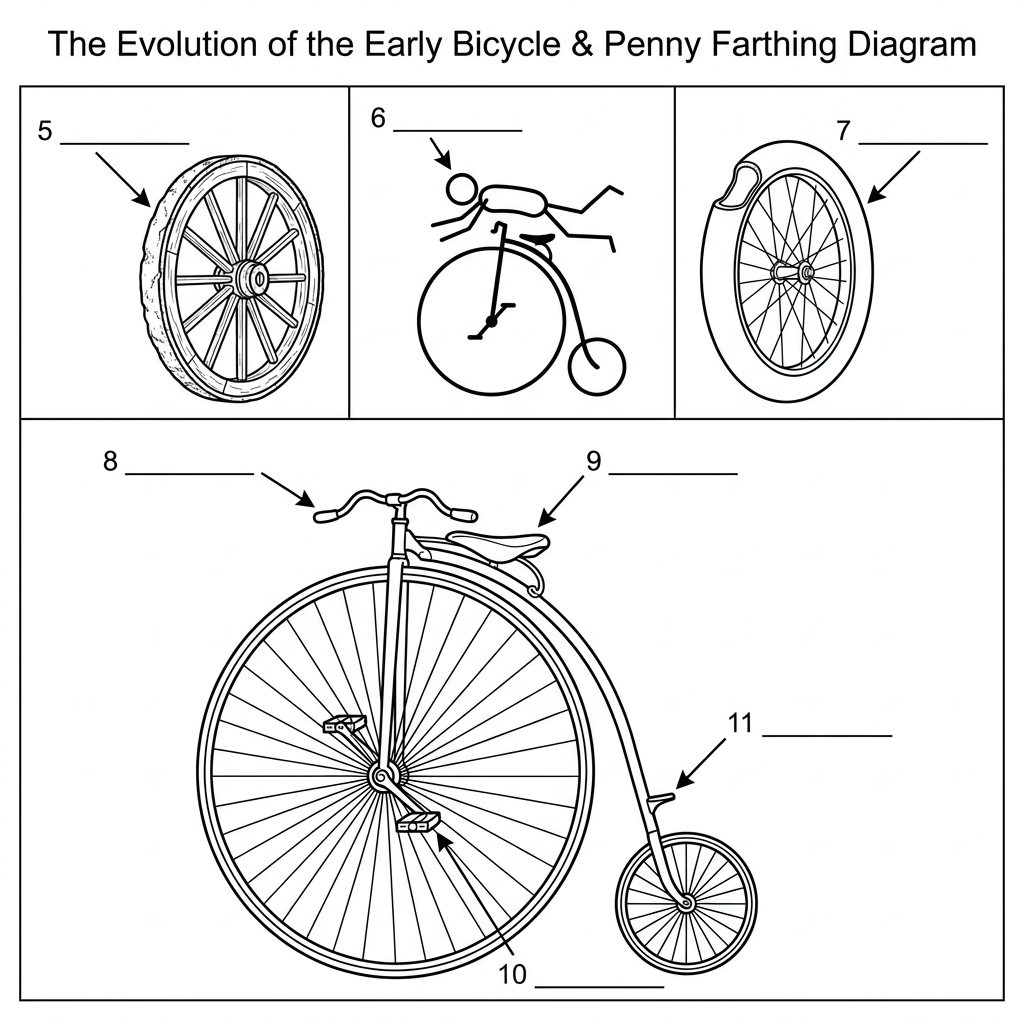
8. ____________________
Show answer 8
handlebars or moustache-shaped handlebars
9. ____________________
Show answer 9
saddle or the saddle
10. ____________________
Show answer 10
pedals or the pedals
11. ____________________
Show answer 11
mounting peg or the mounting peg
Passage 8
The Evolution of the Atmospheric Diving Suit
Humans have long sought to explore the ocean floor, but water pressure and the need for air restricted early divers. Free-diving allowed only brief glimpses, and early diving bells provided air but limited mobility. To truly walk the ocean floor, inventors realized they needed a suit that could withstand immense pressure while maintaining normal atmospheric conditions inside.
The earliest recorded enclosed diving apparatus was created by an English merchant, John Lethbridge, in 1715. His device was essentially a reinforced wooden barrel with a glass viewing window and two leather sleeves for the diver's arms. While it allowed Lethbridge to successfully salvage cargo from shallow shipwrecks, it was severely limited. The water pressure on the leather sleeves meant that beyond a depth of 15 metres, the diver could not move their arms.
The quest for a fully mobile, humanoid-shaped suit led to the first true 'Atmospheric Diving Suit' (ADS). In 1882, two French brothers, Alphonse and Théodore Carmagnolle, patented a remarkable metal suit. It featured 22 rolling convolute joints, allowing for unprecedented theoretical movement. However, the Carmagnolle suit was deeply flawed. The joints could not be made completely watertight, and the suit was impractically heavy, meaning it never saw active commercial use.
It was not until the 1920s that a functional ADS was successfully deployed. The German engineering firm Neufeldt and Kuhnke developed a steel suit that relied on ball-bearing joints. This suit was famously used during the 1920s and 30s to salvage gold from the sunken British ship SS Egypt. While the diver could not swim, they could be lowered to the wreck and use the suit's simple claw-like hands to direct explosives and grab items. Yet, at depths exceeding 100 metres, the ball-bearing joints still seized up under the immense water pressure.
The major breakthrough in ADS technology occurred in the late 1960s with the creation of the JIM suit. Named after Jim Jarrett, the chief diver of its early prototype, the suit was pioneered by engineers Mike Humphrey and Mike Borrow. The JIM suit solved the pressure problem using a revolutionary liquid-supported joint design. Because the joints were filled with oil, which does not compress, the diver could flex their arms and legs effortlessly even at depths of 300 metres.
Constructed from a lightweight magnesium alloy, the JIM suit looked like a piece of space equipment. It completely eliminated the danger of decompression sickness (the 'bends') because the internal air pressure remained identical to that at the surface. A diver could work on an underwater oil rig for hours and return to the surface immediately without spending days in a decompression chamber.
The anatomy of the JIM suit was highly specialized. The top of the suit featured a large, transparent acrylic dome, granting the pilot a wide field of vision. Inside the main body was an independent life-support system comprising oxygen cylinders and carbon dioxide scrubbers, meaning the suit did not require an air hose attached to the surface. The arms ended in mechanical manipulators—pincer-like tools that could be swapped out depending on the task, such as cutting wires or turning bolts. Movement was achieved by walking on the sea floor, and stability was maintained by heavy lead ballast weights attached to the boots, which could be jettisoned in an emergency to allow the suit to float to the surface.
Questions 1-5
Answer the questions below. Choose no more than three words and/or a number from the text for each answer.
1. What material was used to make the arm coverings of Lethbridge's diving barrel?
Show answer 1
leather
2. How many joints did the Carmagnolle brothers' suit have?
Show answer 2
22 or twenty-two
3. What ship was salvaged using the Neufeldt and Kuhnke suit?
Show answer 3
SS Egypt
4. What substance filled the joints of the JIM suit to prevent them from seizing under pressure?
Show answer 4
oil
5. What serious medical condition did the JIM suit completely eliminate the risk of?
Show answer 5
decompression sickness or the bends
Questions 6-9
Label the diagram below. Choose no more than three words from the text for each answer.
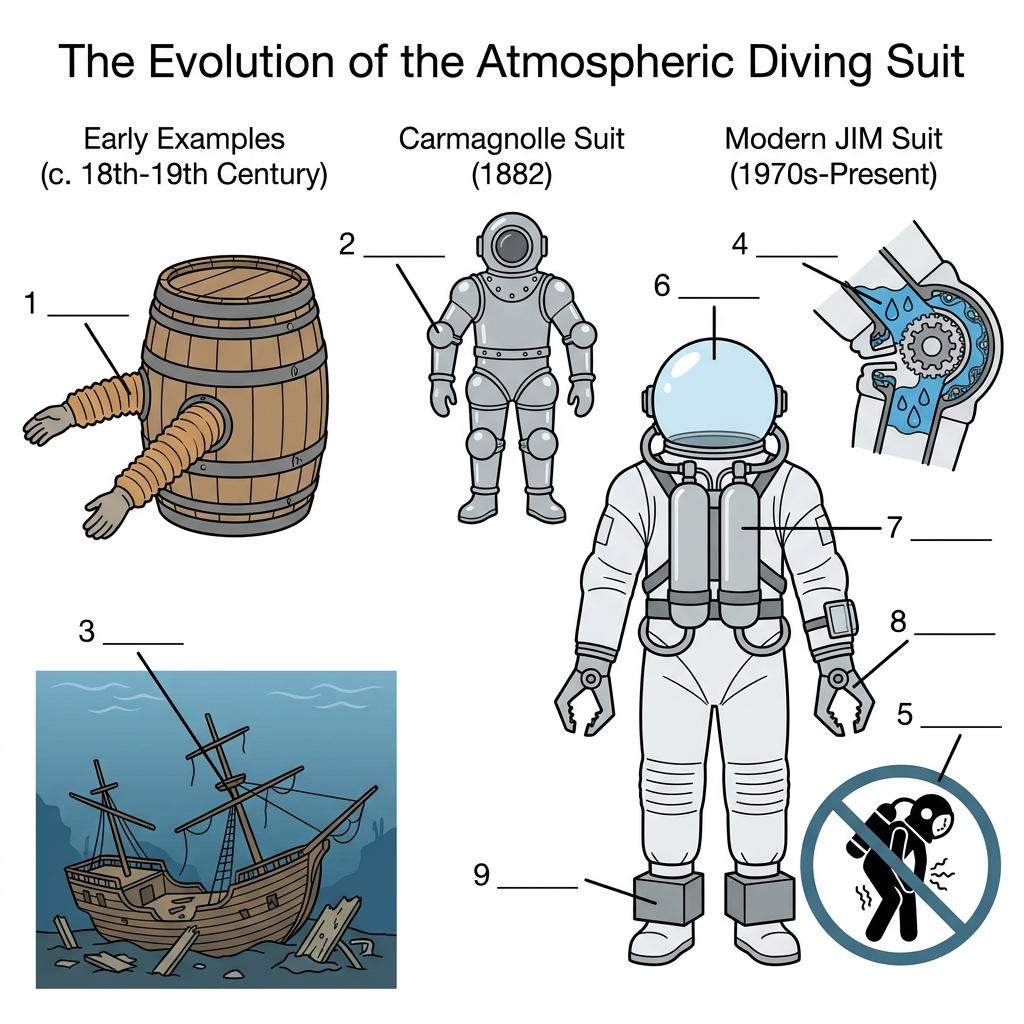
Show answer 6
acrylic dome
Show answer 7
life-support system or independent life-support system or oxygen cylinders
Show answer 8
mechanical manipulators or manipulators
Show answer 9
ballast weights or lead ballast weights
Questions 10-13
Do the following statements agree with the information given in Reading Passage 1?
TRUE if the statement agrees with the information
FALSE if the statement contradicts the information
not given if there is no information on this
- John Lethbridge's diving barrel was used to recover items from deep seawater.
- The Carmagnolle suit was too heavy to be used commercially.
- The inventors of the JIM suit were inspired by the design of spacesuits.
- Divers using the JIM suit required an air hose connected to a surface ship.
Show answers
1. John Lethbridge's diving barrel was used to recover items from deep seawater. — FALSE
2. The Carmagnolle suit was too heavy to be used commercially. — TRUE
3. The inventors of the JIM suit were inspired by the design of spacesuits. — NOT GIVEN
4. Divers using the JIM suit required an air hose connected to a surface ship. — FALSE
Passage 9
The Evolution of the University Library
A. For centuries, the academic library was envisioned primarily as a fortress for the written word. Early university libraries utilized closed-stack systems, meaning students could not browse the shelves directly. Instead, architecture prioritized the preservation of physical texts, with minimal natural light to prevent page fading and strict spatial divisions. The environment was rigorously policed for absolute silence, reflecting a pedagogical belief that learning was a strictly individual and solitary endeavor.
B. The late 20th century introduced a profound shift. The rapid expansion of digital resources meant that vast amounts of information no longer required physical shelf space. Consequently, architects and university planners began to rethink the library's primary function. The concept of the "Learning Commons" emerged, transforming the space from a mere book repository into an active hub for student interaction. This paradigm shift recognized that modern education increasingly relies on group projects and peer-to-peer discussion, necessitating spaces that permit conversation.
C. Architect Julian Vance was at the forefront of this physical transformation. Vance successfully argued that if libraries were to host collaborative work, physical modifications to their sound environments were essential. He pioneered the use of 'acoustic zoning', dividing the library into micro-environments. Ground floors were designated for active group work, utilizing sound-absorbing baffles and carpet tiles to prevent noise from traveling upwards. Upper floors remained dedicated to silent, focused study, creating a vertical gradient of noise tolerance.
D. The transition to these active spaces required a complete overhaul of library furnishings. The heavy, bolted-down wooden carrels of the past were replaced. Modern libraries now favor modular furniture—lightweight tables on casters, flexible seating, and mobile whiteboards. This allows the students themselves to reconfigure the space organically depending on the size of their study group and the demands of their current project.
E. The impact of these modern designs has been actively studied. Sociologist Dr. Elena Rostova conducted extensive research on student habits within these redesigned buildings. Her data revealed that collaborative environments encourage learners to stay significantly longer in the building than they did in previous decades. Rostova concluded that students now view the modern library as a vital "third space"—a distinct, comfortable environment that serves as a bridge between their private residences and formal lecture halls.
F. However, the shift towards the Learning Commons is not without its critics. Professor Marcus Thorne, an educational psychologist, cautions against the wholesale abandonment of traditional library values. Thorne asserts that the disappearance of strictly quiet areas negatively impacts intense concentration and deep cognitive work. He notes that while group areas are popular, the remaining silent zones are frequently oversubscribed during exam periods, suggesting that students still fundamentally crave spaces devoid of distraction.
Questions 1-4
Look at the following statements (Questions 1-4) and the list of people below.
Match each statement with the correct person, A, B, or C.
Select the correct letter in boxes 1-4 on your answer sheet.
NB You may use any letter more than once.
List of People
A. Julian Vance
B. Elena Rostova
C. Marcus Thorne
- Physical modifications to sound environments were necessary to accommodate new learning styles.
- The disappearance of quiet areas negatively impacts intense concentration.
- Collaborative environments encourage learners to stay longer in the building.
- Students now view the library as a distinct environment separate from their residence or lecture halls.
Show answers
1. Physical modifications to sound environments were necessary to accommodate new learning styles. — A. Julian Vance
2. The disappearance of quiet areas negatively impacts intense concentration. — C. Marcus Thorne
3. Collaborative environments encourage learners to stay longer in the building. — B. Elena Rostova
4. Students now view the library as a distinct environment separate from their residence or lecture halls. — B. Elena Rostova
Questions 5-8
Do the following statements agree with the information given in Reading Passage 1?
In boxes 5-8 on your answer sheet, select:
TRUE if the statement agrees with the information
FALSE if the statement contradicts the information
not given if there is no information on this
- Early university libraries were primarily designed to protect physical texts.
- The transition to digital resources completely eliminated the need for physical books.
- Modular furniture is more expensive to maintain than traditional wooden carrels.
- Modern libraries use distinct acoustic zones to manage different noise levels.
Show answers
1. Early university libraries were primarily designed to protect physical texts. — TRUE
2. The transition to digital resources completely eliminated the need for physical books. — FALSE
3. Modular furniture is more expensive to maintain than traditional wooden carrels. — NOT GIVEN
4. Modern libraries use distinct acoustic zones to manage different noise levels. — TRUE
Questions 9-13
Complete the summary below.
Choose one word only from the passage for each answer.
Write your answers in boxes 9-13 on your answer sheet.
The late 20th century saw the rise of the 'Learning Commons' due to the expansion of _______ (9) resources. This new model moved away from the idea that learning was purely a _______ (10) activity. To support group work, heavy wooden desks were discarded in favor of _______ (11) furniture that students can easily rearrange. Additionally, architects introduced _______ (12) zoning to manage noise levels across different floors. As a result of these changes, research shows that students treat the library as a _______ (13) space, distinct from their homes and classrooms.
Show answers
9. digital
10. solitary
11. modular
12. acoustic
13. third
Passage 10
The Development of the Hovercraft
In the early 1950s, British engineer Christopher Cockerell began exploring ways to increase the speed of boats. He identified that the primary obstacle to achieving higher speeds was the friction created between a ship's hull and the water. Cockerell theorised that if a vessel could be lifted entirely out of the water and supported by a cushion of pressurised air, this drag could be virtually eliminated, allowing the craft to travel significantly faster while using less energy.
To test his theory of a 'momentum curtain'—a method of trapping air to create a high-pressure cushion—Cockerell constructed a rudimentary model. He demonstrated the concept using two empty cylindrical cans: a cat food tin placed inside a slightly larger coffee tin. By blowing air through the gap between the tins using an ordinary hairdryer, he proved that a high-pressure ring of air could effectively trap a cushion of air in the centre, providing substantial lifting force.
Despite the success of his scale models, Cockerell struggled to gain immediate commercial backing. The British military took an interest in the technology, but rather than funding a commercial venture, they classified the project as a state secret, believing it had potential as a stealth military vehicle. It was not until the project was finally declassified in 1958 that real progress was made. A British aviation company, Saunders-Roe, was commissioned to build the first full-scale prototype, named the SR.N1. In 1959, this pioneering craft successfully crossed the English Channel, proving the viability of the hovercraft to the world.
The basic anatomy of a hovercraft involves several key components working in unison. A large internal fan draws in air from the outside and channels it downwards beneath the craft. This creates the high-pressure air cushion necessary for lift. To prevent this air from escaping instantly from the sides and to give the craft greater clearance over uneven surfaces or waves, a flexible rubber skirt is attached around the lower perimeter of the hull. Because the craft is suspended in the air, traditional marine propellers are useless for forward movement. Instead, a separate propeller is mounted on the roof of the vehicle to provide forward thrust, while rudders are positioned directly behind this propeller to allow the pilot to steer the vehicle left or right.
The golden age of the commercial hovercraft peaked in the 1970s and 1980s with the massive SR.N4 models, which could carry hundreds of passengers and dozens of cars across the English Channel in a fraction of the time taken by conventional ferries. However, the commercial dominance of these giant craft was not to last. The introduction of the Channel Tunnel in 1994 provided a reliable, weather-independent alternative for fast cross-channel travel. Combined with rising fuel costs and the development of highly efficient wave-piercing catamarans, the large passenger hovercraft were eventually rendered economically unviable and the cross-channel service was discontinued.
Today, while no longer a staple of commercial mass transit, the hovercraft remains an invaluable tool in specialised fields. Its unique ability to traverse shallow water, mud, ice, and swamps makes it ideal for search and rescue operations, as well as military beach landings, ensuring Cockerell's invention maintains an enduring legacy.
Questions 1-4
Do the following statements agree with the information given in the reading passage?
Choose:
TRUE if the statement agrees with the information
FALSE if the statement contradicts the information
not given if there is no information on this
- Cockerell's primary motivation was to overcome the friction between a boat's hull and the water.
- The British military immediately funded a commercial passenger service based on Cockerell's design.
- The SR.N1 was the largest hovercraft ever constructed in Britain.
- The addition of a flexible rubber skirt improved the hovercraft's ability to travel over waves.
Show answers
1. Cockerell's primary motivation was to overcome the friction between a boat's hull and the water. — TRUE
2. The British military immediately funded a commercial passenger service based on Cockerell's design. — FALSE
3. The SR.N1 was the largest hovercraft ever constructed in Britain. — NOT GIVEN
4. The addition of a flexible rubber skirt improved the hovercraft's ability to travel over waves. — TRUE
Questions 5-7
Answer the questions below using no more than three words from the passage for each answer.
5. What common household appliance did Cockerell use in his first scale model?
Show answer 5
ordinary hairdryer or hairdryer or an ordinary hairdryer
6. Which company constructed the first full-scale hovercraft prototype?
Show answer 6
Saunders-Roe or Saunders Roe
7. What major infrastructure project contributed to the decline of cross-channel hovercraft services?
Show answer 7
Channel Tunnel or the Channel Tunnel
Questions 8-11
Label the diagram below using no more than two words from the passage for each answer.
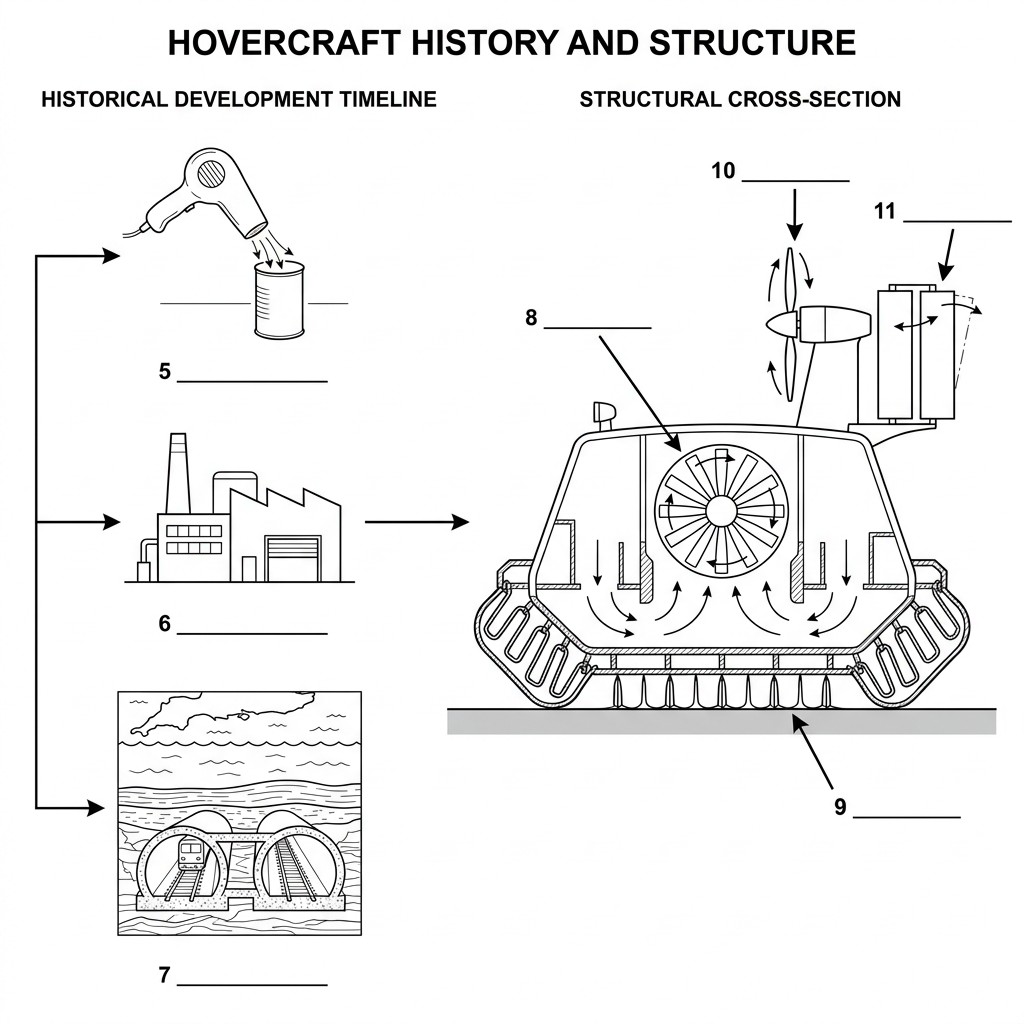
8. A =
Show answer 8
internal fan or fan
9. B =
Show answer 9
rubber skirt or flexible skirt or skirt
10. C =
Show answer 10
separate propeller or propeller
11. D =
Show answer 11
rudders
Passage 11
The Pioneers of Gliding Flight
For centuries, humanity dreamed of taking to the skies. Early attempts often mimicked birds, with inventors strapping feathered contraptions to their arms and attempting to flap their way into the air. The true breakthrough in aerodynamics came in 1799 when the British engineer Sir George Cayley established the modern concept of the fixed-wing flying machine. Cayley realised that flapping wings were inefficient for human flight. Instead, he separated the mechanisms of lift and thrust, designing unpowered aircraft with fixed wings to provide lift and a separate tail mechanism for stability. His theories laid the groundwork for the modern glider.
While Cayley established the theory, it was the German engineer Otto Lilienthal who became known as the 'Glider King' in the late nineteenth century. Unlike his predecessors, who relied mostly on theoretical mathematics, Lilienthal believed in practical experimentation. He spent years meticulously observing the flight of storks and gulls, eventually publishing a groundbreaking book in 1889 on the aerodynamics of bird flight. This text became the foundational manual for early aviators.
Using the data he gathered from birds, Lilienthal began constructing his own unpowered flying machines. His first truly successful design, completed in 1891, was known as the Derwitzer Glider. This craft allowed him to make flights of up to 25 metres. Over the next five years, he designed various monoplanes and biplanes. To steer these machines, Lilienthal pioneered the concept of weight shifting. By swinging his torso and legs in different directions, he could alter the centre of gravity and control the glider's path, a method still used by modern hang-glider pilots today.
To maximize his practice time, Lilienthal required a location that would allow him to launch into the wind regardless of its direction. In 1894, he constructed an artificial hill in Lichterfelde, near Berlin, which he called the Fliegeberg. Standing 15 metres high, this conical mound enabled him to make over two thousand successful flights. His leaps from the Fliegeberg attracted photographers and journalists from around the world, making him the first globally recognized aviator.
The construction of Lilienthal's gliders was remarkably simple yet effective. The main framework was constructed from stripped willow wands, chosen for their unique combination of flexibility and strength. This wooden skeleton was then tightly covered with a tough cotton fabric to form the aerodynamic lifting surface. At the rear of the craft, a stabilizing tail was securely attached to prevent the glider from pitching unpredictably in the wind. The pilot was suspended in the middle of the apparatus by resting their arms on a padded central frame, allowing their legs to dangle freely for both the running takeoff and the landing.
Despite his immense skill, gliding remained a highly dangerous pursuit. In August 1896, while testing a new glider design, a sudden gust of wind caused his craft to stall and crash from a height of 15 metres. Lilienthal succumbed to his injuries the following day. Although he did not live to see the dawn of powered flight, his rigorous scientific approach and extensive flight logs directly inspired the Wright brothers, who would eventually achieve the first successful powered flight in 1903.
Questions 1-5
Do the following statements agree with the information given in Reading Passage 1?
In boxes 1-5 on your answer sheet, write:
TRUE if the statement agrees with the information
FALSE if the statement contradicts the information
not given if there is no information on this
Classify the statements as TRUE, FALSE, or not given.
- Sir George Cayley believed that human flight should involve flapping wings.
- Otto Lilienthal's 1889 book was based on his observations of birds.
- The Derwitzer Glider was the first aircraft to ever carry a passenger.
- Natural hills near Berlin were not steep enough for Lilienthal's experiments.
- Lilienthal's method of steering is still utilized in some forms of aviation today.
Show answers
1. Sir George Cayley believed that human flight should involve flapping wings. — FALSE
2. Otto Lilienthal's 1889 book was based on his observations of birds. — TRUE
3. The Derwitzer Glider was the first aircraft to ever carry a passenger. — NOT GIVEN
4. Natural hills near Berlin were not steep enough for Lilienthal's experiments. — NOT GIVEN
5. Lilienthal's method of steering is still utilized in some forms of aviation today. — TRUE
Questions 6-9
Answer the questions below. Choose no more than three words from the passage for each answer.
Write your answers in boxes 6-9 on your answer sheet.
6. What was the name of the aircraft Lilienthal successfully flew in 1891?
Show answer 6
Derwitzer Glider or the Derwitzer Glider
7. What technique did Lilienthal use to direct the movement of his gliders?
Show answer 7
weight shifting
8. What did Lilienthal build in 1894 to allow flights in any wind direction?
Show answer 8
an artificial hill or Fliegeberg or the Fliegeberg
9. Who successfully achieved powered flight in 1903 using Lilienthal's research?
Show answer 9
the Wright brothers or Wright brothers
Questions 10-13
Label the diagram below using no more than two words from the passage for each answer.
Write your answers in boxes 10-13 on your answer sheet.
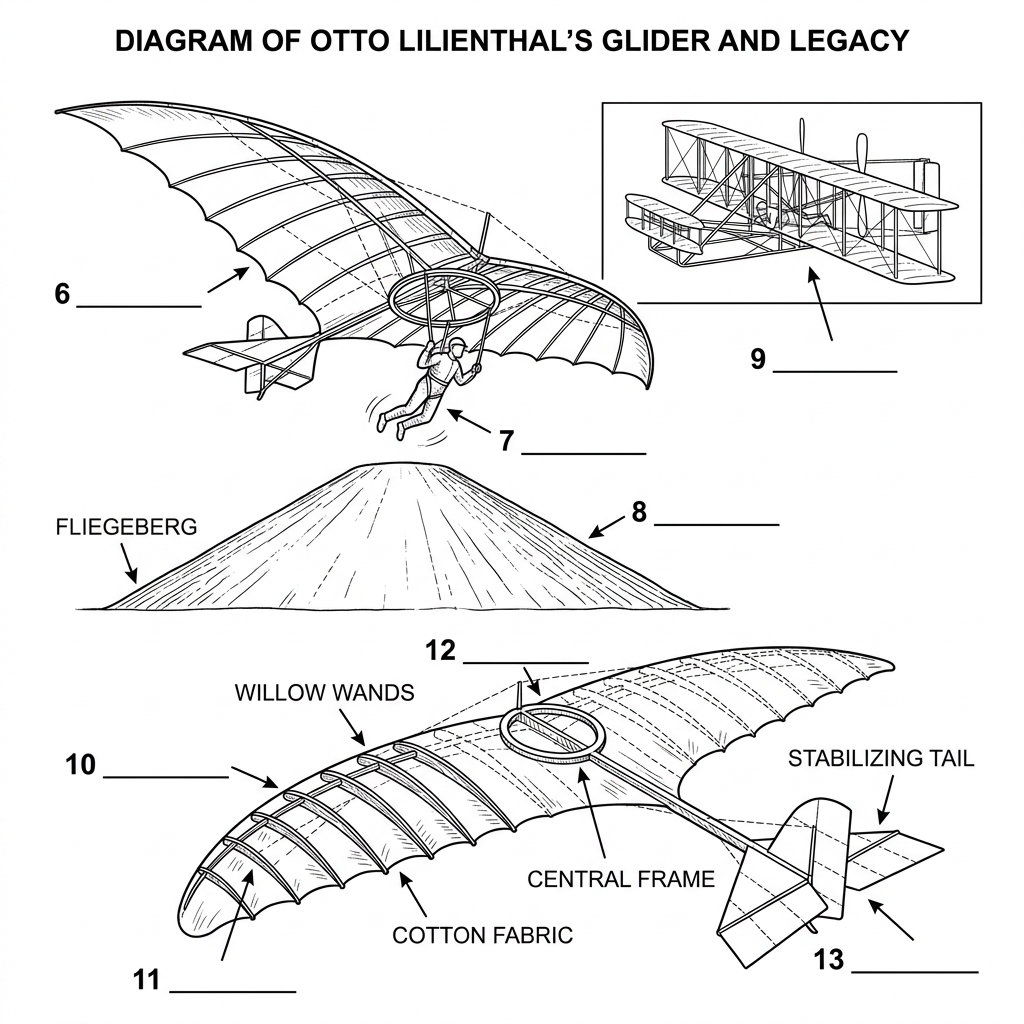
10. framework made of ____________
Show answer 10
willow wands
11. lifting surface made of ____________
Show answer 11
cotton fabric
12. padded ____________ supporting the pilot
Show answer 12
central frame
13. ____________ at the rear for balance
Show answer 13
stabilizing tail
Passage 12
The Evolution of the Parachute
While the concept of a parachute was famously sketched by Leonardo da Vinci in the 15th century, the first practical demonstration of a descent using a parachute is largely attributed to the French inventor Sebastien Lenormand in 1783. Lenormand successfully jumped from the tower of the Montpellier observatory using a rigid frame with a canvas canopy. He coined the term 'parachute', combining the Italian prefix 'para', meaning 'against', and the French word 'chute', meaning 'fall'. His work primarily served to demonstrate how people might escape from burning buildings, but it captured the attention of early aeronauts.
It was another Frenchman, Andre-Jacques Garnerin, who made the first successful descent using a frameless parachute in 1797. Garnerin dropped from a hot air balloon at a height of 1,000 metres over Paris. His parachute was made of white canvas and resembled a large umbrella. Unlike modern parachutes, Garnerin’s device oscillated wildly during the descent, a problem he later solved by adding a vent at the top of the canopy to allow air to pass through in a controlled manner. This addition significantly improved the stability of the fall and remains a fundamental feature in parachute design today.
The transition from canvas to silk was a major milestone in parachute manufacturing. Silk was lighter, stronger, and more readily folded, making it the ideal material. In 1907, the American inventor Charles Broadwick demonstrated the first folded parachute packed into a knapsack that the user could wear. Broadwick also introduced the static line – a cord attached to the aircraft that automatically pulled the parachute out of its pack as the jumper fell away. A few years later, the manually operated ripcord was developed, allowing the user to deploy the parachute at a chosen moment, which was crucial for escaping disabled aircraft.
During the First World War, parachutes were mainly used by observation balloonists, as military commanders initially feared that equipping airplane pilots with parachutes would encourage them to abandon their aircraft prematurely. By the Second World War, however, parachutes had become standard safety equipment for all aviators and were also used extensively to deploy troops and supplies into combat zones. When silk supplies from Asia were cut off during the war, manufacturers rapidly switched to nylon, a newly invented synthetic fabric that offered superior elasticity and resistance to mildew.
Today, there is a wide variety of parachute designs, but the fundamental components remain quite standard. The main fabric portion, known as the canopy, is responsible for creating the air resistance needed to slow the descent. It is connected to the jumper by a series of strong nylon cords called suspension lines, which gather at the risers and attach securely to the harness worn by the parachutist. The entire system is packed into a container. Most modern sport parachutes also feature a small, spring-loaded pilot chute. When the jumper pulls the ripcord, the pilot chute springs out, catches the wind, and pulls the main canopy out of the container.
Piloting a modern parachute, especially the rectangular ram-air canopies used in sports, takes considerable skill and instruction. Jumpers can control their speed and direction by pulling on steering toggles attached to the suspension lines. Although skydiving is an extreme sport, it is heavily regulated by bodies such as the United States Parachute Association (USPA), which was founded to promote safe skydiving practices. The USPA issues licenses and oversees training programs for novices. A significant modern safety innovation is the Automatic Activation Device (AAD). This small computer constantly monitors the jumper's altitude and speed; if the jumper is falling too fast at a dangerously low altitude, the AAD automatically deploys the reserve parachute, saving countless lives.
Questions 1-4. Do the following statements agree with the information given in the reading passage?
- TRUE if the statement agrees with the information
- FALSE if the statement contradicts the information
- not given if there is no information on this
Select TRUE, FALSE, or not given for each statement.
- Leonardo da Vinci was the first person to successfully demonstrate a parachute jump.
- Garnerin’s first parachute descent was made from a hot air balloon.
- Charles Broadwick's knapsack parachute was initially rejected by the military.
- Nylon was adopted for parachute manufacturing before the First World War.
Show answers
1. Leonardo da Vinci was the first person to successfully demonstrate a parachute jump. — FALSE
2. Garnerin’s first parachute descent was made from a hot air balloon. — TRUE
3. Charles Broadwick's knapsack parachute was initially rejected by the military. — NOT GIVEN
4. Nylon was adopted for parachute manufacturing before the First World War. — FALSE
Questions 5-7. Answer the questions below using no more than three words from the passage for each answer.
5. From what type of disaster did Lenormand intend his parachute to help people escape?
Show answer 5
burning buildings or from burning buildings
6. What development allowed jumpers to deploy their parachute at a chosen moment?
Show answer 6
manually operated ripcord or the ripcord or ripcord
7. What modern safety equipment ensures a parachute opens if the jumper is falling too quickly?
Show answer 7
Automatic Activation Device or AAD or the Automatic Activation Device or the AAD
Questions 8-11. Label the diagram below using no more than two words from the passage for each answer.
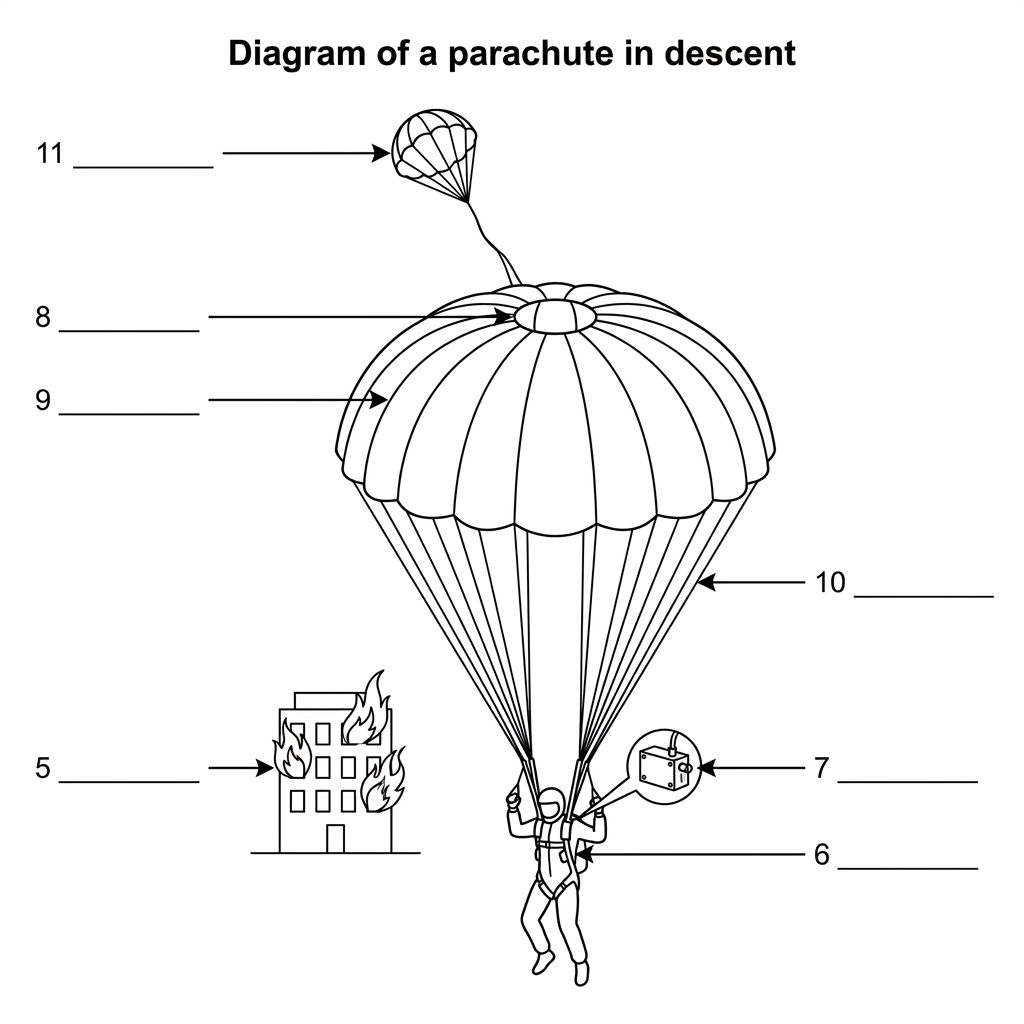
8. A =
Show answer 8
vent or a vent
9. B =
Show answer 9
canopy or the canopy
10. C =
Show answer 10
suspension lines
11. D =
Show answer 11
pilot chute or a pilot chute
Passage 13
The Evolution of Deep-Sea Diving Suits
For centuries, humanity has looked at the ocean and wished to explore its depths. Early attempts to discover what lay beneath the waves relied solely on a person's ability to hold their breath. While pearl divers and sponge gatherers could reach modest depths for brief periods, the human body cannot survive for long without a continuous supply of oxygen. The desire to stay underwater longer and go deeper eventually led to the invention of specialized diving equipment.
The first major breakthrough in personal diving gear occurred in the early 19th century with the invention of the standard diving dress. In the 1820s, the Deane brothers in England developed a basic smoke helmet intended for firefighters, which they later adapted for underwater salvage work. However, this early helmet was open at the bottom, meaning water could rush in if the diver leaned over. It was the engineer Augustus Siebe who improved this design in 1837 by creating a completely sealed system.
Siebe’s design became the blueprint for diving operations for over a century. It consisted of a spun copper helmet tightly attached to a waterproof canvas suit. Air was continuously supplied to the diver through a long flexible hose that was connected to a hand-powered air pump on a surface vessel. An exhaust valve on the side of the helmet allowed used air to escape into the water as bubbles. To counteract the natural buoyancy of the air-filled suit, heavy lead weights were strapped to the diver's chest and back. Finally, weighted boots made of leather and lead were worn to help the diver sink quickly and remain upright on the sea floor.
Despite its commercial success, the standard diving dress had significant physiological drawbacks. Divers wearing these suits were exposed to the ambient pressure of the deep water. If they returned to the surface too quickly after a deep dive, they risked developing decompression sickness. This is a painful and sometimes fatal condition caused by nitrogen bubbles forming in the bloodstream as the surrounding water pressure suddenly drops. Consequently, deep dives required dangerously long and slow ascents to safety.
To protect divers from immense underwater pressure, inventors began working on atmospheric diving suits (ADS). These were essentially wearable, human-shaped submarines that maintained normal surface pressure internally, regardless of the depth. In 1882, the Carmagnolle brothers designed an early ADS made entirely of cast iron. It featured a domed helmet with multiple small glass viewing ports to give the diver a wide field of vision. Unfortunately, the suit weighed over 300 kilograms, and its complex fabric joints leaked heavily under pressure, rendering it unsafe for actual use in the ocean.
It was not until the 1970s that a truly successful atmospheric suit was deployed. Named the JIM suit, it was constructed from a lightweight magnesium alloy rather than heavy iron. The JIM suit featured revolutionary articulated joints filled with oil that allowed the diver to bend their arms and legs with relative ease while remaining completely protected from the crushing weight of the deep ocean. Because the internal pressure remained constant, the diver could breathe normally and return to the surface immediately without the need for a lengthy decompression process.
Today, while remote-operated vehicles (ROVs) perform many of the most dangerous deep-sea tasks, the technology behind the JIM suit lives on. Modern atmospheric diving systems are still utilized for complex underwater construction, scientific research, and submarine rescue missions, proving that the desire to place humans safely on the ocean floor remains as strong as ever.
Questions 1-6
Answer the questions below.
Choose no more than three words from the passage for each answer.
1. What profession originally used the protective headgear designed by the Deane brothers?
Show answer 1
firefighters or fire fighters
2. What was the sealed suit in Augustus Siebe's design made of?
Show answer 2
waterproof canvas or canvas
3. What dangerous condition is caused by nitrogen bubbles in a diver's blood?
Show answer 3
decompression sickness
4. What material did the Carmagnolle brothers use to build their atmospheric diving suit?
Show answer 4
cast iron or iron
5. What specific part of the 1882 diving suit leaked when exposed to pressure?
Show answer 5
fabric joints or complex fabric joints or joints
6. What modern machines now carry out many deep-water jobs instead of humans?
Show answer 6
remote-operated vehicles or ROVs
Questions 7-13
Label the diagram below.
Choose no more than two words from the passage for each answer.
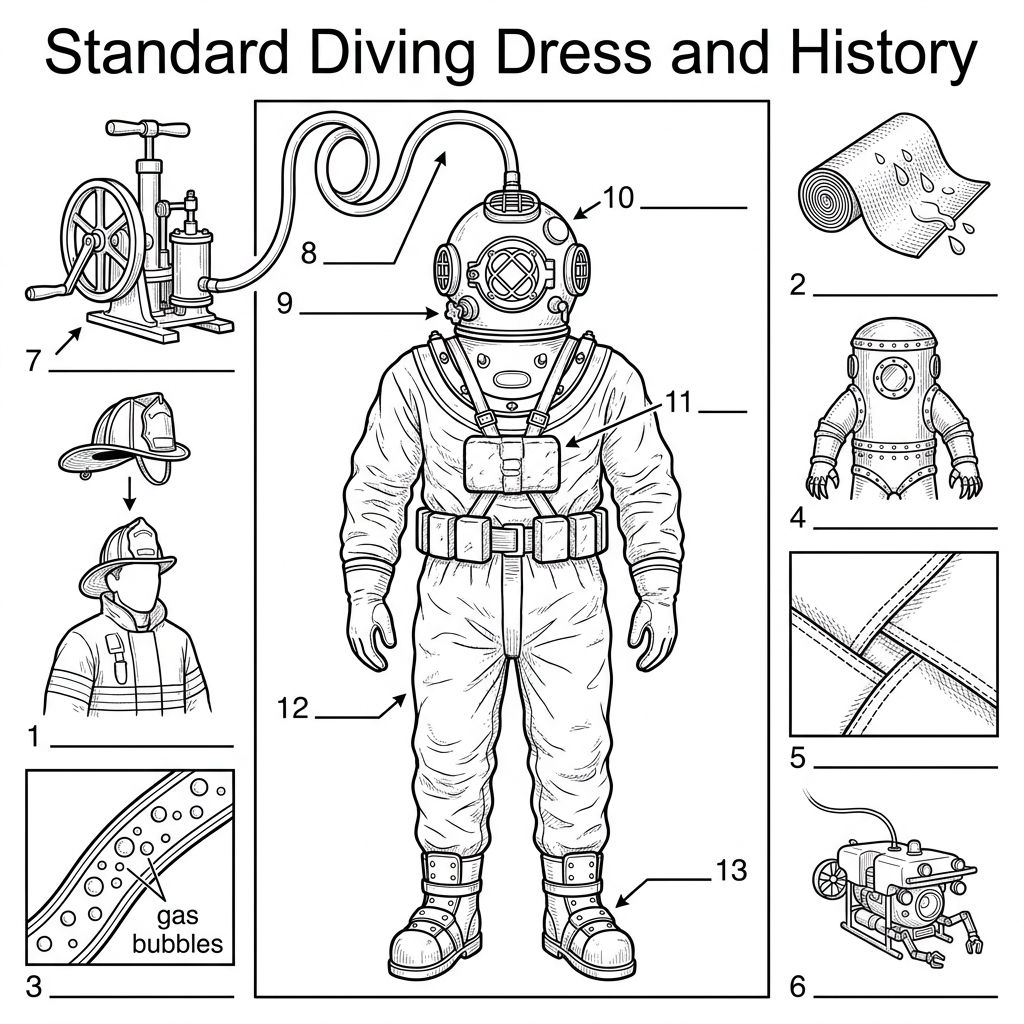
Show answer 7
air pump
Show answer 8
flexible hose or hose
Show answer 9
exhaust valve or valve
Show answer 10
copper helmet or helmet
Show answer 11
lead weights or weights
Show answer 12
canvas suit or waterproof suit or suit
Show answer 13
weighted boots or boots
Passage 14
The Recovery of the HMS Valiant
On 14 November 1692, the British galleon HMS Valiant was navigating the treacherous waters off the coast of Cornwall when it was caught in a massive, unseasonal storm. The ship had been commissioned only a year earlier and was carrying an impressive arsenal of heavy bronze cannons. Despite the crew's desperate attempts to steer the vessel to safety, the Valiant struck a submerged reef and sank rapidly. Accounts from the few survivors indicated that the ship was heavily weighed down by its armaments, which contributed to its swift descent. The tragic event claimed the lives of over 300 sailors and marines, and early salvage attempts organized by the Royal Navy the following spring were quickly abandoned due to the depth and dangerous local currents.
For centuries, the HMS Valiant lay undisturbed on the ocean floor. The vessel came to rest on its port side, settling deep into a trench. The swift-moving currents of the Cornish coast gradually deposited a thick layer of fine sand over the lower half of the hull. This sandy blanket created an anaerobic (oxygen-free) environment, successfully protecting the lower timbers from shipworms and other wood-boring marine organisms. However, the exposed upper decks and starboard side were eventually worn away by the relentless mechanical action of the tides and biological decay, leaving only the buried portion of the galleon largely intact.
The first hints of the wreck's survival emerged in 1855. A group of local sponge divers were working in the area when they noticed an unusual shape jutting out from the seabed. It proved to be a heavily encrusted iron anchor. Word of the discovery reached a commercial diver named Thomas Higgins, who subsequently explored the site in 1858. Using primitive diving apparatus, Higgins managed to clear away some debris and successfully hoisted two pristine bronze cannons to the surface. Despite this triumph, the severe weather conditions and unpredictable tides made continued work far too hazardous, and Higgins was forced to abandon the site later that year.
The exact location of the Valiant was lost once again until the latter half of the twentieth century. In 1972, marine archaeologist Dr. Evelyn Reed launched 'Project Deep Watch' with the primary goal of charting historic wrecks along the Cornish coastline. Her ultimate ambition, however, was to locate the legendary Valiant. Initial visual surveys using scuba divers yielded no results. Realizing that conventional methods were insufficient, Reed secured the use of a highly sensitive magnetometer in 1974. This device detects variations in the Earth's magnetic field caused by large iron or bronze objects. Within weeks, the magnetometer registered a significant magnetic anomaly, explicitly pinpointing the wreck's location beneath the sand.
Following test excavations that revealed beautifully preserved wooden decking and a wealth of seventeenth-century artifacts, public enthusiasm surged. To manage the immense task of protecting and potentially raising the ship, the Valiant Heritage Foundation was established in 1978. Extensive underwater structural assessments were carried out. After years of careful planning, the Foundation finally concluded that the surviving hull was robust enough to be lifted. The official recovery operation was authorized, and the physical lifting commenced in the summer of 1985.
Raising the Valiant required a delicate, two-stage engineering approach to prevent the fragile timber shell from breaking apart under its own weight. In the first phase, divers spent months tunneling beneath the wreck to assemble a custom-built steel cradle directly around the hull. Once the cradle was secure, a network of thick steel cables was attached to its sides. To break the powerful suction of the seabed mud, engineers deployed a series of enormous, water-filled pontoon floats. Pumping air into these floats gradually displaced the water, providing a gentle, uniform upward pull that slowly lifted the cradle clear of the sea floor. In the second stage, once the ship was suspended in the water column, a heavy-duty salvage barge was maneuvered above the site. The cables were transferred to the barge's industrial cranes, which carefully hoisted the Valiant entirely out of the water, allowing it to be transported to a specialized conservation facility.
Questions 1-5
Do the following statements agree with the information given in Reading Passage 1?
In boxes 1-5 on your answer sheet, write:
- TRUE if the statement agrees with the information
- FALSE if the statement contradicts the information
- not given if there is no information on this
Select the correct categorization for each statement.
- The HMS Valiant was destroyed during a battle with an opposing naval fleet.
- A lack of oxygen in the sand helped preserve the lower portion of the ship's hull.
- Thomas Higgins earned a significant amount of money from the bronze cannons he recovered.
- Dr. Evelyn Reed's initial visual surveys successfully located the remains of the Valiant.
- The Valiant Heritage Foundation received its initial funding from the British government.
Show answers
1. The HMS Valiant was destroyed during a battle with an opposing naval fleet. — FALSE
2. A lack of oxygen in the sand helped preserve the lower portion of the ship's hull. — TRUE
3. Thomas Higgins earned a significant amount of money from the bronze cannons he recovered. — NOT GIVEN
4. Dr. Evelyn Reed's initial visual surveys successfully located the remains of the Valiant. — FALSE
5. The Valiant Heritage Foundation received its initial funding from the British government. — NOT GIVEN
Questions 6-9
Look at the following statements (Questions 6-9) and the list of dates below.
Match each statement with the correct date, A-G.
Write the correct letter, A-G, in boxes 6-9 on your answer sheet.
List of dates
A 1692
B 1855
C 1858
D 1972
E 1974
F 1978
G 1985
Select the correct date for each statement.
- The exact location of the wreck was pinpointed using magnetic variation technology.
- A formal organization was created to manage the protection of the ship.
- The first evidence of the ship's survival was discovered by chance.
- The hull of the ship was finally brought to the surface.
Show answers
1. The exact location of the wreck was pinpointed using magnetic variation technology. — E (1974)
2. A formal organization was created to manage the protection of the ship. — F (1978)
3. The first evidence of the ship's survival was discovered by chance. — B (1855)
4. The hull of the ship was finally brought to the surface. — G (1985)
Questions 10-13
Label the diagram below.
Choose no more than two words from the passage for each answer.
Write your answers in boxes 10-13 on your answer sheet.
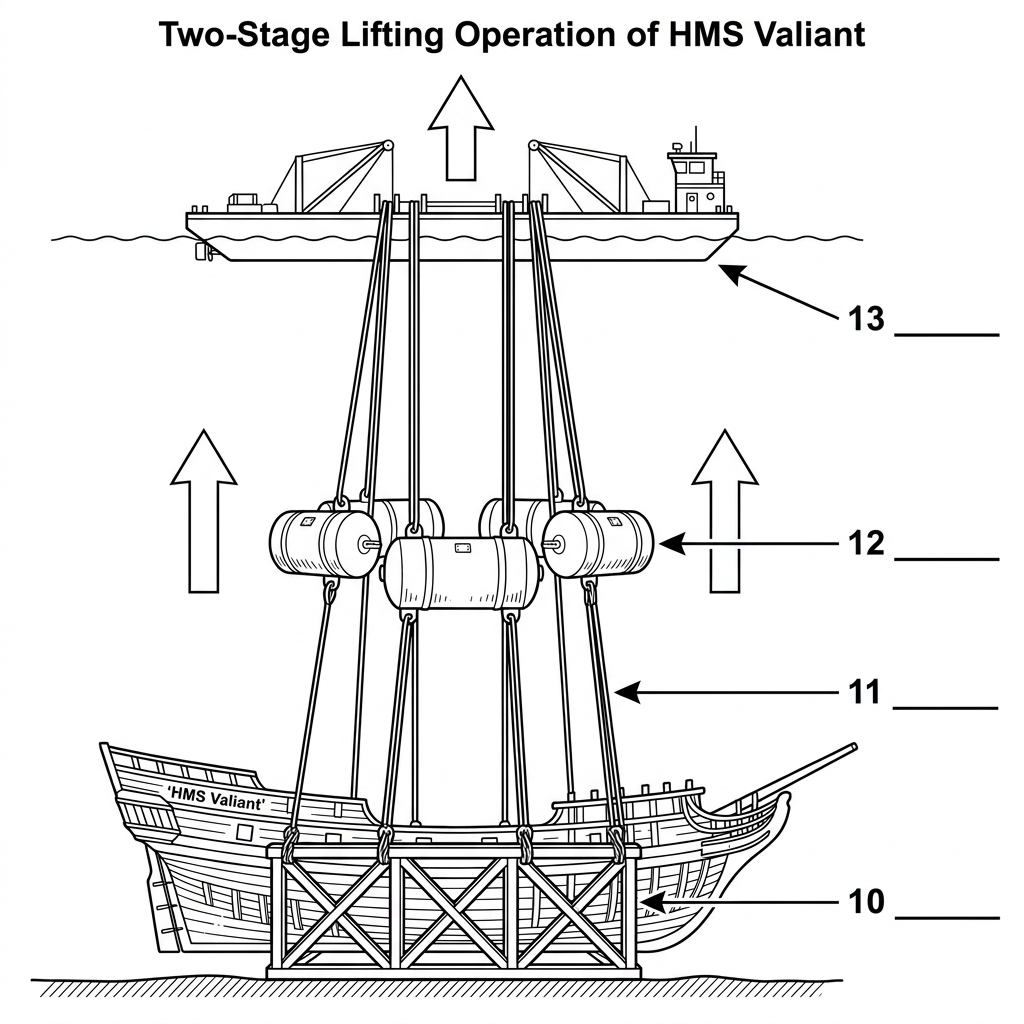
Show answer 10
steel cradle
Show answer 11
steel cables
Show answer 12
pontoon floats
Show answer 13
salvage barge
Passage 15
The Era of the Airship
A. The concept of steering a lighter-than-air craft led to the development of the dirigible, commonly known as the airship. While early non-rigid designs existed, it was the pioneering work of German inventor Count Ferdinand von Zeppelin that brought the rigid airship to prominence. In 1900, his first vessel, the LZ 1, successfully took to the skies over Lake Constance. Unlike simple hot air balloons that were entirely at the mercy of the wind, this massive craft was equipped with internal combustion engines and steering mechanisms, allowing for controlled, independent navigation. Zeppelin’s vision sparked a new era of aviation that would dominate the sky for the early decades of the twentieth century.
B. At the heart of the classic rigid airship was its complex structural design. The framework was constructed from duralumin, a lightweight but exceptionally strong aluminium alloy. This rigid skeleton maintained the ship’s aerodynamic shape regardless of the pressure of the lifting gas inside. Within the duralumin framework were multiple separate compartments called gas cells. These cells contained the lifting gas—initially highly flammable hydrogen, though modern ships exclusively use inert helium. By dividing the gas into separate cells, the airship was safeguarded against a total loss of lift if a single tear occurred. The entire framework was then wrapped in a tightly laced outer cover made of doped fabric, which reduced aerodynamic drag and protected the inner cells from the harsh elements.
C. To achieve forward momentum and directional control, airships relied on an array of external components. Several engines were mounted on the lower exterior of the hull in small, enclosed structures called engine cars or gondolas. These housed the mechanics and the propellers, keeping the dangerous heat and sparks of the engines away from the highly combustible hydrogen. At the rear, or tail, of the airship were the cruciform tail fins, which consisted of vertical rudders for steering left and right, and horizontal elevators to control the pitch (pointing the nose up or down). At the forward underside of the hull hung the control car, where the captain and crew commanded the vessel, managing navigation, communicating with engine cars via telegraphs, and operating the gas release valves.
D. The 1920s and 1930s are often remembered as the golden age of the airship. Vessels like the Graf Zeppelin offered luxurious transatlantic passenger service, featuring dining rooms and sleeping cabins that rivalled the finest ocean liners of the day. However, the reliance on hydrogen gas proved to be a fatal flaw. In 1937, the Hindenburg tragically caught fire while attempting to moor in New Jersey, resulting in significant loss of life. This disaster, captured on film and broadcast worldwide, instantly shattered public confidence in airship travel. Combined with the rapid advancement of faster, heavier-than-air airplanes, the era of the great passenger airships abruptly ended.
E. Despite this dramatic decline, the airship did not disappear entirely. Non-rigid airships, commonly known as blimps, which lack an internal structural framework and rely entirely on internal gas pressure to maintain their shape, found extensive use in aerial advertising and military surveillance. In recent years, there has been a resurgence of interest in semi-rigid and rigid airships. Modern iterations, such as the Zeppelin NT, utilize an internal framework combined with helium, ensuring absolute safety from fire. Today, these modern behemoths are being explored for eco-friendly cargo transport, scientific research, and luxury tourism, proving that lighter-than-air flight still holds a place in the future of aviation.
Questions 1-4
Do the following statements agree with the information given in the reading passage?
Select:
TRUE if the statement agrees with the information
FALSE if the statement contradicts the information
not given if there is no information on this
- Count Ferdinand von Zeppelin invented the first non-rigid airship.
- Duralumin was selected for the framework due to its lightweight and strong properties.
- The Graf Zeppelin was the most profitable passenger airship of its time.
- Helium was the lifting gas utilized in the Hindenburg.
Show answers
1. Count Ferdinand von Zeppelin invented the first non-rigid airship. — FALSE
2. Duralumin was selected for the framework due to its lightweight and strong properties. — TRUE
3. The Graf Zeppelin was the most profitable passenger airship of its time. — NOT GIVEN
4. Helium was the lifting gas utilized in the Hindenburg. — FALSE
Questions 5-8
Label the diagram below using no more than two words from the passage for each answer.
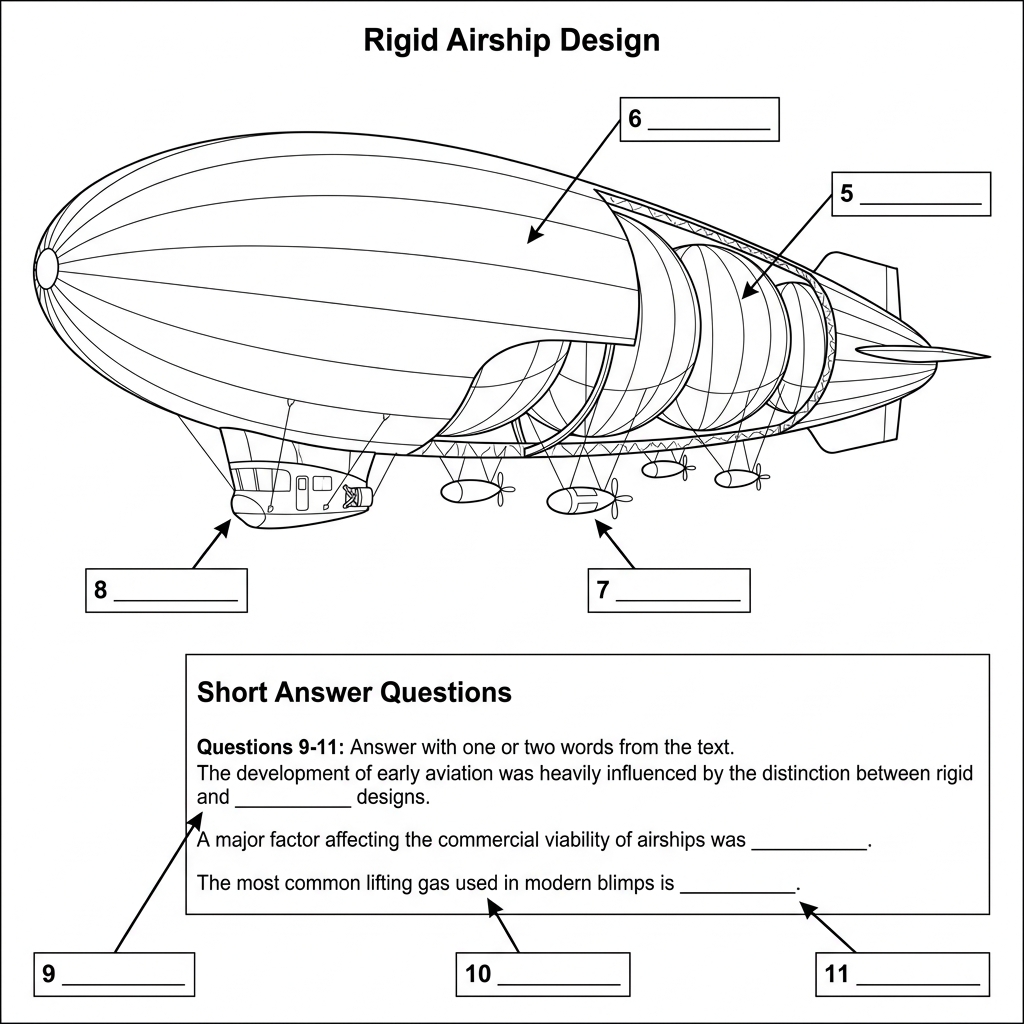
5. A =
Show answer 5
gas cells
6. B =
Show answer 6
outer cover
7. C =
Show answer 7
engine cars or gondolas
8. D =
Show answer 8
control car
Questions 9-11
Answer the questions below using no more than three words from the passage for each answer.
9. What type of craft lacked an internal structural framework?
Show answer 9
non-rigid airships or blimps
10. What did the fatal incident in 1937 shatter regarding airship travel?
Show answer 10
public confidence
11. What inert substance do modern airships use to secure absolute safety from fire?
Show answer 11
helium
Questions 12-13
Choose TWO letters, A-E.
Which TWO of the following modern uses for airships are mentioned in the text?
Which TWO of the following modern uses for airships are mentioned in the text?
A. Military combat
B. Aerial advertising
C. Deep-sea exploration
D. Scientific research
E. High-speed passenger transit
Show answers
B, D
Passage 16
Redesigning Transitional Justice: The Halfway House Experiment
The journey from incarceration back into society is fraught with challenges, often resulting in high rates of re-offending. While much attention is placed on the conditions within prisons, the intermediate step—transitional centers or halfway houses—is frequently overlooked. A new initiative, however, is rethinking the architecture of these facilities in an effort to foster genuine rehabilitation and successful societal reintegration.
Historically, halfway houses have been marginalized, often situated in repurposed, dilapidated industrial buildings or isolated on the outskirts of towns. These structures typically mimic the penal institutions their residents have just left, characterized by high security fences, bleak aesthetics, and rigid, institutional layouts. The psychological impact of such environments is profound, instilling a sense of alienation and reinforcing an institutionalized mindset at a time when individuals are supposed to be preparing for independent living.
Recognizing this critical flaw, the 'Civic Transitions' project, spearheaded by architectural firm Rostova Design, was commissioned to develop a new model for transitional housing. The underlying principle of the project is that physical environments actively shape human behavior and self-perception. Rostova argues that if the goal is to produce responsible community members, the facility itself must resemble a community space rather than a minimum-security fortress.
A central feature of the Rostova model is the deliberate reduction in scale. Rather than housing upwards of a hundred individuals in a single facility, the new centers are designed for a maximum capacity of 15 to 20 residents. This smaller scale promotes social accountability and helps to create a familial, supportive atmosphere. Furthermore, the traditional layout of long, echoing corridors lined with identical doors has been abandoned. Instead, the design utilizes a 'cluster' arrangement, where small groups of rooms open onto a shared communal living space, encouraging interaction and mutual support among residents.
The design of the individual living quarters has also undergone a radical transformation. Moving away from the crowded, multi-bed dormitories of the past, the new model prioritizes single-occupancy rooms. This shift is intended to provide residents with a sense of privacy, dignity, and personal space—elements that are notoriously absent in prison life. Each room is equipped with a built-in desk to facilitate job searching, studying, or skill development. Additionally, large windows are incorporated to maximize natural light, which has been shown to significantly improve mood and reduce anxiety.
Beyond the living quarters, the new facilities integrate essential support services directly into the building's architecture. The ground floor is dedicated to counseling rooms, vocational training workshops, and administrative offices. Crucially, the kitchen is no longer a centralized, cafeteria-style operation. Instead, residents have access to a shared kitchen area where they can cook their own meals. This not only builds practical life skills but also fosters a sense of independence and responsibility.
While the initial construction and operational costs of these redesigned halfway houses are higher than traditional models, proponents argue that the investment is economically sound in the long run. Early data from a pilot facility in Manchester indicates a marked decrease in parole violations and a higher rate of successful job placements among residents. By investing in an environment that actively supports rehabilitation rather than merely housing individuals, society stands to break the costly cycle of re-offending.
Questions 1-5
Complete each sentence with the correct ending, A-H, below. Select the correct letter A-H for each question.
A. develop practical life skills and independence.
B. a sense of isolation and institutionalization.
C. physical surroundings influence self-perception and actions.
D. reduce the overall costs of running the facility.
E. restore privacy and personal dignity to individuals.
F. foster a supportive and accountable social environment.
G. ensure strict security and constant supervision.
H. keep individuals away from local businesses.
- The traditional architecture of halfway houses typically causes
- The core philosophy of the 'Civic Transitions' project is that
- Limiting the number of residents in the new facilities helps to
- The introduction of single-occupancy rooms aims to
- Providing a shared kitchen area allows residents to
Show answers
1. The traditional architecture of halfway houses typically causes — B
2. The core philosophy of the 'Civic Transitions' project is that — C
3. Limiting the number of residents in the new facilities helps to — F
4. The introduction of single-occupancy rooms aims to — E
5. Providing a shared kitchen area allows residents to — A
Questions 6-9
Choose the correct letter A, B, C or D.
6. What is the main problem with historical halfway houses mentioned in the second paragraph?
A. They are located too close to city centers.
B. They resemble the prisons that residents just left.
C. They are too expensive to maintain.
D. They lack adequate security measures.
Show answer 6
B
7. The 'cluster' arrangement in the new design replaces
A. the large capacity of previous facilities.
B. the multi-bed dormitories.
C. the long corridors found in traditional layouts.
D. the ground floor counseling rooms.
Show answer 7
C
8. Why are large windows included in the new individual rooms?
A. To make it easier for staff to monitor residents.
B. To reduce the cost of electricity in the building.
C. To improve residents' mental well-being.
D. To allow residents to communicate with the outside.
Show answer 8
C
9. According to the final paragraph, the initial higher costs of the new model
A. are a major barrier to future projects.
B. are offset by the long-term reduction in re-offending.
C. have caused the Manchester pilot to be delayed.
D. were funded entirely by the local government.
Show answer 9
B
Questions 10-13
Label the diagram below. Write no more than two words from the passage for each answer.
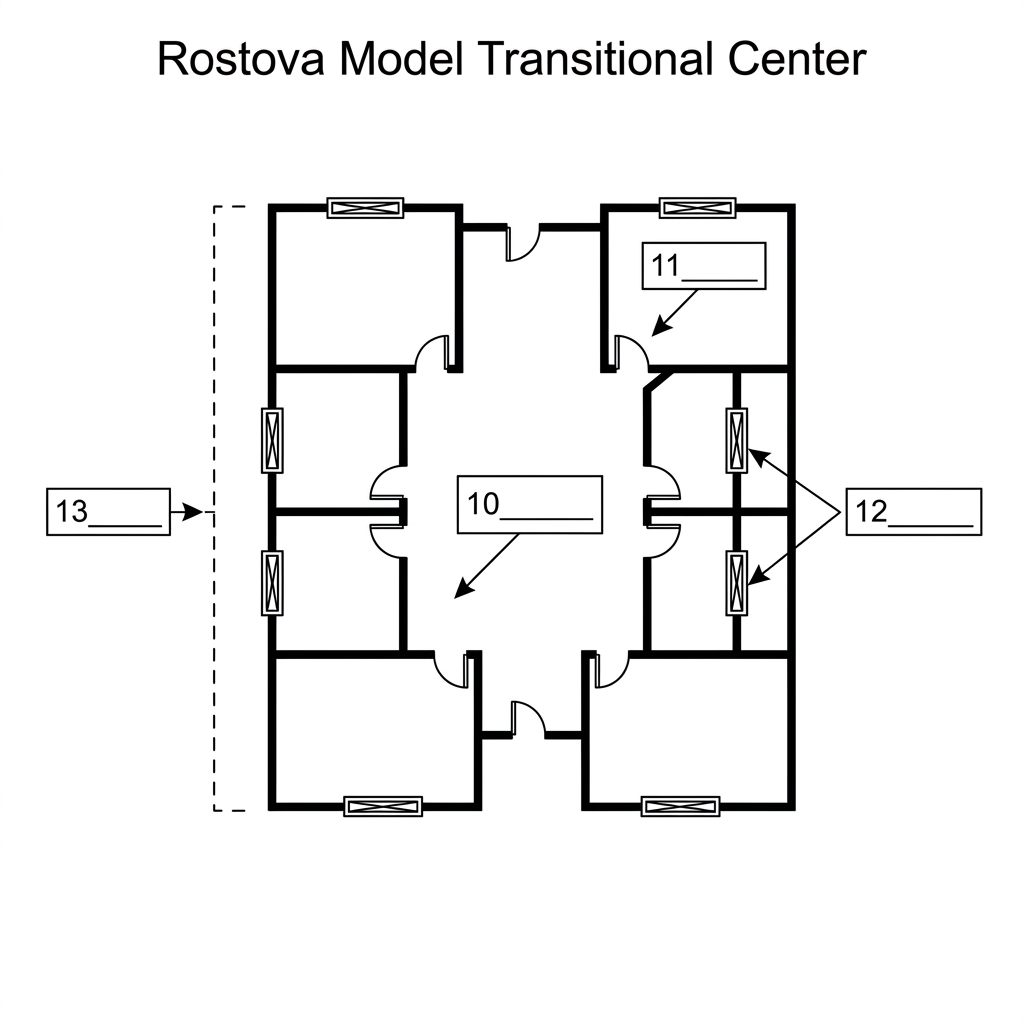
Maximum capacity of 15 to 20 _______ (10)
_______ (11) to maximize natural light
_______ (12) to facilitate job searching
_______ (13) for cooking meals
Show answers
10. residents
11. Large windows
12. Built-in desk
13. Shared kitchen
Passage 17
The Evolution of the Submarine
People have dreamt of traveling beneath the surface of the ocean for centuries. Legend holds that Alexander the Great descended into the sea in a glass barrel, but the first verifiable successfully navigated submarine was built in 1620 by a Dutch engineer named Cornelis Drebbel. Designed to be rowed underwater, Drebbel’s craft consisted of a wooden frame tightly covered in greased leather to make it watertight. It was propelled by oars that protruded through flexible leather seals, allowing the oarsmen to pull the blades through the water without flooding the cabin. Although it successfully transported passengers beneath the River Thames, it was viewed mostly as a novelty rather than a machine with practical applications.
The true potential of the submarine as a military vessel was first explored during the American Revolutionary War. In 1775, David Bushnell invented the "Turtle", a one-person, hand-powered craft shaped like an acorn. The operator would crank propellers to move the vessel and use a foot pedal to pump water in and out for diving and surfacing. The Turtle’s primary mission was to covertly approach British naval ships and attach explosive charges to their hulls. Although the Turtle’s missions were ultimately unsuccessful due to the difficulty of navigating underwater currents and piercing the copper sheathing of enemy ships, it proved that submarines could be used in naval warfare.
Throughout the 19th century, inventors focused on replacing human power with mechanical propulsion. Early attempts included the French vessel "Plongeur", launched in 1863, which used compressed air, and the Spanish "Ictineo II", which utilized a chemical reaction to create steam while simultaneously generating oxygen for the crew. However, the major breakthrough came at the end of the century when the Irish-American inventor John Philip Holland combined an electric motor for submerged travel with a gasoline engine for surface cruising. This dual-propulsion system became the standard for submarines until the advent of nuclear power in the 1950s.
Regardless of their power source, all submarines rely on the same fundamental principle of physics to navigate vertically: buoyancy. According to Archimedes' principle, an object will float if it displaces a weight of water equal to its own weight. To control whether it floats or sinks, a submarine is equipped with ballast tanks located between its inner and outer hulls. When the submarine is on the surface, these ballast tanks are filled with air, giving the vessel positive buoyancy. To submerge, the crew opens valves at the top of the ballast tanks known as vents. The air escapes, and seawater floods into the tanks through openings at the bottom. This increases the overall mass of the submarine, giving it negative buoyancy and causing it to sink.
Once the submarine reaches the desired depth, the crew adjusts the ratio of air and water in the tanks to achieve neutral buoyancy, allowing the vessel to remain suspended underwater without sinking further or rising. When it is time to surface, highly compressed air is forcefully released into the ballast tanks from onboard storage flasks. This high-pressure air pushes the seawater back out through the bottom openings, decreasing the vessel's mass. As positive buoyancy is restored, the submarine rises to the surface.
While ballast tanks control vertical movement, a submarine also needs to navigate horizontally and maintain its orientation. This is achieved using hydroplanes, which are movable wing-like structures located at the front (bow planes) and rear (stern planes) of the vessel. By tilting the hydroplanes, the crew can direct the flow of water over them as the submarine moves forward, pushing the nose of the submarine up or down. At the rear of the submarine, a traditional rudder is used to steer left and right, much like on a surface ship.
Today, submarines are utilized for a variety of purposes beyond military operations. They are essential tools for deep-sea exploration, allowing scientists to study marine biology, underwater geology, and hydrothermal vents. Specialized submersibles are also used in the offshore oil industry to inspect and repair underwater pipelines and cables. Despite their advanced technology, operating a submarine remains inherently dangerous. The immense pressure of the deep ocean means that even a minor structural failure can be catastrophic. Consequently, modern submarines are built with numerous redundant safety systems and are supported by international rescue organizations equipped with specialized deep-submergence rescue vehicles designed to extract crews from stranded submarines.
Questions 1-4
Do the following statements agree with the information given in Reading Passage 1?
TRUE if the statement agrees with the information
FALSE if the statement contradicts the information
not given if there is no information on this
- Cornelis Drebbel’s submarine was primarily used for transporting military supplies.
- The "Turtle" failed to sink British ships because it could not penetrate their protective coating.
- John Philip Holland’s dual-propulsion system was used until the 1950s.
- Modern submarines require less maintenance than early mechanical submarines.
Show answers
1. Cornelis Drebbel’s submarine was primarily used for transporting military supplies. — FALSE
2. The "Turtle" failed to sink British ships because it could not penetrate their protective coating. — TRUE
3. John Philip Holland’s dual-propulsion system was used until the 1950s. — TRUE
4. Modern submarines require less maintenance than early mechanical submarines. — NOT GIVEN
Questions 5-9
Label the diagram below. Choose no more than two words from the passage for each answer.
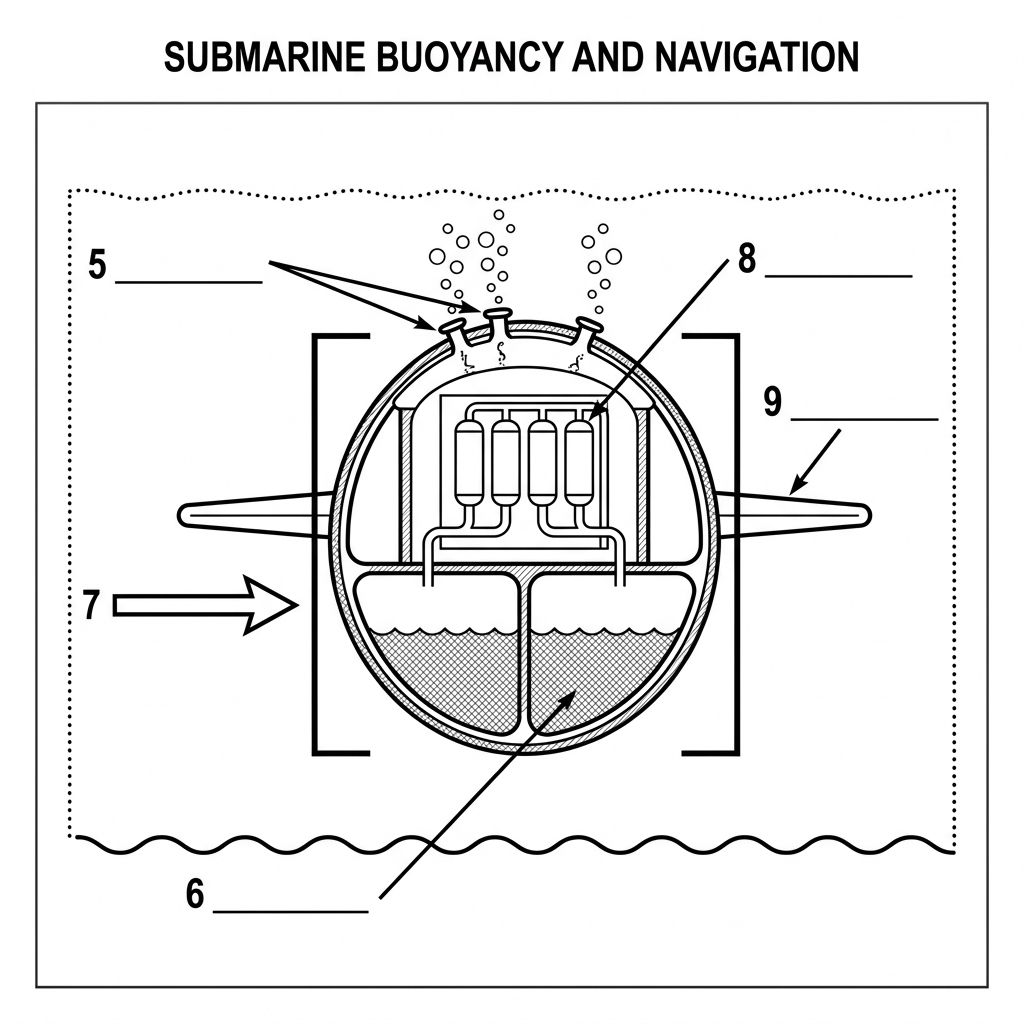
5. Air escapes through: ____________
Show answer 5
vents
6. Water enters the: ____________
Show answer 6
ballast tanks
7. State maintained to stay suspended: ____________
Show answer 7
neutral buoyancy
8. Used to force water out: ____________
Show answer 8
compressed air
9. Wing-like structures for pitch control: ____________
Show answer 9
hydroplanes
Questions 10-13
Complete the summary below. Choose no more than two words from the passage for each answer.
While submarines use ballast tanks for _______ (10) movement, they also rely on other mechanisms for steering. Movable structures called hydroplanes help adjust the vessel's pitch, and a conventional _______ (11) is used to turn left or right. In modern times, submarines serve many non-military roles, such as conducting _______ (12) and maintaining infrastructure for the _______ (13) industry. However, the extreme pressure of the ocean makes these missions dangerous, requiring specialized rescue vehicles.
Show answers
10. vertical
11. rudder
12. deep-sea exploration
13. oil
Passage 18
The Evolution of High-Altitude Mountaineering Equipment
A. In the early days of high-altitude exploration during the 19th century, explorers faced extreme conditions wearing heavy wool and ordinary tweed suits. Footwear consisted of rigid leather boots fitted with metal hobnails for grip. For safety, climbers relied on natural hemp ropes, which were notoriously heavy when wet and highly susceptible to snapping when frozen. The focus during this era was heavily placed on human endurance rather than specialized gear, resulting in many perilous ascents where climbers were exposed to the full, harsh reality of the elements.
B. Following the First World War, the 1920s saw a gradual shift in mountaineering apparel. Climbers began utilizing lightweight gabardine fabrics to block the biting wind while retaining mobility. The famous 1924 Everest expedition, led by George Mallory and Andrew Irvine, marked a significant milestone with the first use of supplemental oxygen. However, this early apparatus was highly primitive, controversial among purists, and housed in incredibly heavy steel cylinders that added a tremendous physical burden to the climbers wearing them.
C. By the mid-20th century, technology had advanced considerably. The successful 1953 Everest ascent by Edmund Hillary and Tenzing Norgay showcased several crucial innovations. Most notably, synthetic nylon replaced traditional materials for climbing ropes. Nylon was significantly stronger, lighter, and crucially, did not freeze in sub-zero temperatures. Footwear also evolved rapidly; the team wore boots insulated with reindeer fur and featuring early rubber soles instead of metal hobnails. Furthermore, oxygen apparatus had become much lighter and more reliable by utilizing newly developed aluminum alloys, allowing climbers to carry sufficient air supplies with less exertion.
D. The 1970s and 1980s heralded the arrival of advanced synthetics. The introduction of materials like Gore-Tex provided climbers with completely waterproof yet breathable layers, revolutionizing high-altitude clothing by keeping climbers dry from both snow and internal perspiration. Additionally, plastic double boots were invented, which drastically reduced the incidence of frostbite by providing superior insulation and a waterproof exterior. Safety standards also improved dramatically as specialized climbing harnesses replaced the dangerous practice of tying ropes directly around the waist.
E. In the modern era, beginning in the 2000s, the focus shifted toward maximizing efficiency through ultra-lightweight materials. Today, climbers use ice axes made from carbon fiber and wear one-piece suits filled with high-loft synthetic down. Furthermore, climbers now rely heavily on advanced satellite communication devices and solar-powered wearable technology to monitor incoming weather systems and personal health metrics. While the fundamental physical challenge of the mountains remains the same, these technological advancements have increased the margin of safety dramatically.
Questions 1-5
Do the following statements agree with the information given in Reading Passage 1?
In boxes 1-5 on your answer sheet, write:
TRUE if the statement agrees with the information
FALSE if the statement contradicts the information
not given if there is no information on this
- Hemp ropes used in early mountaineering were susceptible to breaking when exposed to freezing conditions.
- 19th-century climbers wore boots equipped with rubber soles.
- The 1953 Everest expedition utilized oxygen cylinders constructed from aluminum alloys.
- Gore-Tex materials were originally developed for military applications before being used by climbers.
- Climbers in the 1970s continued the practice of tying climbing ropes directly around their waists.
Show answers
1. Hemp ropes used in early mountaineering were susceptible to breaking when exposed to freezing conditions. — TRUE
2. 19th-century climbers wore boots equipped with rubber soles. — FALSE
3. The 1953 Everest expedition utilized oxygen cylinders constructed from aluminum alloys. — TRUE
4. Gore-Tex materials were originally developed for military applications before being used by climbers. — NOT GIVEN
5. Climbers in the 1970s continued the practice of tying climbing ropes directly around their waists. — FALSE
Questions 6-11
Complete the table below.
Choose no more than two words from the passage for each answer.
| Era | Clothing & Footwear | Equipment & Technology |
|---|---|---|
| 19th Century | Heavy wool and _______ (6) | Natural _______ (7) that could freeze and snap |
| 1920s | Lightweight _______ (8) fabrics | Primitive oxygen housed in heavy _______ (9) |
| 1950s | Boots insulated with _______ (10) | Climbing ropes made of synthetic _______ (11) |
Show answers
6. tweed suits
7. hemp ropes
8. gabardine
9. steel cylinders
10. reindeer fur
11. nylon
Questions 12-13
Answer the questions below.
Choose no more than three words from the passage for each answer.
12. What modern communication technology is now commonly used by high-altitude climbers?
Show answer 12
satellite communication devices
13. What material is used to construct the ultra-lightweight ice axes of the modern era?
Show answer 13
carbon fiber
Passage 19
The Antikythera Shipwreck and Its Mechanism
A. In the spring of 1900, a group of Greek sponge divers led by Captain Dimitrios Kondos were returning from North Africa when they were blown off course. They sought shelter from a severe storm near the tiny, rocky island of Antikythera, located between Kythira and Crete. While waiting for the weather to improve, a diver named Elias Stadiatis decided to explore the local waters. When he emerged, he reported seeing a seabed scattered with the rotting remains of a ship and the bodies of horses. The 'horses' turned out to be bronze and marble statues that had been slowly deteriorating underwater for over two millennia. This chance event marked the beginning of what is often considered the world's first major underwater archaeological expedition.
B. Recognising the significance of the find, the Greek Ministry of Education and the Hellenic Navy quickly organised an official recovery expedition, which lasted from late 1900 to 1901. The divers faced exceptionally perilous conditions, descending to depths of 45 to 50 metres using standard diving dresses made of heavy canvas and copper helmets. The work was exhausting and dangerous. Tragically, the extreme conditions took their toll; one diver died and two others were permanently disabled by decompression sickness. Despite these immense challenges, the team managed to bring up an impressive haul of antiquities, including marble sculptures, ancient coins, and delicate glassware.
C. Among the salvaged items were several heavily encrusted pieces of bronze that garnered little attention at first. However, in May 1902, archaeologist Valerios Stais was examining the finds at the National Archaeological Museum in Athens when he noticed something unusual. Embedded within a calcified lump of bronze was a visible gear wheel. Initially, Stais and his colleagues were unsure what to make of it, with some suggesting it was an astrolabe or perhaps a mechanism from a much later era that had accidentally been dropped onto the wreck site. It was soon realised, however, that the device dated back to the same period as the shipwreck, roughly 70 to 60 BCE.
D. For over 50 years, the exact function of the Antikythera Mechanism remained a heavily debated mystery. It was not until the 1950s that Derek J. de Solla Price, an English physicist and historian of science, began a comprehensive study of the heavily corroded fragments. He proposed a groundbreaking theory: the device was not merely an astrolabe, but a sophisticated ancient computer used to calculate astronomical positions. To prove his theory, Price collaborated with a nuclear physicist in 1971 to take the first internal X-ray images of the mechanism. These images revealed a complex arrangement of dozens of interlocking gear wheels hidden inside the bronze fragments.
E. The true complexity of the Antikythera Mechanism was finally unveiled in the early 21st century. In 2005, the Antikythera Mechanism Research Project (AMRP) was established. The team employed cutting-edge 3D microfocus X-ray computed tomography (CT) and high-resolution surface imaging to peer deep into the device. This advanced imaging technology allowed them to read thousands of tiny text characters inscribed on the mechanism's interior parts, which served as an ancient user manual. The text confirmed that the device was a highly sophisticated astronomical calculator capable of predicting solar and lunar eclipses, tracking the phases of the moon, and mapping the movements of the planets known to the ancient Greeks.
F. While the mechanism itself is safely housed in a museum, the wreck site continues to yield new discoveries. The initial salvage operation in 1901 had to be abandoned before the entire site could be explored. More than a century later, a new series of expeditions dubbed 'Return to Antikythera' began in 2014. Equipped with modern technology, including closed-circuit rebreathers and advanced robotic exosuits, modern divers were able to stay underwater longer and reach greater depths safely. These recent dives have uncovered more of the ship's hull, bronze spears, and even human skeletal remains, opening the door to ancient DNA analysis and providing an even clearer picture of the tragic voyage.
Questions 1-5
Do the following statements agree with the information given in Reading Passage 1?
In boxes 1-5 on your answer sheet, choose:
TRUE if the statement agrees with the information
FALSE if the statement contradicts the information
not given if there is no information on this
- The sponge divers intentionally travelled to Antikythera to search for the shipwreck.
- The Greek government provided support for the early recovery operations.
- All of the divers survived the initial recovery operation without injury.
- Valerios Stais immediately knew the bronze lump was an astronomical calculator.
- The Antikythera Mechanism is the oldest surviving bronze artifact in the world.
Show answers
1. The sponge divers intentionally travelled to Antikythera to search for the shipwreck. — FALSE
2. The Greek government provided support for the early recovery operations. — TRUE
3. All of the divers survived the initial recovery operation without injury. — FALSE
4. Valerios Stais immediately knew the bronze lump was an astronomical calculator. — FALSE
5. The Antikythera Mechanism is the oldest surviving bronze artifact in the world. — NOT GIVEN
Questions 6-9
Look at the following statements (Questions 6-9) and the list of dates below.
Match each statement with the correct date, A-E.
Write the correct letter, A-E, in boxes 6-9 on your answer sheet.
List of dates
A. 1900
B. 1902
C. 1971
D. 2005
E. 2014
- The first internal images of the mechanism were taken.
- A researcher spotted gears inside a piece of salvaged bronze.
- Advanced imaging technology exposed obscure inscriptions.
- Modern diving technology was used to search for biological evidence.
Show answers
1. The first internal images of the mechanism were taken. — C
2. A researcher spotted gears inside a piece of salvaged bronze. — B
3. Advanced imaging technology exposed obscure inscriptions. — D
4. Modern diving technology was used to search for biological evidence. — E
Questions 10-13
Complete the flow-chart below.
Choose no more than two words from the passage for each answer.
Write your answers in boxes 10-13 on your answer sheet.
Stages of Antikythera Discovery and Research
- 1900 - Wreck discovered by divers seeking refuge from a _______ (10).
- 1900-1901 - Initial salvage resulted in the retrieval of items like statues, coins, and _______ (11), but caused health issues for divers.
- 1950s - Derek J. de Solla Price suggested the device functioned as an ancient _______ (12).
- 2005 onwards - Researchers used CT scanning to uncover _______ (13) concealed within the device.
Show answers
10. storm or severe storm
11. glassware or delicate glassware
12. computer
13. text characters
Passage 20
The Recovery of the Vasa
In the early 17th century, King Gustavus Adolphus of Sweden commissioned the construction of a magnificent warship, the Vasa. Designed to be the pride of the Swedish navy and a symbol of the king's military power, the ship was heavily armed with 64 bronze cannons and decorated with hundreds of ornate wooden sculptures. However, the ambitious design made it dangerously top-heavy. On August 10, 1628, the Vasa set sail on its maiden voyage just outside Stockholm harbor, watched by thousands of spectators. Before it had even left the bay, a sudden gust of wind caught its sails, causing the unstable vessel to heel over dramatically. Water rushed in through the open gun ports, and the ship sank quickly to the bottom of the sea. Many lives were lost, and although a few lightweight cannons were salvaged shortly after using a diving bell, all early attempts to raise the massive hull failed due to the limited technology of the time.
For over three centuries, the Vasa lay forgotten at the bottom of the Baltic Sea, but its location proved to be its ultimate salvation. Unlike the salty waters of the world's major oceans, the Baltic Sea has exceptionally low salinity due to the influx of freshwater from numerous rivers and the limited exchange of water with the North Sea. This unique, brackish environment prevents the survival of the shipworm (Teredo navalis), a marine mollusc that typically devours sunken wooden wrecks in saltier waters within a matter of decades. Furthermore, the cold, dark, and oxygen-poor waters of Stockholm harbor helped preserve the sturdy oak timber almost perfectly. Over time, the ship settled deep into a thick layer of protective mud, which shielded it from physical damage and further decay.
The rediscovery of the Vasa was primarily the work of Anders Franzén, a marine historian and amateur researcher who began systematically searching for the wreck in the early 1950s. Franzén was well aware of the shipworm's absence in the Baltic and deduced that 17th-century wooden wrecks could still be largely intact. Instead of relying on expensive deep-sea divers, he used a custom-made core sampler—a heavy, bomb-shaped device—to drag the harbor bottom and punch into submerged anomalies. In 1956, after years of mapping and sweeping the harbor, his persistence paid off when he extracted a plug of blackened oak from the depths. This distinctly preserved wood confirmed he had finally located the elusive warship.
Raising a massive, fragile wooden ship completely intact was an unprecedented engineering challenge. The salvage operation, led by the Swedish Navy and supported by private enterprises, involved a complex and highly dangerous procedure. Because constructing a rigid frame around the delicate, waterlogged hull was impossible, divers had to dig tunnels underneath the ship through the dense clay of the seabed. Working in complete darkness and freezing temperatures, they used high-pressure water jets to blast away the mud and carefully create six tunnels beneath the wreck. This was perilous work, as a collapse of the mud or the ship itself could have been fatal for the divers.
Once the tunnels were successfully completed, the lifting process could begin. Heavy steel cables were threaded through the mud tunnels and attached to two large salvage pontoons on the surface, which were named Oden and Frigg. The pontoons were filled with water to lower them deep into the harbor, and the cables were pulled tight around the hull. Once everything was secure, the water was pumped out of the pontoons. As the pontoons became buoyant and rose to the surface, they slowly lifted the Vasa out of the thick mud. Because the ship could only be raised a short distance at a time, this process was repeated in 18 separate lifts over several weeks to gradually move the wreck to shallower waters, where final preparations could be made.
In April 1961, the Vasa finally broke the surface of the water, greeted by cheers from thousands of onlookers. However, preserving the wood presented a completely new challenge for scientists. If left to dry naturally in the open air, the waterlogged timber would shrink, warp, and crack, ultimately destroying the ship. To prevent this catastrophic outcome, the hull was continuously sprayed with polyethylene glycol, a waxy, water-soluble substance that slowly replaces the water in the wood cells. This meticulous spraying process lasted for 17 years, ensuring the Vasa could be safely dried and displayed as a permanent museum piece. Today, the Vasa Museum in Stockholm stands as a testament to this extraordinary feat of maritime archaeology.
Questions 1-5
Do the following statements agree with the information given in Reading Passage 1?
In boxes 1-5 on your answer sheet, choose:
TRUE if the statement agrees with the information
FALSE if the statement contradicts the information
not given if there is no information on this
- The Vasa sank because it was attacked by enemy ships.
- The low salt content of the Baltic Sea protected the Vasa from being destroyed by shipworms.
- Anders Franzén located the Vasa using advanced sonar technology.
- The divers who dug under the Vasa were paid a high salary for their dangerous work.
- The Vasa was lifted to the surface in a single, continuous movement.
Show answers
1. The Vasa sank because it was attacked by enemy ships. — FALSE
2. The low salt content of the Baltic Sea protected the Vasa from being destroyed by shipworms. — TRUE
3. Anders Franzén located the Vasa using advanced sonar technology. — FALSE
4. The divers who dug under the Vasa were paid a high salary for their dangerous work. — NOT GIVEN
5. The Vasa was lifted to the surface in a single, continuous movement. — FALSE
Questions 6-9
Complete the table below.
Choose no more than two words from the passage for each answer.
Write your answers in boxes 6-9 on your answer sheet.
| Environmental Factor | Effect on the Vasa |
|---|---|
| Low salinity of the Baltic Sea | Prevented the survival of the _______ (6) |
| Cold, dark, oxygen-poor water | Preserved the ship's _______ (7) |
| Thick layer of mud | Protected the ship from physical damage and _______ (8) |
| Spraying with polyethylene glycol | Replaced the water in the _______ (9) |
Show answers
6. shipworm
7. oak timber or timber
8. further decay or decay
9. wood cells or cells
Questions 10-13
Complete the flow-chart below.
Choose no more than two words from the passage for each answer.
Write your answers in boxes 10-13 on your answer sheet.
- Heavy steel cables attached to two large _______ (10) on the surface.
- The pontoons were filled with _______ (11) to lower them.
- Cables were pulled tight and water was _______ (12) the pontoons.
- The ship was moved to _______ (13) in 18 separate lifts.
Show answers
10. salvage pontoons or pontoons
11. water
12. pumped out
13. shallower waters
Passage 21
The Excavation of Port Royal
During the 17th century, Port Royal, Jamaica, was known as one of the wealthiest and most wicked cities in the world. It was a bustling hub for merchants, artisans, and privateers who used the deep-water port to launch raids on Spanish vessels. However, on the morning of June 7, 1692, a massive earthquake struck the island. The sandy ground beneath the city liquefied, and within minutes, two-thirds of Port Royal sank beneath the Caribbean Sea, taking thousands of lives with it.
Unlike a typical shipwreck, which represents an isolated event involving a single vessel and its crew, Port Royal is a submerged city. Archaeologists refer to it as a 'catastrophic site'—a place where time stopped instantly, preserving everyday life exactly as it was at the moment of the disaster. When the city sank, it was quickly buried under layers of silt. The oxygen-free environment created by the thick mud helped preserve organic materials that would normally have decayed in seawater.
Early salvage attempts over the centuries were largely motivated by the search for treasure, with divers hauling up cannons and scattered coins. It was not until the 1950s that Edwin Link conducted the first thorough archaeological survey of the submerged ruins using a specialized research vessel. Link mapped several underwater buildings and famously discovered a pocket watch whose hands had frozen at exactly 11:43 am, pinpointing the precise moment the earthquake struck.
A major academic excavation commenced in 1981, led by researchers from Texas A&M University. Because the submerged city lay in relatively shallow water, often no more than a few meters deep, divers could work extended shifts without the usual risks of deep-sea diving. They utilized water dredges to gently clear away the silt, slowly revealing the intact brick walls of 17th-century houses, taverns, and shops.
The conservation of artifacts was a massive undertaking. Once exposed to air, historical artifacts begin to degrade rapidly. To prevent this, organic materials like wood and leather were immediately kept in water. Later, they were treated with a chemical compound known as PEG to prevent them from shrinking as they dried. Meanwhile, metal objects that had become heavily encrusted over the centuries required x-rays to identify their contents before any delicate cleaning process could begin.
The excavation unearthed thousands of mundane objects. Items such as pewter plates, clay pipes, and animal bones painted a comprehensive picture of colonial life. Today, the sunken city remains a protected archaeological zone, and many of the meticulously conserved artifacts are displayed in museums, offering a unique window into the past.
Questions 1-4
Do the following statements agree with the information given in Reading Passage 1?
In boxes 1-4 on your answer sheet, choose:
TRUE if the statement agrees with the information
FALSE if the statement contradicts the information
not given if there is no information on this
- Before the earthquake, Port Royal was celebrated primarily for its religious institutions.
- The lack of oxygen in the mud at the bottom of the sea assisted in the preservation of organic items.
- Edwin Link's 1950s expedition recovered the largest collection of gold coins from the site.
- Divers in the 1981 excavation were restricted to very short underwater shifts.
Show answers
1. Before the earthquake, Port Royal was celebrated primarily for its religious institutions. — FALSE
2. The lack of oxygen in the mud at the bottom of the sea assisted in the preservation of organic items. — TRUE
3. Edwin Link's 1950s expedition recovered the largest collection of gold coins from the site. — NOT GIVEN
4. Divers in the 1981 excavation were restricted to very short underwater shifts. — FALSE
Questions 5-8
Complete the flow-chart below.
Choose no more than one word from the passage for each answer.
- Artifacts are successfully brought to the surface.
- Organic materials such as wood and leather are placed in _______ (5) immediately.
- These organic items are then treated with _______ (6) to stop them from shrinking.
- Heavily encrusted metal objects are examined using _______ (7) to see inside.
- Metal objects undergo a delicate _______ (8) process.
Show answers
5. water
6. PEG
7. x-rays
8. cleaning
Questions 9-13
Answer the questions below.
Choose no more than three words from the passage for each answer.
9. What term do archaeologists use to describe a location where time stopped instantly?
Show answer 9
catastrophic site
10. What specific artifact stopped at 11:43 am?
Show answer 10
pocket watch or a pocket watch
11. Which university was responsible for the major excavation that began in 1981?
Show answer 11
Texas A&M University
12. What tools did the excavation team use to gently remove silt from the buildings?
Show answer 12
water dredges
13. Apart from clay pipes and animal bones, what everyday items gave insight into colonial life?
Show answer 13
pewter plates
Passage 22
The Evolution of Underwater Research Habitats
For decades, the human reliance on the ocean has driven a desire not just to travel underwater, but to live there. While submarines allowed for temporary excursions, the dream of an enduring underwater presence led to the development of underwater research habitats. The breakthrough that made these habitats possible was the invention of saturation diving in the late 1950s. This technique allows divers' tissues to absorb the maximum amount of inert gas for a given depth, meaning that once saturated, the time required for decompression remains constant regardless of how long they stay submerged.
The first practical application of this concept was initiated by the French oceanographer Jacques Cousteau. In 1962, he launched Conshelf I, a submerged habitat situated ten metres below the surface off the coast of Marseille. It was essentially a simple cylindrical steel barrel where two divers lived and worked for an entire week. They spent their days constructing underwater farms and studying marine life, proving that humans could function effectively while living on the ocean floor. Following this success, Cousteau developed Conshelf II in the Red Sea, which featured multiple structures including a garage for a small submersible.
Meanwhile, the United States Navy began its own habitat program known as Sealab. Sealab I was deployed off the coast of Bermuda in 1964 at a depth of nearly 60 metres. Its primary goal was to test the physiological and psychological limits of humans living in extreme isolation and high-pressure environments. The divers successfully demonstrated that humans could live safely under such conditions, though the mission was cut short by an approaching storm. Sealab II followed, featuring heating systems to combat the intense cold of the deep ocean, and a viewing port for observing the surrounding marine ecosystem.
While early designs varied, a standard architecture for underwater habitats eventually emerged. The core of a typical modern habitat is the main pressure hull. This is usually a heavily reinforced horizontal steel cylinder designed to withstand immense external water pressure. Inside this central structure is the dry living compartment, which is divided into a sleeping quarter with built-in bunks, a compact galley for preparing meals, and a laboratory space packed with monitoring equipment.
Accessing the habitat requires a unique architectural feature. Rather than a conventional door, divers enter through a structure known as a moon pool. This is an open hatch located on the underside of the habitat. Because the air pressure inside the habitat is maintained at a level equal to the surrounding water pressure, the water is prevented from rushing inside, creating a natural liquid door. Immediately above the moon pool is a designated area called the wet porch. Here, divers shed their heavy diving suits, oxygen tanks, and fins before stepping into the dry, climate-controlled living quarters.
Sustaining life underwater requires a sophisticated array of support mechanisms. A critical component is the umbilical cable. This thick, durable pipeline extends from the roof of the habitat all the way to a surface support buoy or ship. The umbilical cable is the lifeline of the habitat, continuously delivering electrical power, fresh breathing gases, and high-speed communication lines. To ensure the internal atmosphere remains safe, the habitat is also equipped with carbon dioxide scrubbers. These devices actively filter the air, removing the toxic carbon dioxide exhaled by the crew. Furthermore, a heavy ballast system, usually consisting of lead weights or water-filled tanks attached to the exterior legs, anchors the buoyant structure firmly to the seabed.
Today, the era of widespread habitat construction has largely passed, replaced by unmanned submersibles. However, the Aquarius Reef Base, located off the Florida Keys, remains the world's last operational underwater research laboratory. It continues to be used by marine biologists studying coral bleaching, as well as by astronauts who use its isolated, weightless-like environment to train for space missions.
Questions 1-6
Answer the questions below.
Choose no more than three words from the passage for each answer.
1. What diving technique made long-term underwater habitats possible?
Show answer 1
saturation diving
2. What was the shape of the first habitat designed by Jacques Cousteau?
Show answer 2
cylindrical steel barrel or steel barrel
3. What did the divers in Conshelf I build during their underwater stay?
Show answer 3
underwater farms
4. Why was the Sealab I mission ended earlier than planned?
Show answer 4
an approaching storm or approaching storm
5. What system was added to Sealab II to protect divers from the ocean temperature?
Show answer 5
heating systems
6. What phenomenon do marine biologists currently investigate at the Aquarius Reef Base?
Show answer 6
coral bleaching
Questions 7-13
Label the diagram below.
Choose no more than three words from the passage for each answer.
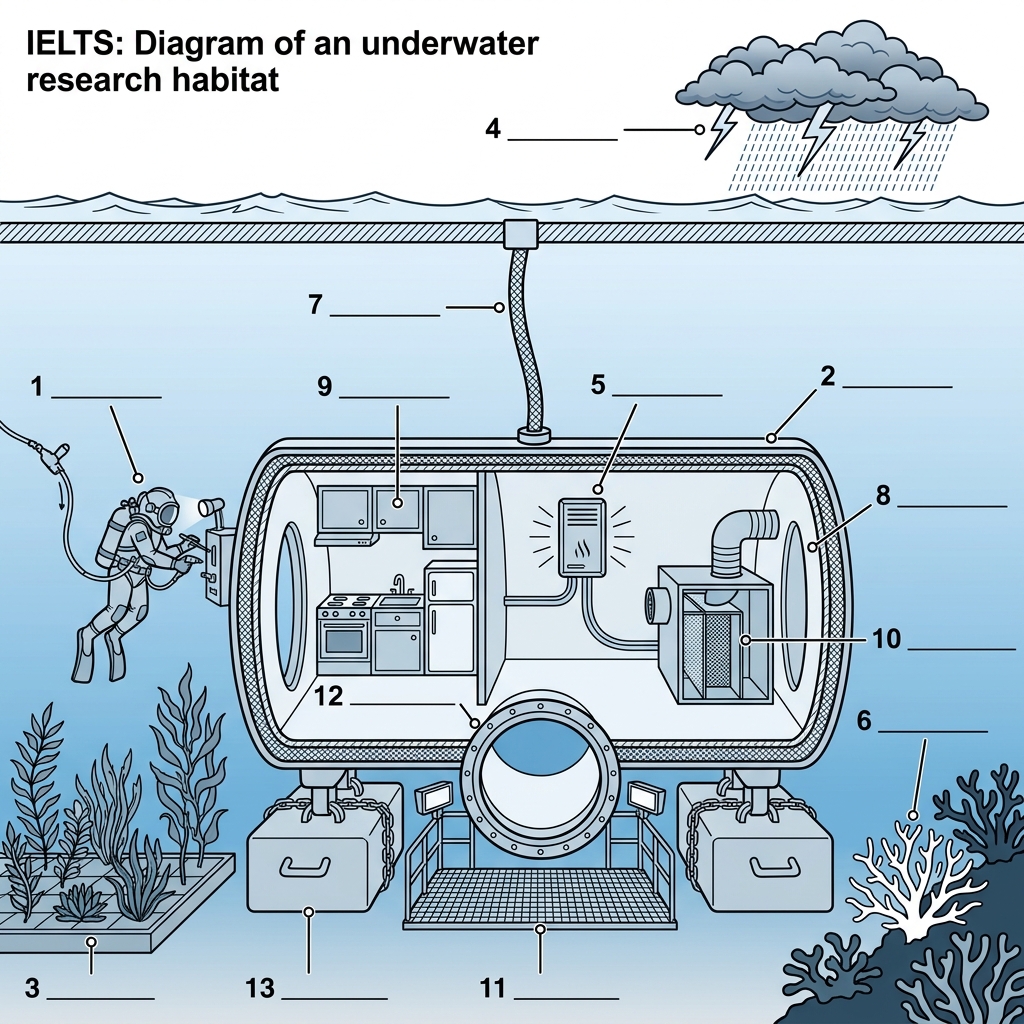
Show answer 7
umbilical cable
Show answer 8
pressure hull
Show answer 9
compact galley
Show answer 10
carbon dioxide scrubbers
Show answer 11
wet porch
Show answer 12
moon pool
Show answer 13
ballast system
Passage 23
The Resurfacing of the Aurelia
In the autumn of 1715, a Spanish merchant vessel named the Aurelia was caught in a massive hurricane off the coast of Florida. Heavily loaded with silver, spices, and exotic wood, the ship was driven onto a hidden reef and sank rapidly. For over two centuries, the exact location of the Aurelia remained a mystery. While a few scattered coins washed ashore over the decades, leading to numerous amateur treasure hunts, the main hull of the ship eluded discovery.
The secret to the Aurelia’s survival lay in the ocean floor's unique topography. When the ship sank, it settled in a deep underwater trench and was quickly buried under a thick layer of fine marine silt. This oxygen-deprived environment prevented the growth of Teredo navalis, the notorious shipworm that typically devours submerged wooden structures. Consequently, nearly 70 percent of the ship's lower hull remained perfectly preserved beneath the seabed.
The wreck was finally discovered by accident in 1988. Dr. Elena Rostova, a marine biologist conducting a sonar survey of deep-water coral reefs, noticed an unusual geometric anomaly on her monitors. Intrigued, she sent down an unmanned submersible, which captured the first images of the ship’s perfectly intact rudder protruding from the sand. Rostova immediately contacted the Institute of Maritime Antiquities, sparking the beginning of a massive archaeological operation.
Excavating the Aurelia presented significant challenges. Standard underwater suction dredges were deemed too aggressive and risked damaging the fragile ancient timbers. Instead, the team spent three years meticulously clearing the silt using gentle water currents generated by handheld thrusters. Once the hull was fully exposed, archaeologists constructed a rigid PVC grid over the site. This grid allowed divers to map the exact position of every artifact, from copper cooking pots to navigational astrolabes, before they were moved.
The most complex phase was raising the hull to the surface. It was decided that lifting the ship in one piece would provide the best chance of preserving its structural integrity. In 1994, engineers slid a custom-built steel platform, known as the 'lifting cradle', underneath the hull. To avoid the suction effect of the mud, a series of synchronized hydraulic pumps slowly pushed the cradle upwards by just five centimeters a day.
Once the cradle was completely free of the seabed, the team deployed a system of industrial-strength inflatable lift bags. Attached to the corners of the steel cradle, these bags were slowly filled with compressed air, providing the buoyancy needed to gently float the Aurelia to the surface. On 12 August 1995, the vessel broke the surface of the water and was immediately towed to a specialized conservation facility, where it was continuously sprayed with cold water to prevent the wood from warping.
Questions 1-4
Do the following statements agree with the information given in Reading Passage 1?
In boxes 1-4 on your answer sheet, select:
- The Aurelia was primarily carrying passengers when it sank in 1715.
- Amateur treasure hunters managed to find the main hull of the ship before 1988.
- The Aurelia was protected from shipworms by a lack of oxygen in the silt.
- Dr. Elena Rostova had previously discovered other sunken vessels in the area.
Show answers
1. The Aurelia was primarily carrying passengers when it sank in 1715. — FALSE
2. Amateur treasure hunters managed to find the main hull of the ship before 1988. — FALSE
3. The Aurelia was protected from shipworms by a lack of oxygen in the silt. — TRUE
4. Dr. Elena Rostova had previously discovered other sunken vessels in the area. — NOT GIVEN
Questions 5-8
Look at the following statements (Questions 5-8) and the list of dates below.
Match each statement with the correct date, A-D.
Write the correct letter, A-D, in boxes 5-8 on your answer sheet.
List of dates
A. 1715
B. 1988
C. 1994
D. 1995
- The hull of the ship was brought to the surface.
- The ship was destroyed by extreme weather.
- A device was placed below the ship to assist with its removal.
- The wreckage was identified during a scientific study of marine life.
Show answers
1. The hull of the ship was brought to the surface. — D. 1995
2. The ship was destroyed by extreme weather. — A. 1715
3. A device was placed below the ship to assist with its removal. — C. 1994
4. The wreckage was identified during a scientific study of marine life. — B. 1988
Questions 9-13
Complete the flow-chart below.
Choose no more than two words from the passage for each answer.
Write your answers in boxes 9-13 on your answer sheet.
- Silt was carefully cleared away using _______ (9)
- A _______ (10) was built to help map the location of artifacts
- A special _______ (11) was slid underneath the ship's hull
- The suction effect of the mud was overcome using _______ (12)
- Inflatable _______ (13) were attached and filled with air to float the ship
Show answers
9. handheld thrusters
10. PVC grid
11. lifting cradle
12. hydraulic pumps
13. lift bags
Passage 24
The Kyrenia Ship: An Ancient Merchant Vessel
A. In the late 4th century BC, a small merchant ship sailed the Mediterranean Sea, carrying a cargo of wine, almonds, and millstones. For reasons still debated by historians—ranging from a sudden storm to a pirate attack—the vessel sank off the northern coast of Cyprus near the town of Kyrenia. It settled on a flat, sandy seabed, where it remained undisturbed for over two millennia. Today, the Kyrenia ship is recognized as one of the best-preserved ancient vessels ever discovered, offering unprecedented insights into classical maritime trade.
B. The shipwreck was discovered by chance in 1965 by Andreas Cariolou, a local sponge diver. While diving to a depth of roughly 30 metres, Cariolou noticed a large mound of ancient ceramic jugs, known as amphorae, partially buried in the sea floor. Recognising the historical significance of his find, he initially kept the exact location a secret. It was not until 1967 that he guided a team of maritime archaeologists from the University of Pennsylvania, led by Michael Katzev, to the site to begin formal surveys.
C. Full-scale excavation commenced in the summer of 1968 and continued into 1969. The archaeological team employed a rigorous grid system made of plastic pipes to map the site accurately before removing any artifacts. They carefully documented the position of over 400 amphorae, which had originated from various Aegean islands, alongside volcanic millstones that served as both cargo and ballast. Beneath this heavy load, the researchers found the remains of thousands of almonds, preserved in jars, which provided vital clues about the ship's final voyage.
D. Once the cargo was cleared, the archaeologists were thrilled to uncover the surviving wooden hull. Approximately 75 percent of the ship's original timber had survived, largely because it had been quickly swallowed by the protective sands, which created an anaerobic (oxygen-free) environment that prevented the wood from rotting. Because the ancient wood was entirely waterlogged and fragile, the timbers could not be lifted whole. Instead, they were carefully dismantled underwater and brought to the surface in custom-built rigid trays.
E. The recovery was only the first step; preserving the ancient wood posed a massive challenge. If the waterlogged timbers were allowed to dry naturally, they would shrink, warp, and crumble into dust. To prevent this, conservators treated the wood with a synthetic wax called polyethylene glycol (PEG). Over several years, the PEG solution gradually replaced the water within the cellular structure of the wood. Once stabilized, the timbers were painstakingly reassembled inside the Kyrenia Castle, where the ship is still displayed today.
F. The archaeological value of the Kyrenia ship extends beyond its recovery. In the 1980s, an experimental archaeology project was launched to construct a full-scale working replica, named Kyrenia II. Built using the same materials and techniques as the original, the replica successfully sailed across the Aegean Sea. This experiment proved that ancient Greek merchant ships were highly capable vessels, able to sail against the wind and navigate complex traditional trade routes, thereby transforming our understanding of ancient maritime technology.
Questions 1-5
Do the following statements agree with the information given in Reading Passage 1?
Choose TRUE if the statement agrees with the information, FALSE if the statement contradicts the information, or not given if there is no information on this.
- The exact cause of the Kyrenia ship's sinking is known to archaeologists.
- Andreas Cariolou immediately shared the location of the shipwreck with archaeologists.
- The millstones on the ship were used as cargo and to help keep the vessel stable in the water.
- The Kyrenia ship was the largest merchant vessel operating in the Mediterranean at that time.
- The sand covering the ship helped to stop the wooden hull from decaying.
Show answers
1. The exact cause of the Kyrenia ship's sinking is known to archaeologists. — FALSE
2. Andreas Cariolou immediately shared the location of the shipwreck with archaeologists. — FALSE
3. The millstones on the ship were used as cargo and to help keep the vessel stable in the water. — TRUE
4. The Kyrenia ship was the largest merchant vessel operating in the Mediterranean at that time. — NOT GIVEN
5. The sand covering the ship helped to stop the wooden hull from decaying. — TRUE
Questions 6-9
Complete the flow chart below.
Choose no more than one word from the passage for each answer.
The Excavation and Preservation Process
- 1968-1969: A _______ (6) system was used to map the site accurately.
- Cargo removal: Amphorae, millstones, and preserved _______ (7) were recovered.
- Hull recovery: Fragile wood was dismantled and taken to the surface using rigid _______ (8).
- Conservation: The wood was treated with a synthetic _______ (9) to stop it from shrinking and warping.
Show answers
6. grid
7. almonds
8. trays
9. wax
Questions 10-13
Look at the following statements (Questions 10-13) and the list of dates below.
Match each statement with the correct date, A-E.
List of Dates
A 4th century BC
B 1965
C 1967
D 1968
E 1980s
- A working replica of the ship was constructed for an experiment.
- The shipwreck site was shown to university researchers.
- The vessel originally traveled across the Mediterranean with its cargo.
- The ship was first spotted by a diver.
Show answers
1. A working replica of the ship was constructed for an experiment. — E
2. The shipwreck site was shown to university researchers. — C
3. The vessel originally traveled across the Mediterranean with its cargo. — A
4. The ship was first spotted by a diver. — B
Passage 25
Designing the Modern Classroom
A. Historically, school design was driven by the need to transmit knowledge efficiently to large numbers of students. The traditional 'cellular' classroom, often likened to an industrial factory model, featured neat rows of forward-facing desks. The teacher stood at the front, acting as the sole focal point and authority figure. High windows were intentionally installed to prevent students from looking outside and being distracted. This architectural layout reinforced a passive learning style, where students listened, copied from the chalkboard, and engaged in rote memorization. While cost-effective and easy for a single teacher to manage, critics eventually argued that this rigid environment stifled creative thinking and failed to accommodate different learning speeds.
B. In the late 1960s and 1970s, a radical architectural movement emerged: the open-plan school. Influenced heavily by progressive educational theories that promoted student-centered learning and collaboration, architects dismantled the interior walls. Entire grades were housed in massive, open rooms, sometimes dubbed 'schools without walls.' The intention was to allow fluid movement between subject areas, encourage team teaching among educators, and break down the rigid, authoritative hierarchy of the traditional classroom. Wall-to-wall carpeting was introduced in an attempt to absorb the anticipated noise of multiple active groups.
C. However, the early open-plan schools quickly encountered significant practical issues, primarily concerning acoustics. Without physical barriers, the noise generated by multiple groups engaged in different activities became overwhelming. Teachers found themselves constantly raising their voices to be heard over the din, leading to widespread reports of vocal strain. Meanwhile, students struggled to concentrate amid the auditory and visual chaos of hundreds of peers moving around. Subsequent educational studies indicated that reading comprehension scores actually dropped in these environments, as the constant distraction severely limited students' ability to focus on complex texts.
D. Consequently, the 1990s saw a widespread architectural retreat. Schools began hastily erecting temporary partitions, dragging tall bookcases to create makeshift rooms, or rebuilding solid walls entirely. In many districts, schools reverted to the cellular classroom model. Yet, educational philosophy had permanently shifted; teachers still wanted the flexibility to conduct group work and project-based learning, which the cramped, rigid traditional classrooms could not easily support. The cellular model was too restrictive, but the open-plan model was too chaotic. A structural compromise was urgently needed.
E. Enter the 'agile' or 'flexible' learning environment of the 21st century. Contemporary school architecture seeks to balance the need for focused, independent study with the desire for dynamic collaboration. Instead of one cavernous space or isolated boxes, modern schools feature interconnected learning zones. A typical layout includes a central 'hub' for large group work and presentations, surrounded by smaller, acoustically sealed 'cave' spaces designed for independent, quiet study. Glass walls are extensively used throughout these modern facilities; they provide necessary acoustic separation while maintaining visual connectivity, allowing a single teacher to supervise multiple groups simultaneously without disrupting the ambient noise level.
F. Beyond spatial arrangement, modern educational architecture places heavy emphasis on physical comfort and sensory factors. Research has conclusively shown that access to natural daylight improves student alertness and overall test scores. Consequently, architects now prioritize large windows and skylights, utilizing dynamic shading systems to prevent glare on digital screens. Furthermore, the furniture itself has evolved. Gone are the heavy, stationary wooden desks of the Victorian era; today's classrooms are populated with adjustable, mobile units that can be quickly reconfigured by the students themselves. This acknowledges that physical comfort and the ability to adapt the environment are prerequisites for sustained cognitive engagement.
Questions 1-5
Do the following statements agree with the information given in Reading Passage 1?
In boxes 1-5 on your answer sheet, select:
TRUE if the statement agrees with the information
FALSE if the statement contradicts the information
not given if there is no information on this
- The cellular classroom layout was primarily intended to promote creative thinking.
- The construction of open-plan schools was heavily influenced by new educational theories.
- Maintaining open-plan schools proved to be more expensive than traditional schools.
- Students' reading comprehension improved in the early open-plan classrooms.
- In the 1990s, many schools reverted to the cellular classroom model.
Show answers
1. The cellular classroom layout was primarily intended to promote creative thinking. — FALSE
2. The construction of open-plan schools was heavily influenced by new educational theories. — TRUE
3. Maintaining open-plan schools proved to be more expensive than traditional schools. — NOT GIVEN
4. Students' reading comprehension improved in the early open-plan classrooms. — FALSE
5. In the 1990s, many schools reverted to the cellular classroom model. — TRUE
Questions 6-9
Label the diagram below.
Choose no more than two words from the passage for each answer.
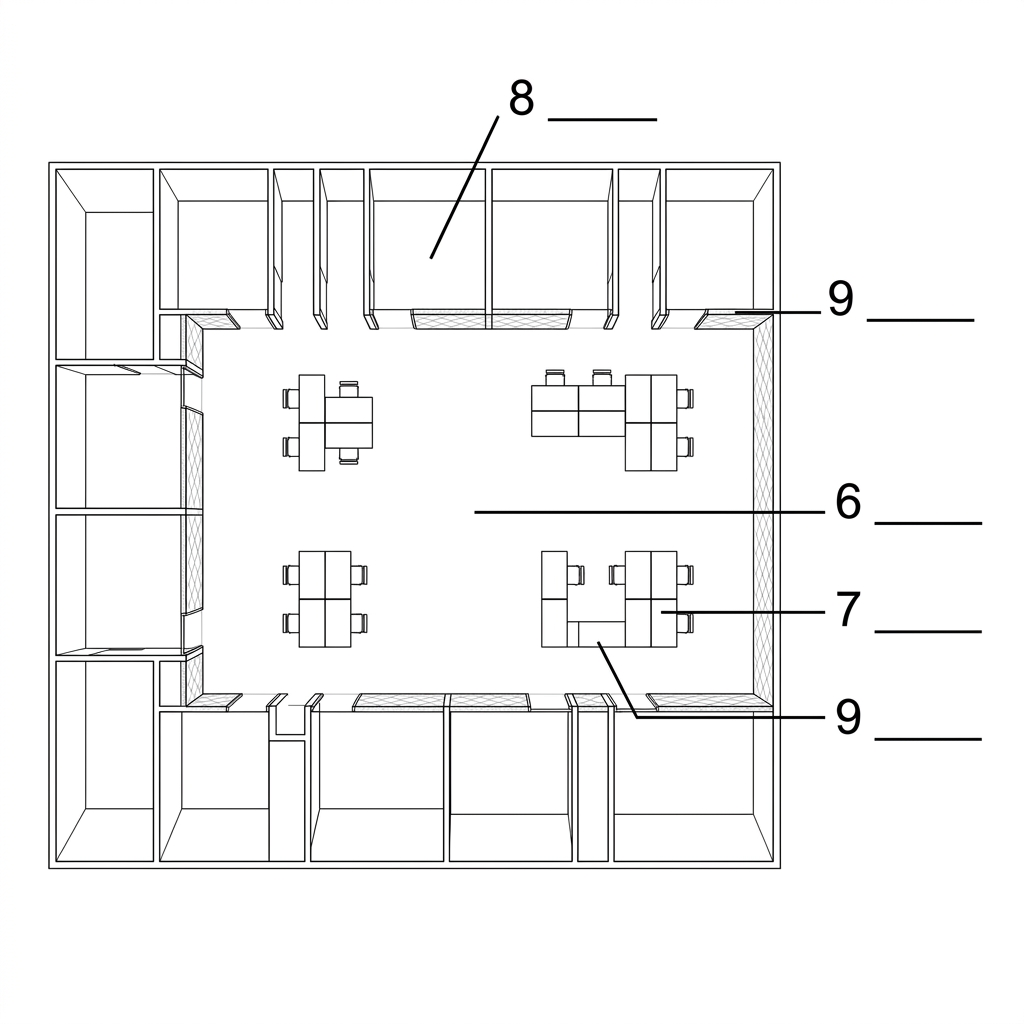
Central _______ (6) used for large group work and presentations
Small, acoustically sealed _______ (7) spaces for independent quiet study
_______ (8) providing acoustic separation while maintaining visual connectivity
Adjustable, _______ (9) that students can quickly reconfigure themselves
Show answers
6. hub
7. cave
8. Glass walls
9. mobile units
Questions 10-13
Complete the table below.
Choose one word only from the passage for each answer.
| Era | Architectural Features | Impact on Students/Teachers |
|---|---|---|
| Traditional Cellular | Forward-facing desks | Encouraged a _______ (10) learning style |
| 1970s Open-Plan | Complete removal of interior walls | Created auditory and _______ (11) chaos |
| Modern Agile | Features interconnected learning _______ (12) | Balances focus with dynamic collaboration |
| Modern Agile | Inclusion of large windows and skylights | Enhances student _______ (13) |
Show answers
10. passive
11. visual
12. zones
13. alertness